
Best Dictation Software for Tendinitis (2026): 6 Apps Compared
Compared 6 dictation apps for wrist tendinitis (de Quervain's, ECU, flexor tendinopathy). Voibe's Hands-Free Mode removes the held-key load other apps require. Honest paragraphs on Superwhisper, Wispr Flow, Apple Dictation, Dragon, MacWhisper.
If your wrist or thumb hurts from tendinitis right now, here is the short version. The most overlooked variable in dictation software for tendinitis sufferers is not accuracy or price — it is whether the app requires you to hold a key down while you speak. That sustained tendon load is exactly the kind of repetitive grip that started the tendinopathy. The fix is an activation model that does not require a held key.
TL;DR: Voibe is our top pick for tendinitis on Mac because its Hands-Free Mode (double-tap to start, double-tap to stop) does not require sustained finger or thumb pressure during speech, runs entirely on your Mac so medical context stays private, and is included in the free tier with no account or card. Superwhisper is a strong second for users who want the most configurable on-device option. Wispr Flow is the best cross-platform choice if you also need Windows, iOS, or Android. Apple Dictation is the free baseline. Dragon Professional remains the Windows gold standard. MacWhisper is the choice when most of your work is transcribing recorded audio rather than live dictation.
Disclosure: Voibe is our product. We compare alternatives honestly and acknowledge competitor strengths throughout this article.
Key Takeaways: Dictation for Tendinitis at a Glance
| Tool | Activation | Where audio is processed | Mac support | 3-year cost |
|---|---|---|---|---|
| Voibe | Hands-Free Mode (double-tap; remappable to foot switch) | On-device (your Mac) | Native (Apple Silicon) | $198 lifetime · free tier included |
| Superwhisper | Push-to-talk default; toggle modes available | On-device or cloud (configurable) | Native | $249.99 lifetime |
| Wispr Flow | Push-to-talk default; hands-free option | Cloud | Native (also Win/iOS/Android) | $432 (Pro Annual × 3) |
| Apple Dictation | Hotkey toggle | Mostly on-device on Apple Silicon | Built-in | Free |
| Dragon Professional | Multiple modes including hands-free | On-device | None since 2018 | $699.99 one-time (Windows only) |
| MacWhisper | Hotkey toggle | On-device | Native | ~$69 lifetime |
Voibe at $198 lifetime is roughly $234 (54%) less expensive than three years of Wispr Flow Pro Annual ($432), and $52 (21%) less than Superwhisper's lifetime ($249.99) — while keeping your dictation audio on your Mac. For tendinitis users specifically, the activation flexibility (default double-tap, remappable to a single non-thumb key or external hardware button) is the structural advantage the cost picture only partly captures.
Why Tendinitis Flares Under Keyboard Load — and Why Dictation Is the Standard Adaptation
Tendinitis (and the more current term tendinopathy) is inflammation or degenerative change in a tendon, typically driven by overuse — sustained or repetitive loading without enough recovery between exposures. For computer users, several tendinopathies show up routinely:
- De Quervain's tenosynovitis — inflammation of the abductor pollicis longus and extensor pollicis brevis tendons at the radial (thumb) side of the wrist. Provoked by repetitive thumb motion and forceful pinch. The AAOS OrthoInfo De Quervain's page lists activity modification, NSAIDs, thumb spica splinting, and corticosteroid injection as standard non-surgical management.
- ECU (extensor carpi ulnaris) tendinopathy — inflammation along the ulnar (pinky) side of the wrist. Provoked by prolonged wrist extension or repeated ulnar deviation at the keyboard, common with flat keyboards that force the wrists outward.
- Flexor tendinopathy — inflammation of the flexor tendons that bend the fingers, often in the palm. Trigger finger is the related condition where the tendon catches in a thickened sheath.
- Intersection syndrome — inflammation where the first dorsal compartment tendons cross over the second compartment tendons; presents as forearm pain a few centimeters above the wrist.
The common functional pattern: the inflamed tendon does not tolerate the sustained or repetitive load that typing demands. The Mayo Clinic tendinitis page identifies overuse — using the tendon too much or too hard without enough rest — as the central cause. Reducing the offending activity is the standard intervention, not pushing through.
For knowledge workers, the offending activity is usually typing, particularly when paired with mouse use that repeats the same loading patterns. Voice dictation is the practical version of activity modification because the mechanism is direct: spoken language uses the vocal apparatus, not the wrist tendons, so dictating reduces tendon load without reducing work output.
The complication is that not every dictation app preserves that benefit. If the dictation app requires you to hold a modifier key while you speak — push-to-talk — you have replaced sustained typing pressure with sustained thumb or finger holding pressure, and the inflamed tendon does not particularly care which one is doing the loading. The dictation app that works for tendinitis is the one whose activation model does not require a held key.
Key Takeaway
Push-to-talk dictation replaces sustained typing pressure with sustained holding pressure on the same tendons. A tap-to-start activation model — especially remapped to bypass the affected tendon — removes that load entirely.
What to Look for in Dictation Software When You Have Tendinitis
Six criteria, in priority order for tendinitis users:
1. Activation model — the one that matters most
The app must support an activation pattern that does not require holding a key during speech. Tap-based activation (double-tap to start, double-tap to stop), toggle activation (single press to start, single press to end), and voice-trigger activation (saying a wake word) all qualify. Push-to-talk does not. This is the criterion to apply first, before pricing, accuracy, or features. Activity modification is the first-line treatment goal; held-key dictation works against it.
2. Configurable hotkey, including non-thumb and external options
Beyond tap-based activation, which key the activation uses still matters. For de Quervain's, the hotkey must avoid the thumb entirely — F5 or a single function key reachable with the index finger is the standard adaptation. For ECU tendinopathy, avoid the right-side modifier keys (Cmd, Option) that require ulnar deviation. For severe or bilateral involvement, mapping to an external hardware button — a Stream Deck button, a USB foot switch, or an accessibility switch — bypasses the wrist and hand entirely. Most serious dictation apps allow remapping; verify before buying.
3. Splint compatibility
If you are wearing a thumb spica splint (for de Quervain's) or a wrist splint (for general tenosynovitis), the activation hotkey must remain reachable with the splint on. Tap-based activation tolerates splints because the activating motion is brief and can be reassigned to whichever finger or function key is unaffected. Push-to-talk that requires a held modifier reach is often unworkable with a rigid splint.
4. System-wide insertion
The app should type text wherever your cursor is — in Microsoft Word, Pages, Google Docs, Slack, Gmail, Notion, web forms, your patient portal, your insurance forms. If the app only works inside its own window and requires copy-paste into your real writing tool, the friction defeats the accessibility benefit and forces extra hand motion to move text.
5. Custom vocabulary for medical and domain terms
Tendinitis users often dictate about tendinitis — medication names (ibuprofen, naproxen, cortisone), anatomical references (abductor pollicis longus, extensor carpi ulnaris, first dorsal compartment), clinician names, and treatment details. General models miss less-common anatomical terms; custom vocabulary support lets you train the system on those terms upfront.
6. On-device processing
The same medical-context argument applies here. Users with tendinitis dictate about medications, doctor names, insurance codes, accommodation requests, and treatment plans. On-device processing keeps that context on your Mac rather than transmitting it to a vendor server. This is a privacy question first, an architecture question second.
Key Takeaway
If you only apply one criterion, apply the activation model. A dictation app that requires a held key during speech is not a usable solution for active tendinitis — it just relocates the same load pattern from typing to holding.
The 6 Best Dictation Apps for Tendinitis Sufferers
Each app below was evaluated against the six criteria above, with the activation model carrying the most weight. All ratings cited are from third-party platforms with the rating count linked in the product section.
1. Voibe — Best Overall for Tendinitis Sufferers on Mac
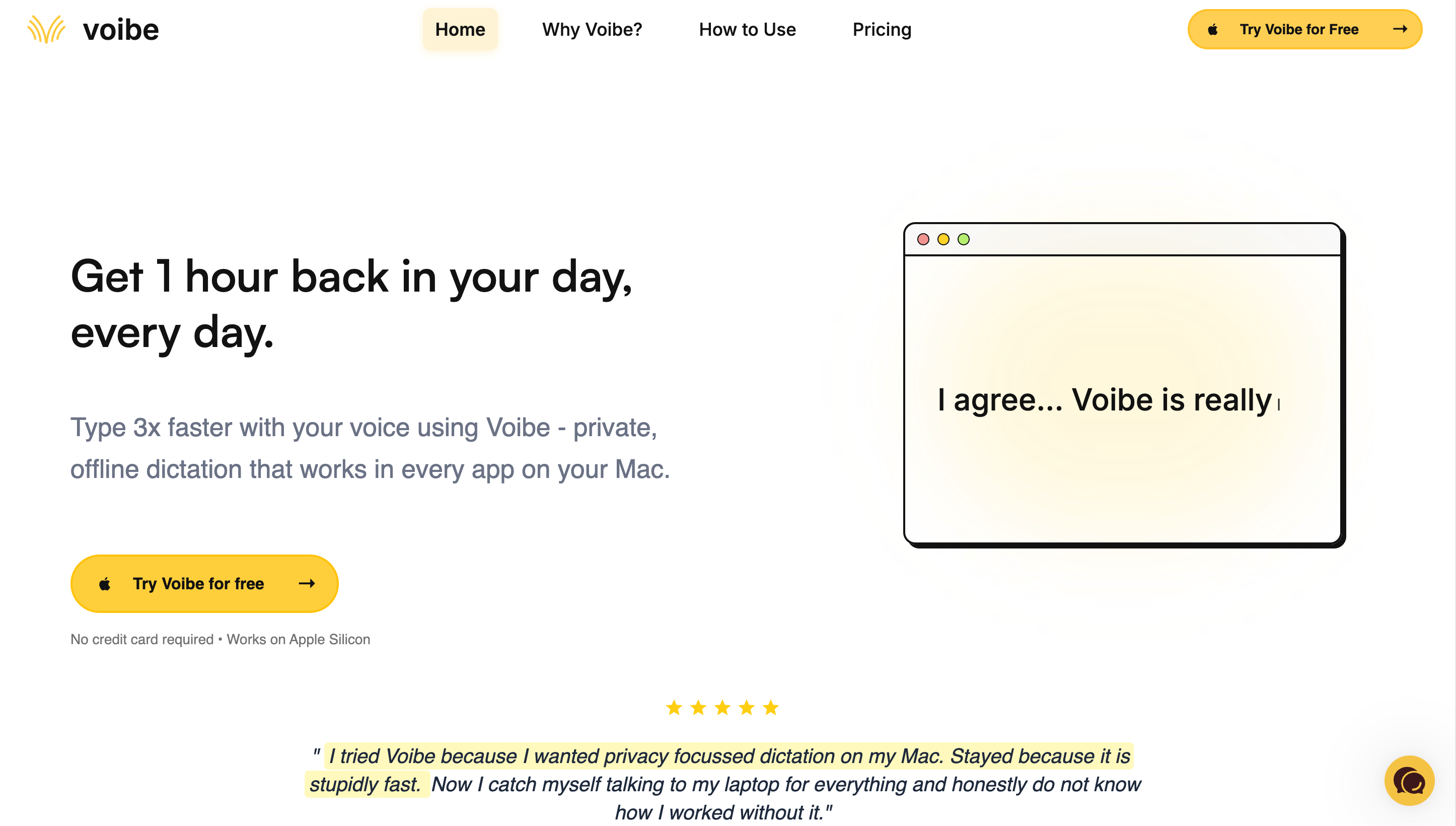
Voibe is an offline dictation app for Mac that runs OpenAI's Whisper models locally on Apple Silicon. All speech processing happens on your device — no audio is uploaded, no account is required, and there is no signup gate on the core dictation features.
Disclosure: Voibe is our product. We include it because it fits the category, and we lay out the trade-offs honestly.
Why it wins for tendinitis specifically: Hands-Free Mode is the activation model designed for users whose tendons cannot tolerate sustained pressure. Double-tap to start, double-tap to stop, no key held during speech. Continuous Transcription shows your words live in a small floating window so you can dictate for as long as the workload demands without watching a session timer.
The default hotkey is fully configurable, which is the key feature for tendinitis adaptation. For de Quervain's (thumb tendons), remap activation to F5 or any single function key reachable with the index finger — the thumb stays out of the activation entirely. For ECU tendinopathy (ulnar wrist), remap away from right-side modifier keys that require ulnar deviation. For severe or bilateral involvement, map to a Stream Deck button, USB foot switch, or accessibility switch — dictation triggers without using the inflamed tendons at all.
System-wide insertion works in any text field on macOS: Microsoft Word, Pages, Google Docs, Slack, Gmail, Notion, Apple Notes, Linear, Jira, web forms, IDEs, your hand therapist's patient portal. Custom Vocabulary on paid plans lets you add medication names (ibuprofen, naproxen, cortisone), anatomical terms (abductor pollicis longus, extensor carpi ulnaris), clinician names, or any other domain words that general models miss. On-device processing means audio about your medical context never leaves your Mac.
The free tier — which includes Hands-Free Mode and Continuous Transcription — is rate-limited to 300 words per day. Paid plans ($9.90/month, $89.10/year, or $198 lifetime) remove the limit and unlock Custom Vocabulary. The free tier has no account, no card, and no automatic conversion; if 300 words per day is enough for you, it stays free indefinitely.
- Hands-Free Mode — no key held during speech
- Configurable hotkey, including non-thumb keys and external hardware
- Works with thumb spica and wrist splints
- On-device — medical context stays on your Mac
- System-wide insertion in any text field
- Custom Vocabulary for anatomical and medication terms
- Free tier with no signup or card — no painful form-filling
- Lifetime option avoids a subscription tail
- Mac only — no Windows, iOS, or Android version
- Requires Apple Silicon (M1 or later)
- General Whisper models — anatomical accuracy depends on Custom Vocabulary setup
- No EHR-specific clinical-note templates
Key Takeaway
Voibe's Hands-Free Mode is the activation model designed for tendinopathy-driven dictation. Combined with hotkey remapping that bypasses the affected tendon and on-device processing, it is the most direct fit for the criteria that matter for active tendinitis.
2. Superwhisper — Best Configurable On-Device Mac Alternative
Superwhisper is the longest-running on-device Whisper dictation product for Mac and earns its strong reputation honestly. It runs Whisper models locally, supports multiple model sizes from Tiny up through Large-v3, and offers extensive per-app customization through Modes. Third-party rating is 4.9/5 from 20 Product Hunt reviews.
For tendinitis users: Superwhisper's default activation is push-to-talk, but it supports a toggle mode (single press to start, single press to end) and can be configured to start with a hotkey rather than a held key. The configuration is more involved than Voibe's Hands-Free Mode out of the box — you will spend time in Settings → Hotkeys to set the activation behavior — but the end state is comparable. For tendinitis users specifically, the setup motion itself is a load to consider; the more you can move through Settings menus by clicking rather than typing, the less it costs the inflamed tendon.
Superwhisper's strength is configurability. Power users who want different transcription Modes for email vs Slack vs technical writing, multiple Whisper model sizes for accuracy/speed trade-offs, and optional cloud LLM cleanup will find more depth here than in Voibe. The trade-off is the setup investment.
One caveat: Superwhisper saves local audio recordings of dictation sessions by default. Users have repeatedly requested the option to disable this, with no resolution as of writing. The recordings stay on your Mac (Superwhisper does not upload them in on-device modes), but they accumulate disk space and are not opt-in. For our full Superwhisper safety investigation, see the dedicated page.
Key Takeaway
Superwhisper is the right choice if you want the most configurable on-device Mac dictation and are willing to set up toggle activation yourself. Voibe is the right choice if you want Hands-Free Mode working out of the box without a Settings-menu tour first.
3. Wispr Flow — Best Cross-Platform Option (Mac, Windows, iOS, Android)
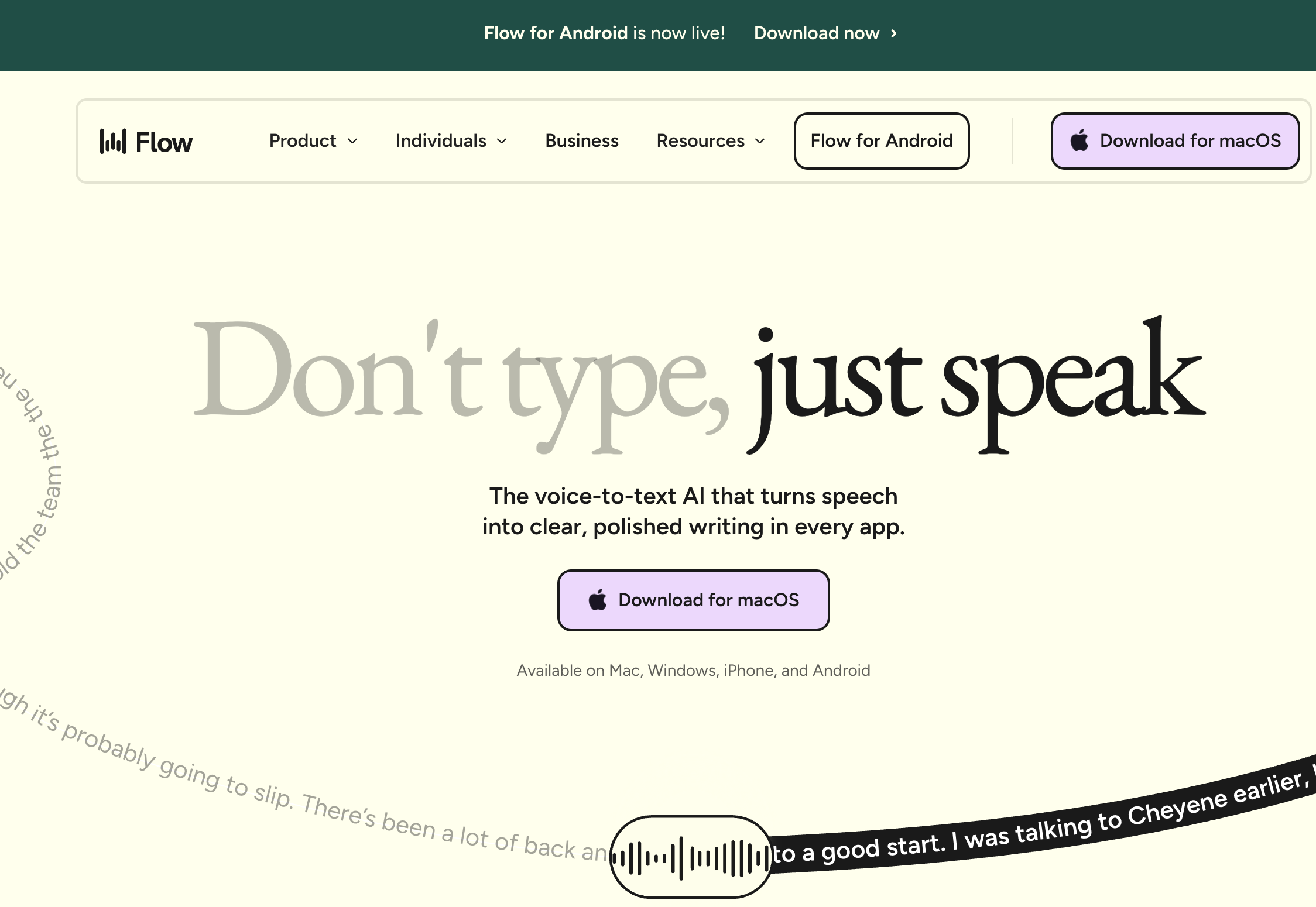
Wispr Flow is a cloud-based AI dictation app that runs on Mac, Windows, iOS, and Android. It is the strongest cross-platform option in this list — if you switch devices throughout the day, Wispr Flow is the only choice that follows you. Third-party rating is 4.5/5 from 7 G2 reviews.
For tendinitis users: Wispr Flow defaults to push-to-talk but supports a hands-free toggle mode that some users prefer. The activation is configurable in the menu bar settings. The bigger caveat is architectural: Wispr Flow processes audio in the cloud (subprocessors include Baseten, OpenAI, Anthropic, Cerebras, and AWS per their public documentation). For tendinitis users dictating about their condition, that means medication names, doctor names, and treatment context are transmitted off-device.
Wispr Flow's Pro plan is $144/year. The free tier has lower daily limits than Voibe's free tier and a paid signup is required to unlock full use. Pricing breaks differently from Voibe — Wispr Flow is subscription-only with no lifetime option, so the gap widens over time: $432 over 3 years vs Voibe's $198 lifetime is a $234 (54%) difference on the Mac half of the comparison. The cross-platform reach is the case for paying more — it is a real feature, not a marketing claim, and for users who dictate from a phone during commute or rest periods, the reach earns its premium.
For the deep dive on Wispr Flow's privacy posture and the March 2026 compliance-audit context, see our is Wispr Flow safe? investigation.
Key Takeaway
Wispr Flow is the right pick if cross-platform reach justifies the cost and the cloud processing. For Mac-only tendinitis users dictating about medical context, on-device options are the better structural fit.
4. Apple Dictation — The Free Built-In Baseline
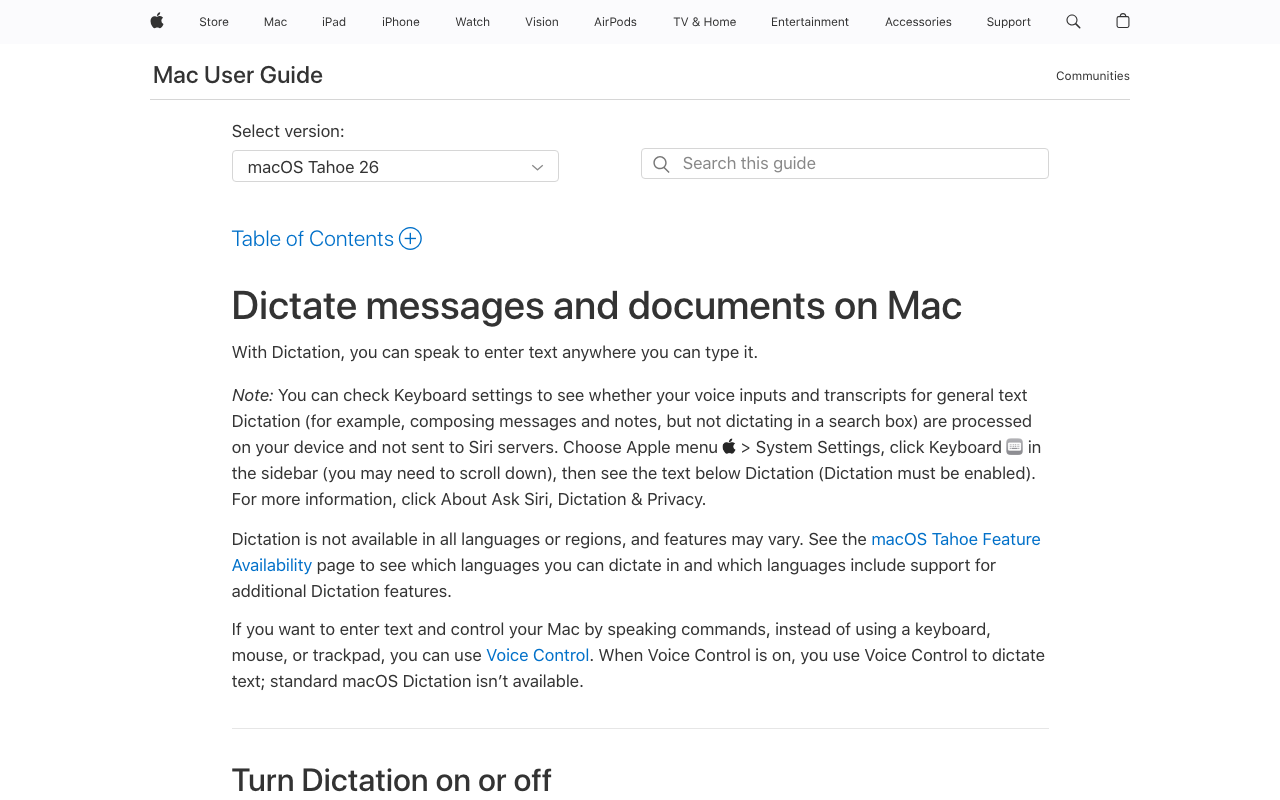
Apple Dictation is included with every Mac and is genuinely free. On Apple Silicon Macs (M1 and later), most processing happens on-device, so audio about your medical context generally does not leave the Mac. Activation is hotkey-toggle (press the configured key to start, press again to stop) — there is no held-key requirement, which makes Apple Dictation usable for tendinitis users.
For tendinitis users: the activation model is fine; the practical limitations are elsewhere. Apple Dictation has a session-length cap (around 30 seconds depending on the version of macOS), no custom vocabulary (so anatomical terms and medication names get mis-recognized), no per-app modes, no document-aware formatting, and no continuous-transcription floating window. For occasional short dictation, it works. For sustained daily use as your primary typing alternative — especially while you are in the activity-modification phase of tendinitis treatment — you will outgrow it quickly. That is when the paid options become worth their price.
Apple does not sign Business Associate Agreements (BAAs), so Apple Dictation is not appropriate for clinical workflows handling Protected Health Information. For the full breakdown of Apple Dictation's privacy posture and configuration, see Apple Dictation privacy and Apple Dictation pricing.
Key Takeaway
Apple Dictation is the right starting point if you want to test whether dictation works for your hands at zero cost and zero commitment. Upgrade to Voibe or Superwhisper when the session-length cap or anatomical-vocabulary gap starts limiting you.
5. Dragon Professional — The Windows Gold Standard (No Native Mac)

Dragon Professional is the longest-running professional dictation product and has the deepest vocabulary support of anything in this article — it was built specifically for legal, medical, and other domain-heavy workflows. Dragon offers multiple activation modes including a hands-free option, custom vocabulary tooling that predates current Whisper-based tools, and a long track record of tendinitis users using it as a workplace accommodation under the ADA.
The catch for Mac users: there is no native Dragon for Mac and has not been since 2018, when Nuance discontinued Dragon Dictate for Mac and never replaced it. After Microsoft's 2022 acquisition of Nuance, the Mac product has not returned. Mac users who need Dragon today either (a) run it on a Windows machine, (b) run it via Parallels or similar virtualization, or (c) use the browser-based Dragon Anywhere mobile/cloud product, which has reduced functionality and is cloud-based.
If you are on Windows and have tendinitis, Dragon Professional remains the strongest single product. The vocabulary depth (medical, legal, financial terms) and command-and-control features (voice navigation, voice editing — “go to end of sentence”, “delete that word”) are still ahead of consumer alternatives for users who need them. For Windows users, see our Dragon pricing breakdown and Dragon privacy investigation. For Mac users orphaned by the 2018 discontinuation, the on-device Whisper-based alternatives (Voibe, Superwhisper, MacWhisper) are the practical replacements.
Key Takeaway
Dragon Professional is still the gold standard on Windows for serious tendinitis-driven dictation, but Mac users have been without a native version since 2018. On Mac, Whisper-based alternatives have closed the accessibility gap for most use cases.
6. MacWhisper — Best for Recorded Audio, Not Primary Dictation
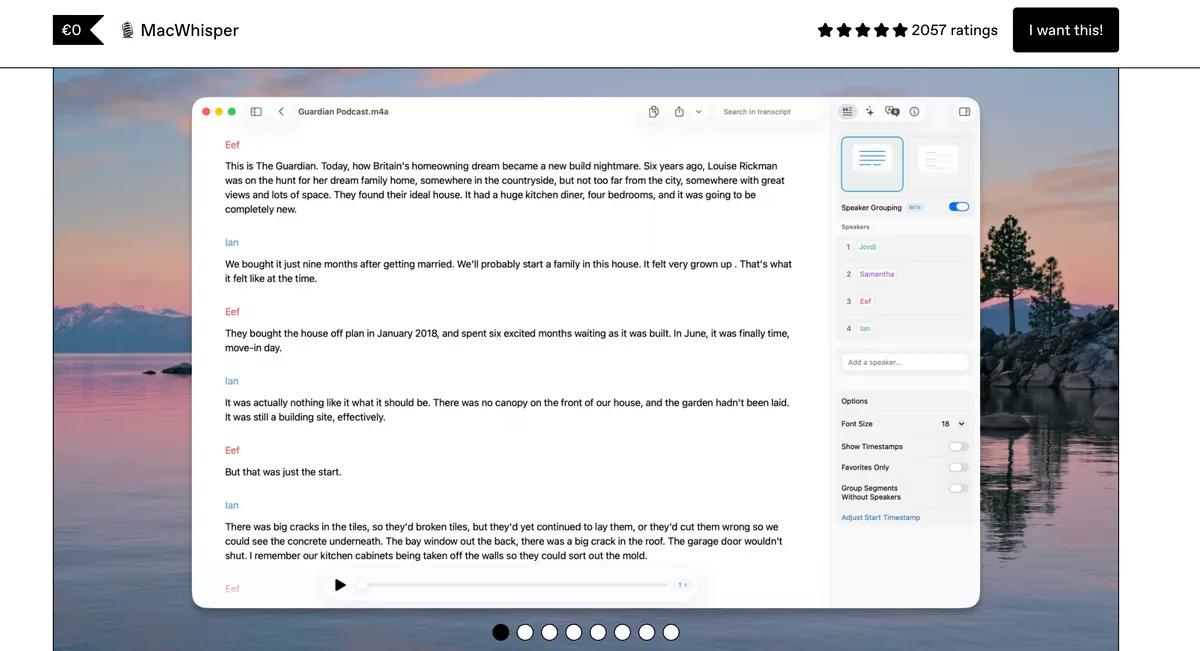
MacWhisper is a Mac app focused on transcribing recorded audio files using local Whisper models. It is on this list for completeness, but it is structurally a different category from the others — MacWhisper is excellent at converting voice memos, meeting recordings, and interview audio into text, with optional dictation as a secondary feature.
For tendinitis users: if your workflow includes recording voice memos when keyboard work is painful — dictating a draft into your phone during a break from the keyboard, recording yourself thinking through a problem, capturing thoughts during a hand-therapy appointment — MacWhisper is the most polished tool for converting those recordings into editable text afterward. It is not the right primary dictation tool, but it pairs well with Voibe or Superwhisper as the “handle the recordings I made on my phone” companion. Third-party rating is 4.9/5 on the App Store.
If your tendinitis strategy includes recording voice memos as you think and transcribing them later (a common pattern for users in the acute phase of a tendinopathy when even tap-based activation is uncomfortable), MacWhisper is the polished version of that workflow. For the full pricing and feature breakdown, see MacWhisper pricing.
Key Takeaway
MacWhisper is a complement to live dictation, not a replacement. Use it for transcribing recordings; use Voibe or Superwhisper for typing-into-apps.
Why On-Device Matters When You're Dictating About Your Tendinitis
Tendinitis users dictate about tendinitis. The dictated stream tends to include the medications you take (ibuprofen, naproxen, cortisone injection plans), the anatomical references you use (abductor pollicis longus, extensor carpi ulnaris, first dorsal compartment, scaphoid, radius), the hand therapist or orthopedic specialist you see, the splints you wear, and the workplace accommodations you negotiate with HR. That context is medically sensitive — in regulated workflows it is the same data class that HIPAA classifies as Protected Health Information when handled by a covered entity.
Cloud-based dictation apps transmit your audio to a third-party server for transcription. Depending on the vendor, that audio may be retained for a period, handled by subprocessors (Wispr Flow's public list includes Baseten, OpenAI, Anthropic, Cerebras, and AWS), and in some cases used to train models on consumer-tier accounts. Enterprise tiers typically have stronger defaults; consumer tiers typically do not.
On-device dictation does not have that exposure surface because the audio is never uploaded in the first place. Voibe, Superwhisper (in on-device modes), MacWhisper, and Apple Dictation on Apple Silicon all process audio locally. Wispr Flow does not. Dragon Professional on Windows is on-device after the initial profile setup; Dragon Anywhere and Dragon Medical One are cloud.
If you are dictating in a regulated workflow (clinical, legal, financial), the architecture is a structural compliance question, not a marketing one. For the deeper investigation, see our cloud vs local dictation, HIPAA dictation guide, and the AI Privacy Tracker which scores 30 voice and AI tools by privacy posture.
How Voibe Specifically Helps Tendinitis Sufferers
Three specifics, beyond what every dictation app should do:
Hands-Free Mode — designed for activity modification
Double-tap to start, double-tap to stop. No key held during speech. The default hotkey is configurable to a single key, a key combination, or an external hardware button — a Stream Deck button, a USB foot pedal, or an accessibility switch — for users whose tendons cannot tolerate even a tap. Continuous Transcription shows your words live in a small floating window so you can dictate for as long as the workload demands; press Enter to commit the text into whatever app your cursor is in.
Custom Vocabulary for anatomical and medication terms
Paid plans include Custom Vocabulary. Add the names of the medications you take (ibuprofen, naproxen, diclofenac), the anatomical references you use (abductor pollicis longus, extensor carpi ulnaris, scaphoid, radius), the conditions you reference (de Quervain's tenosynovitis, intersection syndrome, trigger finger, tenosynovitis), your treating hand therapist and orthopedic specialist, and any other domain words that general Whisper models miss. Recognition accuracy on those specific terms improves. The vocabulary is stored locally — there is no server-side training, no shared dataset, no cross-user vocabulary pool.
Free Tier With No Account, No Signup, No Card
Voibe's free tier — which includes Hands-Free Mode and Continuous Transcription — does not require an account, an email, or a credit card. Download the .dmg, drag to Applications, grant microphone permission, use it. The free tier is rate-limited to 300 words per day at time of writing; paid plans remove that cap. The signup-free model is itself an accessibility feature — for users whose tendons cannot tolerate typing in a long account-creation form, “skip the form, start dictating” is the structural design choice.
Info
Voibe is Mac only — macOS 13 or later on Apple Silicon (M1, M2, M3, M4). For Windows tendinitis users, Dragon Professional remains the strongest option; for cross-platform users, Wispr Flow runs on Mac, Windows, iOS, and Android with the cloud trade-off discussed above.
How to Choose: A Decision Tree for Tendinitis Dictation
Four questions, in order:
- Mac or Windows? Mac → continue. Windows → Dragon Professional ($699.99) for deep professional vocabulary, or Wispr Flow ($144/year) for cross-platform.
- Which tendon is affected? Thumb (de Quervain's) → remap Voibe hotkey to F5 with index-finger reach. Ulnar wrist (ECU) → remap away from right-side modifier keys. Flexor / trigger finger / generalized → remap to whichever finger is unaffected, or to a foot switch.
- Are you wearing a splint? Yes (thumb spica / wrist splint) → tap-based activation only; map to a non-splinted finger or external button. No → the default Voibe Hands-Free Mode works as shipped.
- How much do you dictate per day? Occasional / under 300 words → Voibe free tier or Apple Dictation. Heavy daily use → Voibe lifetime ($198) or Superwhisper lifetime ($249.99), or Wispr Flow if cross-platform is required.
Use-Case Cheat Sheet: Matching Tendinopathy Type, Splint, and Workflow to a Tool
| Your situation | Best fit | Why |
|---|---|---|
| Acute de Quervain's, thumb spica splint on | Voibe + hotkey remapped to F5 | Bypasses the thumb entirely; index-finger reach works with the splint on. |
| Chronic de Quervain's, splint off during work hours | Voibe + default Hands-Free Mode | Double-tap default is fine when the splint is off; activity modification is preserved. |
| ECU tendinopathy, ulnar wrist pain | Voibe + hotkey remapped to left modifier keys or F5 | Avoids the ulnar deviation required to reach right-side modifier keys. |
| Flexor tendinopathy or trigger finger | Voibe + hotkey remapped to unaffected finger or function key | Map activation to whichever finger does not trigger the catching motion. |
| Intersection syndrome, forearm pain a few cm above the wrist | Voibe + USB foot switch | Removes the forearm involvement entirely; foot activation skips the affected musculature. |
| Bilateral tendinopathy, both hands compromised | Voibe + USB foot switch or Stream Deck | Configurable hotkey lets you activate dictation without using either hand. |
| Acute flare, all hand motion painful | Voibe + foot switch + dictation-only workflow | Hands rest entirely; voice handles all input until the flare resolves. |
| Post-cortisone injection, hand therapist clearance for light use | Voibe free tier or Apple Dictation | Test dictation with the splint and rest plan; upgrade once you are confident it fits. |
| Need to switch between Mac at work and phone away from the keyboard | Wispr Flow ($144/year) | Only cross-platform option in this list; cloud trade-off is real but the reach is real too. |
| Mostly recording voice memos when away from the keyboard | MacWhisper paired with Voibe | Different categories: MacWhisper for recordings, Voibe for live dictation into apps. |
| Windows-only with no Mac in the workflow | Dragon Professional ($699.99) | Deepest vocabulary; long track record as ADA accommodation tool. |
| Maximum configurability, willing to invest setup time | Superwhisper ($249.99 lifetime) | Per-app Modes, multiple Whisper sizes, cloud LLM cleanup options. |
Related Reading
- Accessibility Dictation Hub — Overview of dictation options for users with hand pain, covering carpal tunnel, arthritis, tendinitis, post-surgery recovery, and more.
- Best Dictation Software for Carpal Tunnel — Median-nerve-compression framing with night-splinting integration — for users whose hand pain comes from nerve compression at the wrist rather than tendon inflammation.
- Best Dictation Software for Arthritis — Joint-protection framing with hotkey mapping by joint involvement (CMC, MCP, PIP, DIP) and biologic-medication vocabulary support.
- Best Dictation Software for Hand Pain — Pattern-based decision tree (by symptom, not diagnosis) for users with overlapping conditions or pain that doesn't fit a single label.
- How to Type With Carpal Tunnel — Ergonomic and dictation walkthrough for CTS, with shared activation-model framing.
- Typing With Arthritis Guide — Joint-protection-aligned keyboard adaptation and dictation walkthrough.
- Why Offline Dictation Matters — Why processing speech on your Mac (instead of in the cloud) matters when you dictate about medications and medical topics.
- Job Accommodation Network: Cumulative Trauma Conditions — JAN's resource covering tendonitis, de Quervain's, tenosynovitis, trigger finger, and related conditions as ADA accommodations.
- AAOS OrthoInfo: De Quervain's Tendinosis — American Academy of Orthopaedic Surgeons patient guidance on diagnosis and non-surgical management.
- Mayo Clinic: Tendinitis — Mayo's overview of tendinitis types, causes, and management.
Final Verdict
For Mac users with de Quervain's, ECU tendinopathy, flexor tendinopathy, intersection syndrome, or any other wrist tendinopathy, Voibe is the most direct fit: Hands-Free Mode (no held key during speech), a configurable hotkey that remaps to bypass whichever tendon is currently the most painful, splint compatibility (works with thumb spica or wrist splints), on-device processing (medication and anatomical context stays on your Mac), and a free tier with no signup form to fill out — itself an accessibility advantage. The lifetime price of $198 is roughly $234 less than three years of Wispr Flow Pro Annual and $52 less than Superwhisper's lifetime, with no subscription tail.
If you are on Windows, Dragon Professional remains the strongest option. If you need cross-platform reach, Wispr Flow is the practical cloud trade-off. If your workflow centers on recorded audio rather than live dictation, MacWhisper is the better complement than a substitute. And if you are not yet sure dictation will work for you at all, Apple Dictation is the right zero-cost test.
The dictation app is the tool; the activation model is the criterion. Pick the tool whose activation model does not require holding a key — the rest of the decision is downstream.
Tip
If your wrist hurts right now, the most useful next step is to download Voibe and test Hands-Free Mode on the free tier with the hotkey remapped to a non-affected finger. Three minutes, no account, no card — if the activation model works for your tendons, the rest of the choice becomes much smaller.
Ready to type 3x faster?
Voibe is the fastest, most private dictation app for Mac. Try it today.
Related Articles
Best Dictation Software After Hand Surgery (2026): 6 Apps for One-Handed Recovery
Compared 6 dictation apps for one-handed post-op use. Voibe's Hands-Free Mode + configurable hotkey let you keep working through carpal tunnel release, trigger finger, or Dupuytren's recovery without re-aggravating the surgical site.
Best Dictation Software for Arthritis (2026): 6 Apps Compared
Compared 6 dictation apps for arthritic hands. Voibe's Hands-Free Mode removes the held-key load other dictation apps require. Honest paragraphs on Superwhisper, Wispr Flow, Apple Dictation, Dragon, MacWhisper.
Best Dictation Software for Carpal Tunnel (2026): 6 Apps Compared
Compared 6 dictation apps for carpal tunnel sufferers. Voibe's Hands-Free Mode is included free with no signup. Honest paragraphs on Superwhisper, Wispr Flow, Apple Dictation, Dragon, MacWhisper.