
Best Rev.com Alternatives for Journalists and Newsrooms (2026)
8 Rev.com alternatives for journalists and newsrooms (2026): on-device transcription, newsroom-built tools, and AI cloud services compared on source confidentiality, cost-per-investigation, and speed.
TL;DR: The best Rev.com alternative for most freelance journalists and small newsrooms in 2026 is a layered stack rather than a single replacement. For confidential-source interviews where audio should never leave the journalist's machine, the on-device pair of Voibe ($149 lifetime) and MacWhisper Pro (€59 / ~$69 lifetime) replaces Rev directly. For newsroom collaboration on multi-source investigations, Trint Advanced ($60–$100/user/month) and its Story Builder is the purpose-built workspace. For podcast and broadcast journalism, Descript ($24–$65/user/month) makes the transcript the editing interface. Reserve Rev human transcription for the specific matters where a certified verbatim transcript is genuinely required.
Disclosure: Voibe is our product. We compare every tool on this page using verified pricing, public attestations, and third-party review ratings, and acknowledge competitor strengths honestly.
| Tool | Type | Best For | Audio On-Device | Pricing |
|---|---|---|---|---|
| Voibe ⭐ | On-device dictation | Writing the story by voice on Mac | Yes | $7.50/mo · $59/yr · $149 lifetime |
| MacWhisper Pro | On-device file transcription | Confidential-source interview transcripts | Yes | €59 (~$69) lifetime |
| Trint | Cloud editorial transcription | Newsroom collaboration + Story Builder | No | $52–$100/user/mo |
| Descript | Transcription + audio/video editing | Podcast and broadcast journalism | No | $0–$65/user/mo |
| Otter.ai | Live cloud transcription | Press conferences, remote interviews | No | Free–$19.99/user/mo |
| Sonix | Cloud AI transcription | 40+ languages, predictable pricing | No | $10/audio hr + $22/seat/mo |
| Pinpoint | Free investigative tool | Document corpus + entity extraction | No | Free (Google News Initiative) |
| SuperWhisper | On-device dictation | Power users wanting model control | Yes | $8.49/mo · $249.99 lifetime |
Key takeaway: No single tool replaces every Rev workflow. The strongest configuration for most journalists is on-device tools (Voibe + MacWhisper Pro) for confidential-source audio, a newsroom-fit cloud tool (Trint or Descript) for collaborative non-confidential work, and Rev human transcription kept on retainer only for the specific certified-evidentiary cases that justify the per-minute cost.
Why Journalists and Newsrooms Are Looking Beyond Rev.com in 2026
Rev built a journalism practice on real strengths: 14,000+ NDA-bound human transcriptionists, 99% claimed accuracy, SOC 2 Type II, fast 24-hour turnaround (with 2-hour rush available), no minimums, and a stated no-AI-training policy with email opt-out. Rev has served journalists, courts, and broadcasters since 2010. The reasons reporters still look for alternatives are not security failures; they are structural mismatches between Rev's product and the protections journalism specifically needs.
- Cloud transcription introduces a third-party records holder for source audio. A vendor holding journalist audio can be subpoenaed, served with a search warrant, or compelled to produce records — sometimes without notice to the journalist. State shield laws in roughly 30 states protect the journalist from being compelled to testify or disclose sources, but their application to third-party vendors holding the journalist's audio is jurisdiction-specific and uncertain. Branzburg v. Hayes (1972) holds that the First Amendment does not protect a journalist from grand jury subpoena. The PRESS Act, which would create a federal shield extending to third-party records holders, remains pending as of 2026. For confidential-source audio, the most defensible posture is to keep the recording inside the journalist's custodial perimeter — which is what on-device transcription delivers.
- The per-minute meter has no investigation cap. Rev human transcription is billed at $1.99 per audio minute. A 50-source investigation with 60-minute interviews equals 3,000 audio minutes, which costs $5,970 before any subscription discount. A reporter running multiple long-form investigations a year can clear $20,000+ in annual Rev spend before subscription discounts of 3 to 15 percent for Essentials and Pro subscribers. The on-device stack (Voibe + MacWhisper Pro = ~$267 lifetime) reaches break-even after the third interview and costs nothing more thereafter.
- Workflow fragmentation: Rev does verbatim transcription, not story building. Newsrooms that build long-form stories from many interviews need quote collation, multi-source editing, and team collaboration. Rev returns a transcript file; what newsrooms actually want is a workspace. Trint's Story Builder lets journalists highlight quotes across many transcripts and drag them into a narrative document — a purpose-built tool that closes the gap between transcript and finished story. Descript turns the transcript itself into the editor for the audio or video. Rev does not solve either of those workflow shapes.
- Rev AI's $0.25/minute mode trades accuracy for cost — and is still cloud-based. Rev's automated AI tier costs roughly 87 percent less per minute than human transcription, but the audio still leaves the newsroom for processing. For confidential-source work, the AI tier reduces cost without changing the third-party records-holder issue. For non-confidential work, Sonix and Otter offer comparable cloud AI transcription with seat-based pricing that may be more predictable than per-minute billing.
- Mac is the dominant platform across modern journalism. Reporters in 2026 overwhelmingly work on Macs (M1 through M4), and on-device Whisper transcription is fast on Apple Silicon. The native-Mac transcription half of the workflow is best handled by Mac-native tools; Rev's web upload interface works on any platform but does not solve the on-device privacy or speed advantages.
The remaining sections of this guide map each of these problems to specific alternatives and quantify the savings.
Key Takeaway
Journalists don't leave Rev.com because of a security failure — they leave because confidential-source audio belongs inside the journalist's custodial perimeter where shield laws are strongest, because the per-minute meter has no investigation cap, and because newsroom collaboration tools like Trint and Descript do specific journalism jobs Rev was never designed for.
How Modern Tools Solve the Rev.com Problems for Journalism Workflows
Each of the five frictions above maps cleanly to a category of alternative.
- Source confidentiality and shield-law exposure → on-device transcription. Voibe, MacWhisper Pro, SuperWhisper, and Apple Dictation run Whisper-based speech recognition entirely on the journalist's Mac. No third-party records holder enters the chain of custody. This is the strongest source-protection posture under both state shield laws and any future federal shield (the pending PRESS Act). See our cloud vs. local dictation comparison for the underlying technical difference.
- Open-ended per-minute cost → flat-rate or one-time pricing. On-device tools (Voibe at $149 lifetime, MacWhisper Pro at €59 lifetime, SuperWhisper at $249.99 lifetime) replace the per-minute meter with a one-time license. Cloud subscriptions (Trint $52–$100/user/mo, Descript $24–$65/user/mo, Otter Business $19.99/user/mo, Sonix Premium ~$72/user/mo blended) cap monthly spend regardless of audio volume. Rev human's $1.99/minute remains the appropriate model only for the specific certified-evidentiary jobs that justify it.
- Workflow fragmentation → newsroom-fit tools. Trint's Story Builder is purpose-built for multi-source editorial work — highlight quotes across many transcripts and drag them into a story. Descript turns the transcript into a text-based audio/video editor for podcast and broadcast workflows. Pinpoint (free, from the Google News Initiative) adds document OCR and entity recognition for investigative reporting at scale. Each tool solves a journalism-specific job that Rev's transcription pipeline does not.
- Rev AI's accuracy/cost trade-off → on-device Whisper at no per-minute cost. The same Whisper models that power Rev AI's Reverb tier run locally inside Voibe, SuperWhisper, and MacWhisper Pro on Apple Silicon. The accuracy is comparable for clear English audio, and there is no per-minute meter. For evidentiary certainty (court audio, public-records hearings, deposition-equivalent material), Rev human transcription remains the right tool — but for routine interview transcription, the on-device tools deliver similar accuracy without the cloud round-trip.
- Vendor data retention → no retention or local-only retention. Voibe does not store audio at all (it is discarded immediately after transcription). MacWhisper Pro stores audio only on the journalist's Mac. The custodial perimeter ends at the journalist's machine, which simplifies any later compelled-production analysis and aligns with shield-law architecture.
The next section translates these solution categories into specific evaluation criteria you should apply when choosing a Rev alternative for your reporting.
Key Takeaway
On-device transcription removes the third-party records holder, on-device tools and cloud subscriptions both remove the per-minute meter, and newsroom-fit tools (Trint, Descript) solve the editorial-collaboration job Rev was never designed for. The right configuration is rarely a single Rev replacement; it is a layered stack.
What to Look For in a Rev.com Alternative for Journalism
Six criteria separate the eight tools below. Use them to scope your shortlist before pricing comparisons.
- Where does the audio go? On-device tools (Voibe, MacWhisper Pro, SuperWhisper, Apple Dictation on Apple Silicon) keep audio on the journalist's Mac. Cloud tools (Trint, Descript, Otter, Sonix, Pinpoint, Rev) transmit audio to the vendor. For confidential-source audio, on-device is the simplest path to source-protection — there is no third-party records holder. For non-confidential public-record audio (press conferences, public hearings, on-record interviews), cloud tools are appropriate with reasonable diligence on the vendor's contract.
- Single transcript or newsroom workspace? Rev returns a transcript file; some journalism workflows need a multi-document workspace where quotes from many interviews collate into a single story. Trint's Story Builder is the strongest tool for this. Descript turns the transcript into an editor for the audio or video itself. Otter excels at live capture during press conferences. Pinpoint adds document OCR and entity recognition for investigative document corpora.
- Confidentiality contract and vendor risk posture. Cloud vendors that will see source audio should have explicit confidentiality language in the master services agreement, no-training commitments, and ideally documented procedures for handling subpoenas and government requests. Sonix Enterprise offers HIPAA BAAs (less directly relevant for non-medical journalism but signals contract maturity). Trint's enterprise tier offers custom MSAs. Rev's standard terms cover most journalism use cases. On-device tools sidestep most of this analysis because audio never leaves the device.
- Total cost over an investigation horizon. Rev human transcription scales linearly with audio volume. Subscription tools cap monthly spend regardless of volume. One-time-purchase on-device tools (Voibe $149, MacWhisper Pro €59 lifetime, SuperWhisper $249.99) flatten the cost curve. For a freelance investigative reporter running two long-form investigations a year, the on-device combo (~$267 once) replaces approximately $11,940 of Rev human transcription at typical investigation volumes.
- Mac-native versus web-based. Voibe, SuperWhisper, MacWhisper Pro, and Apple Dictation are Mac-native and use Apple Silicon's Neural Engine for fast on-device processing. Descript has a native macOS app. Trint, Otter, Sonix, Pinpoint, and Rev are web-based and platform-neutral. For high-volume on-device transcription, native Mac tools are materially faster than browser-based alternatives.
- Speaker identification, search, and multi-language fit. Multi-source investigations benefit from automatic speaker identification (Trint, Descript, Otter, Sonix, MacWhisper Pro speaker diarization). International reporting may require strong multi-language coverage (Sonix supports 40+ languages; Whisper models cover 90+ but with varying quality). For long-form audio searchable across an investigation, Trint's editor and Pinpoint's entity extraction stand out.
Key Takeaway
Score every alternative on six axes: data path (on-device vs cloud), workflow shape (transcript vs workspace), confidentiality contract, total cost over an investigation horizon, platform-native fit, and speaker/search/multi-language depth. The right configuration is usually two or three tools layered to match different stages of the reporting workflow.
Quick Comparison: 8 Rev.com Alternatives for Journalists at a Glance
| Tool | Type | Audio On-Device | Best For | Pricing | Speaker ID |
|---|---|---|---|---|---|
| Voibe ⭐ | Real-time dictation | Yes | Writing the story by voice | $7.50/mo · $59/yr · $149 lifetime | N/A (single speaker) |
| MacWhisper Pro | File transcription | Yes | Confidential interview transcripts | €59 (~$69) lifetime | Yes (diarization) |
| Trint | Cloud editorial transcription | No | Multi-source story building | $52–$100/user/mo | Yes (multi-speaker) |
| Descript | Transcription + AV editing | No | Podcast and broadcast journalism | $0–$65/user/mo | Yes |
| Otter.ai | Live cloud transcription | No | Press conferences, remote interviews | Free–$19.99/user/mo | Yes |
| Sonix | Cloud AI transcription | No | 40+ languages, predictable pricing | $10/audio hr + $22/seat/mo | Yes |
| Pinpoint | Free investigative tool | No | Document corpus + entity extraction | Free | Yes |
| SuperWhisper | On-device dictation | Yes | Power users wanting model control | $8.49/mo · $249.99 lifetime | Limited |
Reading the table: Voibe and MacWhisper Pro are the two on-device tools that cover writing-the-story and confidential-interview transcription. Trint and Descript are the two newsroom-collaboration tools that solve the workflow shape Rev does not (multi-source story building, audio/video editing). Otter handles live capture; Sonix is the cloud AI fallback when on-device is not workable; Pinpoint is the free investigative-research tool for document-heavy reporting. Most journalists end up using two or three of these together, not one in isolation.
Key Takeaway
For a 50-source investigation, the Voibe + MacWhisper on-device stack ($267 once) saves 95.5% versus Rev human transcription ($5,970) and provides shield-law-aligned source protection. Subscription tools are appropriate for non-confidential workflows with team collaboration.
1. Voibe — Best Rev.com Alternative for Interviews and the Story You Write From Them
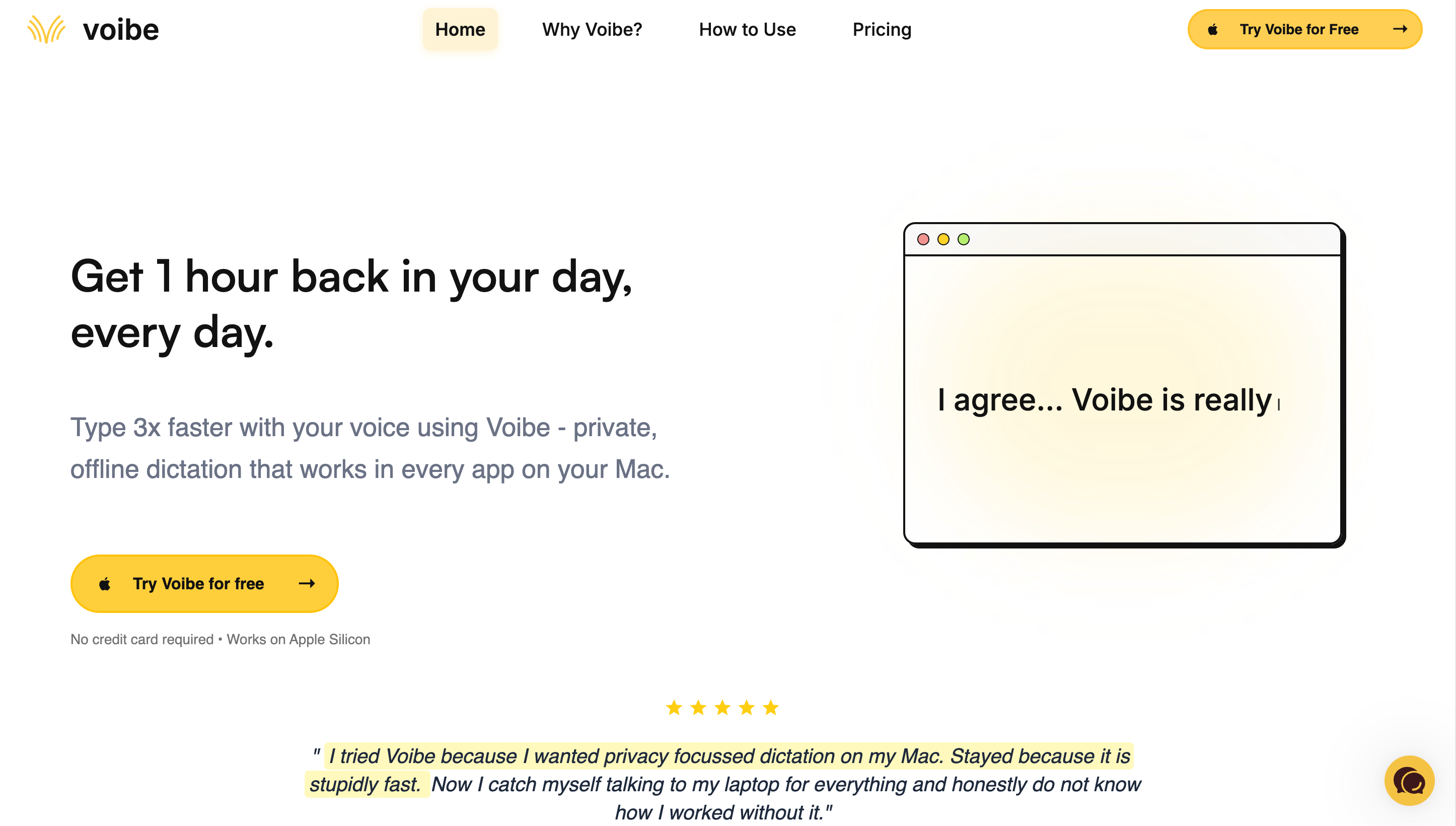
Voibe covers both halves of a reporting workflow, which is unusual on this list: a speech-to-text API that turns recorded interviews into transcripts, and a dictation app for Mac and Windows for writing the piece by voice. The through-line is what happens to the audio. In the app's on-device mode on Apple Silicon, nothing leaves the machine at all; through the cloud mode and the API, the recording is deleted the moment the transcript exists, is never trained on, and that is the default on every tier rather than a setting you have to find. For a reporter, that is the difference between a vendor being a tool and a vendor being a records holder who can be subpoenaed.
For the interviews. Send a recording and you get back a diarized transcript — speaker labels, per-segment timestamps — plus a summary you shape with your own prompt, which in practice means you can ask for a timestamped quote list instead of a narrative. It costs $0.25–$0.30 per hour, so a ninety-minute interview runs about 45 cents, against Trint at $52–$100 per user per month. Billing is per second and charged only on a delivered transcript, so a failed job costs nothing.
You do not need a developer. In Claude Cowork, Claude desktop or Claude web, open Customize › Connectors › Add custom connector, paste https://api.getvoibe.com/mcp and sign in once. Then the request is a sentence: “transcribe the interviews in this folder and give me a transcript plus a timestamped quote list for each.” Reporters who live in a terminal can connect the same server in Claude Code with one claude mcp add command, or script the REST endpoints directly.
For the writing. The desktop app puts dictation into any text field — Google Docs, Word, Notion, Scrivener, your CMS, email — so long-form features, breaking copy and broadcast scripts can be spoken rather than typed. Custom Vocabulary handles source names, place names and foreign-language terms that every general-purpose model gets wrong. It runs on Mac and Windows; on-device processing requires an Apple Silicon Mac, and everything else uses the zero-retention cloud.
Key Features:
- Speech-to-text API for recorded interviews — speaker labels, per-segment timestamps, prompt-steered summaries at $0.25–$0.30/hour
- Hosted MCP server so an agent does the transcribing: a Connectors screen in Claude Cowork, desktop and web; one command in Claude Code
- On-device or zero-retention cloud dictation — your choice; on-device runs locally on Apple Silicon (M1–M4)
- System-wide dictation on Mac and Windows: Google Docs, Microsoft Word, Notion, Scrivener, your CMS, email, Slack
- Custom Vocabulary for source names, place names, foreign-language terms
- Hands-Free Mode (Fn+Space or double-tap Fn) for continuous sessions up to 5 minutes — Escape cancels instantly
- Local dictation history with one-click copy and Ctrl+Option+V paste-last-transcript; transcript storage can be disabled entirely
- 100+ languages with in-app switching, fully offline in on-device mode — covers multilingual reporting
- Audio deleted the moment the transcript exists, never trained on — the default everywhere
- Covers interviews and the writing without a second vendor or a second subscription
- No cloud vendor accumulating your source recordings; on-device dictation means drafts never leave the machine
- Cheapest transcription on this page by a wide margin — about 45 cents for a ninety-minute interview
- $149 lifetime replaces indefinite subscription spend on the writing half
- Retention terms are the default on every tier, not a setting you have to remember before a sensitive interview
- Transcription is batch only — no live transcript while a press conference is running (Otter still owns that job)
- No human-verified accuracy tier; for a certified transcript, Rev's human service remains the answer
- No published data-residency option — if your requirement is EU-only processing, Sonix and the EU-hosted vendors address it and Voibe does not
- No web interface for transcription: no upload box, no share link, no editor for fixing a speaker label by ear
- Desktop only, no mobile apps; on-device dictation needs an Apple Silicon Mac
Third-party rating: 4.8/5 on Product Hunt (6 reviews).
Where MacWhisper Pro still wins: if your rule is that source audio never leaves the laptop under any circumstances, MacWhisper Pro (below) processes entirely on-device and remains the stricter answer. Voibe's API is a cloud service that deletes rather than a local tool that never receives — a meaningful distinction for the most sensitive material.
Best for: reporters who record interviews and write by voice, and who would rather not have either sitting on a vendor's servers. Try Voibe for Free →
Tip
For a freelance reporter writing a long-form feature: a 4,000-word piece dictated at 150 wpm takes about 27 minutes of speech. Voibe handles that in real time on the journalist's Mac; in on-device mode nothing leaves the Mac — useful when sources, document references, or case-strategy details appear in the dictation.
2. MacWhisper Pro — Best Rev.com Alternative for Confidential-Source Interview Transcription
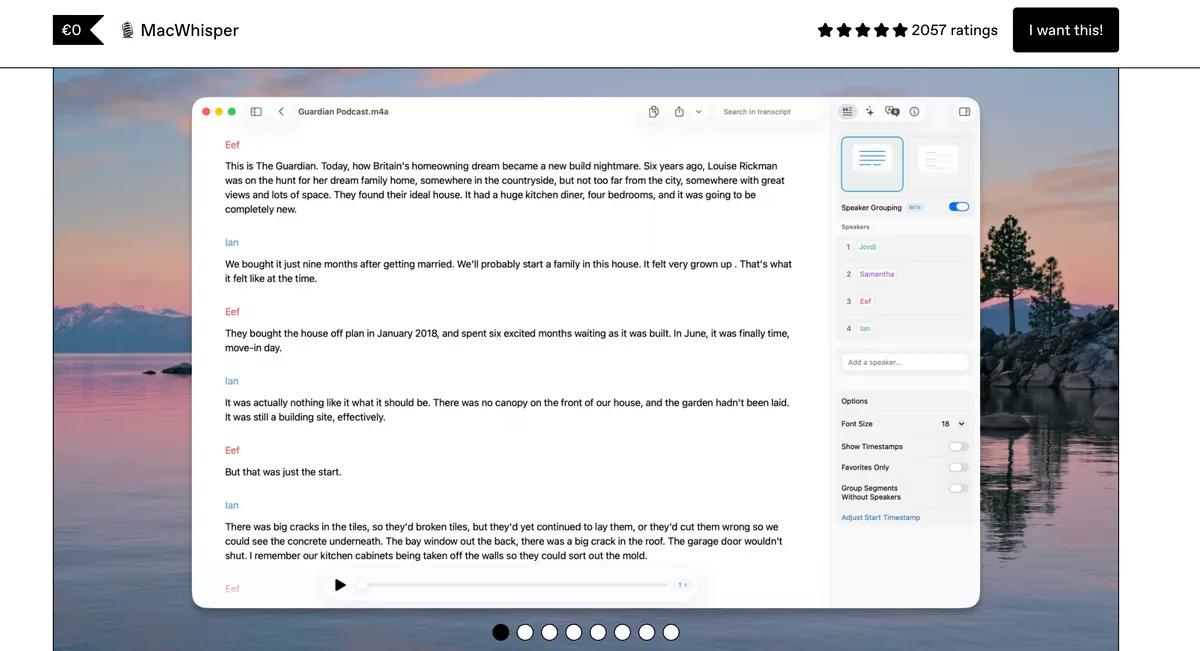
MacWhisper Pro is an on-device file transcription app for Mac that uses OpenAI Whisper models to convert recorded audio (interviews, press conferences, public hearings, voice memos) into text. Like Voibe, all processing happens locally on Apple Silicon — no audio is uploaded, no third-party transcriptionist listens, no vendor retains the file. Where Voibe handles real-time dictation, MacWhisper Pro handles the recorded-audio job that Rev human transcription is built for. For confidential-source interviews, anonymous-source recordings, and any audio in jurisdictions with weak shield-law coverage of third-party vendors, MacWhisper Pro replaces Rev directly.
Key Features:
- On-device transcription using Whisper models up to Large V3
- Batch folder processing — process a week of interviews overnight
- Speaker diarization to separate interview subjects in multi-party recordings
- Subtitle and timestamp export (SRT, VTT) for video-source synchronization
- YouTube URL transcription (useful for public-record video evidence)
- Native macOS app with Apple Silicon-optimized inference
- One-time lifetime purchase via Gumroad — no recurring subscription
- Recorded interview audio never leaves the journalist's Mac — no third-party records holder
- €59 (~$69) lifetime replaces an indefinite Rev per-minute spend
- Speaker diarization for multi-party interviews and panel recordings
- Batch processing for high-volume investigative work
- Not certified — not appropriate for filed evidentiary transcripts that require certification
- Whisper accuracy on heavy accents or low-quality phone audio is below Rev human transcription
- No newsroom collaboration features (use Trint or Descript for that)
- Mac-only (Apple Silicon recommended for the largest models)
Third-party rating: Not formally aggregated; established reputation in Mac power-user community. See our MacWhisper pricing breakdown for the full feature comparison.
Best for: Reporters who record confidential-source interviews, anonymous-source meetings, or sensitive material and want the audio transcribed without sending the files to an outside vendor. Pairs with Voibe for the writing-the-story half of the workflow.
3. Trint — Best Newsroom-Built Alternative to Rev for Multi-Source Story Building
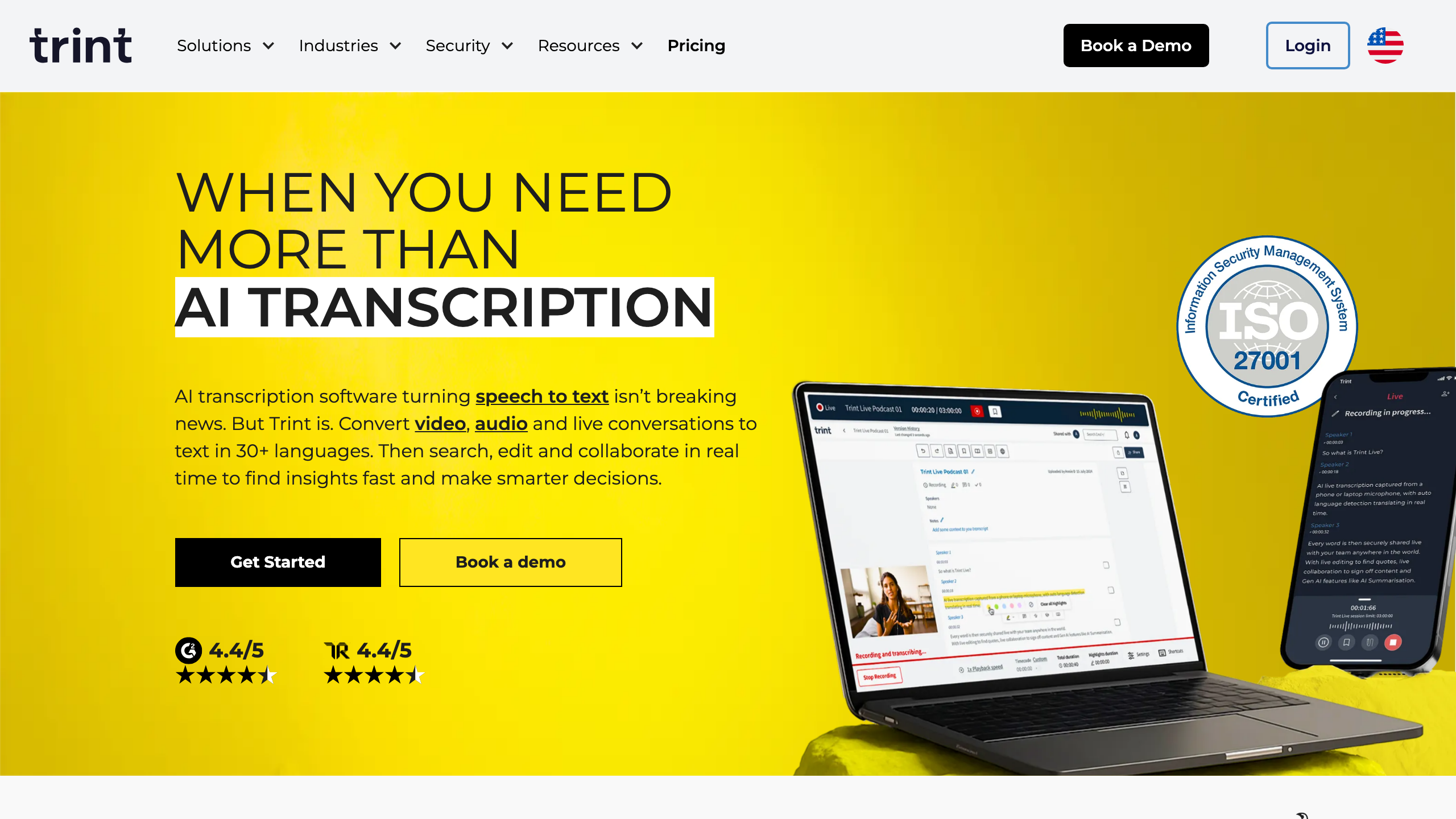
Trint was built specifically for newsrooms, journalists, and media professionals. Its product decisions show that focus throughout: multi-speaker transcription with timestamps, live transcription for press conferences, translation across 54 languages, collaborative editing, and API integrations for content management systems. The differentiator is Story Builder — a workspace where journalists highlight quotes across multiple transcripts and drag those quotes into a single narrative document, building a story without copying between files. For multi-source investigations and editorial team collaboration on long-form pieces, Trint is the strongest non-Rev workflow tool for journalism.
Key Features:
- Story Builder workspace for multi-source quote collation
- Multi-speaker transcription with timestamps
- Live transcription for press conferences and live events
- Translation across 54 languages
- Collaborative editing with comments and version history
- API integrations for CMS publishing pipelines
- SOC 2 Type II compliance
- Purpose-built for journalism workflow — no other tool has Story Builder
- Strong multi-speaker, multi-language coverage for international reporting
- Live transcription for press events
- Editorial collaboration with comments and version history
- API integrations for newsroom CMS publishing
- Cloud-based — interview audio uploaded to Trint infrastructure
- $52–$100/user/month is materially more than per-audio-hour services for low-volume use
- Starter plan capped at 7 files/month per seat
- Not the right tool for confidential-source audio that should not leave the journalist's machine
Third-party rating: 4.5/5 on G2.
Best for: Newsrooms and freelance journalists running multi-source investigations who want a workspace that bridges transcript and finished story, with editorial team collaboration features. Use on-device tools (Voibe + MacWhisper Pro) for the confidential-source portion of the same workflow and Trint for the non-confidential team-collaboration half.
4. Descript — Best Rev.com Alternative for Podcast and Broadcast Journalism

Descript is the only mainstream tool that makes the transcript itself the editing interface for the underlying audio or video. Edit the transcript, and the audio edits to match. For podcast and broadcast journalism — and increasingly for video-first reporting — Descript collapses the transcribe-then-edit workflow into a single tool. It is not a Rev replacement for raw verbatim transcription of interview source material; it is a replacement for the Rev-then-Adobe-then-Final-Cut pipeline most podcast and broadcast journalists used historically.
Key Features:
- Text-based audio and video editing — edit the transcript, the audio cuts to match
- Multi-track recording and editing
- Speaker identification with auto-labeling
- Filler-word removal (umms, ahs, false starts) at one click
- Voice cloning for retakes (controversial — use editorially with care)
- Native macOS and Windows apps
- Built-in publishing for podcast platforms
- Transcript-as-editor saves hours per episode for podcasters and broadcasters
- Native macOS and Windows apps — fast on Apple Silicon
- Speaker identification with auto-labeling
- Free tier (1 hour transcription/month) for evaluation
- Reasonable per-user pricing for full editorial workflow
- Cloud-based — audio uploaded to Descript infrastructure for processing
- Voice cloning feature requires editorial discipline (potential for misuse)
- Not designed for confidential-source-only workflows
- Higher learning curve than a pure transcription tool
Third-party rating: 4.5/5 on G2.
Best for: Podcast journalists, broadcast reporters, and video-first newsrooms who want transcription and audio/video editing in a single tool. Layer on-device tools (Voibe + MacWhisper Pro) for confidential-source interviews where audio should never leave the journalist's machine.
5. Otter.ai — Best Rev.com Alternative for Live Press Conferences and Remote Interviews
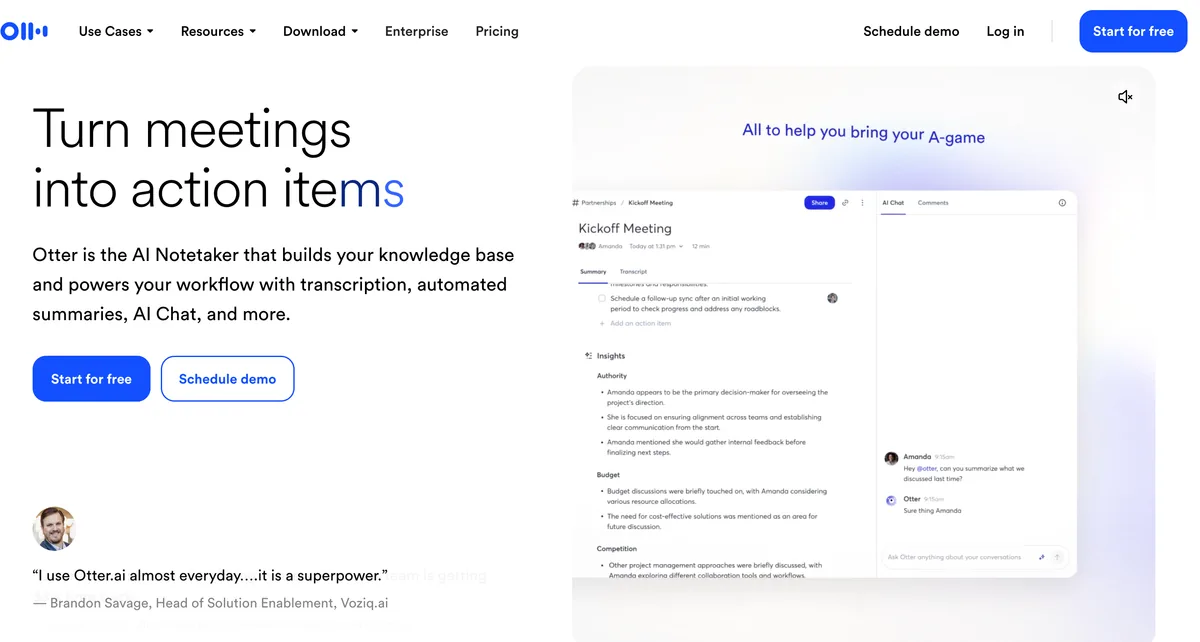
Otter.ai is the leading cloud meeting-transcription tool. For journalists, its strength is real-time live capture during a press conference, remote video interview, or panel — a workflow Rev's post-hoc transcription pipeline does not address. Otter joins Zoom, Google Meet, or Microsoft Teams sessions and produces a searchable, timestamped transcript with speaker labels in the moment, which can be reviewed or quoted from immediately after. For breaking-news beats and live event coverage, Otter is the right tool alongside (not instead of) on-device tools for confidential-source work.
Key Features:
- Real-time live transcription during video meetings
- Automated speaker identification and labeling
- Searchable transcripts with timestamps
- Native Zoom, Google Meet, and Microsoft Teams integrations
- Highlights and AI-generated meeting summaries
- Team sharing and collaboration features
- SOC 2 Type II compliance; HIPAA on Enterprise
- Live transcription during press conferences and remote interviews
- Native integration with the major video conferencing tools
- Speaker identification for multi-party panels
- Predictable per-seat pricing
- Free tier (300 minutes/month) for evaluation
- Cloud-based — audio uploaded to Otter infrastructure
- Not appropriate for confidential-source remote interviews where audio should not leave the journalist's machine
- AI transcription accuracy not at Rev human's 99% certified level
- Free and Pro tiers do not include Enterprise compliance features
Third-party rating: 4.4/5 on G2 (460+ reviews).
Best for: Reporters who cover live press events, breaking-news Zoom briefings, and on-record remote video interviews. Pair with on-device tools (Voibe + MacWhisper Pro) for the confidential-source portion of the workflow.
6. Sonix — Best Multilingual Cloud Alternative to Rev for International Reporting

Sonix is a cloud AI transcription service with strong multilingual coverage (40+ languages) and predictable per-audio-hour pricing. For international reporters working across multiple language sources or newsrooms with significant non-English audio volume, Sonix's $10/audio hour Standard or $5/audio hour Premium pricing is more predictable than Rev's per-minute model and covers more languages than Rev human transcription does. Sonix Enterprise also offers HIPAA business associate agreements (more relevant for medical-legal reporting than general journalism).
Key Features:
- AI transcription with automated speaker identification
- Timestamped transcripts with searchable text
- 40+ language support
- SOC 2 Type II compliance
- HIPAA business associate agreements available on Enterprise
- In-browser editor with audio sync for review and correction
- Integration with Zoom, Adobe Premiere, Final Cut Pro
- Strong multilingual coverage (40+ languages)
- Predictable per-audio-hour pricing vs. Rev's per-minute model
- Strong editorial UX for review and correction
- SOC 2 Type II attestation
- Cloud-based — audio uploaded to Sonix infrastructure
- $22/seat/month subscription on top of audio-hour costs for Premium tier
- AI accuracy below Rev human transcription for evidentiary use
- Not the right tool for confidential-source-only workflows
Third-party rating: 4.7/5 on G2.
Best for: International reporters and newsrooms with significant non-English audio volume who want predictable per-audio-hour cloud transcription and broader language coverage than Rev human transcription provides directly.
7. Pinpoint — Best Free Investigative-Reporting Alternative for Document-Heavy Stories
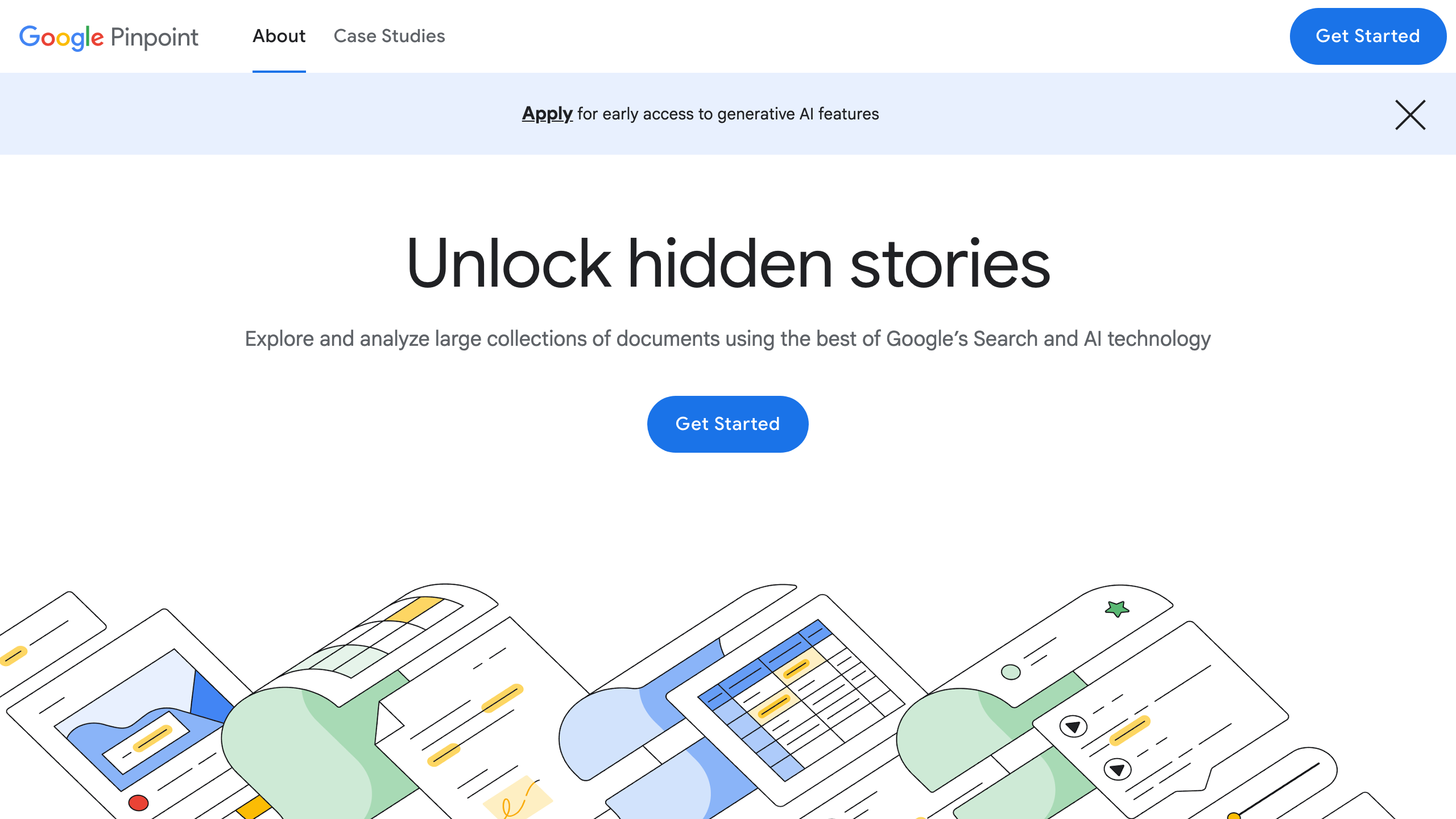
Pinpoint is a free tool from the Google News Initiative built specifically for investigative reporting. It accepts up to 200,000 audio/video minutes per year per user, plus document corpora that it OCRs and indexes for searchable text and entity recognition (people, organizations, places). For investigative stories built from a large corpus of documents and audio — leaked records, FOIA productions, court filings — Pinpoint solves a multi-format research problem that Rev's pure transcription pipeline does not address. It is cloud-based, so the source-protection considerations are the same as any other cloud vendor; for confidential-source audio specifically, on-device tools remain the stronger choice.
Key Features:
- Free tier with 200,000 audio/video minutes per year per user
- OCR and full-text indexing for document corpora (PDF, image, scanned)
- Automatic entity recognition (people, organizations, places)
- Searchable across audio + document corpus simultaneously
- Built specifically for investigative journalism use cases
- Backed by Google News Initiative
- Free for journalists (Google News Initiative funding)
- Generous 200,000 minutes/year volume
- OCR + entity recognition for document-heavy investigations
- Multi-format corpus search (audio + documents in one workspace)
- Cloud-based — audio and documents uploaded to Google infrastructure
- Not appropriate for the most sensitive confidential-source audio
- Less newsroom-collaboration polish than Trint
- No story-building workspace — designed for research, not writing
- Free tier comes with implicit data-use considerations from the vendor
Third-party rating: Industry-supported tool from Google News Initiative; reviews are largely from documented use in investigative outlets.
Best for: Investigative reporters working on document-heavy stories who need OCR, entity recognition, and multi-format corpus search. Use on-device tools (Voibe + MacWhisper Pro) alongside Pinpoint for the confidential-audio portion of the same investigation.
8. SuperWhisper — Best On-Device Alternative for Power-User Journalists
SuperWhisper is an on-device dictation app for Mac that, like Voibe, processes speech locally on Apple Silicon with no audio uploaded. Where Voibe optimizes for plug-and-play simplicity, SuperWhisper exposes the underlying Whisper model selection and post-processing pipeline to the user. Power-user journalists who want to load a specific Whisper model size for a particular language, build custom modes for different reporting workflows, or integrate optional cloud LLM post-processing (BYOK) for non-confidential editing tasks will find SuperWhisper's flexibility valuable. For most reporters, the additional configurability is overhead rather than benefit.
Key Features:
- 100% on-device processing on Apple Silicon (default modes)
- Multiple Whisper model sizes (Tiny through Large V3) for accuracy/speed tuning
- Custom modes with optional LLM post-processing (BYOK)
- System-wide dictation across all Mac apps
- Keyboard shortcut activation
- Custom vocabulary support
- On-device by default — confidential audio stays on the Mac
- Flexible model selection for accuracy/latency tuning per language
- Strong accuracy with Whisper Large V3
- $8.49/month or $249.99 lifetime
- $249.99 lifetime is ~$100 more than Voibe ($149)
- Optional cloud LLM post-processing (BYOK) reintroduces a cloud round-trip if enabled — verify modes are on-device-only for confidential reporting
- Stores audio recordings by default per published feedback — review settings before confidential-source use
- More complex setup than plug-and-play alternatives
Third-party rating: 4.9/5 on Product Hunt (20 reviews).
Best for: Power-user journalists and technical reporters who want full control over the speech-recognition pipeline, work across multiple languages, and are comfortable verifying that their custom modes are configured for on-device-only operation when handling confidential source material.
How to Choose the Right Rev.com Alternative for Your Reporting Workflow
Use these five decision questions to narrow the eight tools above to a layered stack that fits your reporting workflow.
1. Is the audio confidential-source material or non-confidential public-record?
- Confidential-source: Choose on-device only — Voibe (real-time dictation) + MacWhisper Pro (recorded interviews) on Mac, or SuperWhisper if you want model control. No third-party records holder.
- Non-confidential (public hearings, on-record interviews, press releases, public records): Cloud tools (Trint, Descript, Otter, Sonix, Pinpoint, Rev) are appropriate with reasonable diligence on the vendor's contract.
2. Are you replacing transcription, story-building, or audio/video editing?
- Transcription only: Voibe + MacWhisper Pro (on-device) or Sonix (cloud AI) or Rev (certified human).
- Multi-source story-building: Trint Advanced ($60–$100/user/month) — Story Builder is the differentiator.
- Podcast or broadcast journalism (audio/video editing): Descript ($24–$65/user/month) — transcript-as-editor.
- Investigative document corpus: Pinpoint (free) — OCR + entity recognition.
3. Live or recorded?
- Live press conferences, remote video interviews: Otter Business ($19.99/user/month) for live capture with speaker identification.
- Recorded interviews and audio files: MacWhisper Pro (on-device) for confidential, Trint or Sonix for cloud, Rev human for certified.
- Live and recorded mixed: Layer Otter for live + on-device or Trint for the recorded portion.
4. What is your monthly transcription volume?
- Under 5 hours/month: Apple Dictation (free) for dictation; Pinpoint (free) for non-confidential transcription; Rev pay-per-minute for the rare certified job.
- 5–30 hours/month: The Voibe + MacWhisper Pro stack ($267 once) is cheapest. Subscription tools (Trint, Descript) are competitive for the workflow features.
- Over 30 hours/month: The on-device stack saves $5,000+ per investigator over a typical investigation horizon vs. Rev human transcription. Reserve Rev human for the matters that genuinely need certified output.
5. What is your jurisdictional shield-law context?
- Working in a state with a strong shield law (e.g., New York, California): Cloud transcription is more defensible because the journalist's primary protection extends to records held in connection with the journalism. Still, on-device is the strongest posture.
- Working in a state with a weak or no shield law, or in federal jurisdiction: On-device is the most defensible posture. Cloud vendors holding the audio are exposed to subpoena under broader rules, and the application of state shield laws to vendor-held records is uncertain.
- Cross-border or multi-jurisdictional reporting: Default to on-device for the audio-handling layer; layer cloud collaboration tools only on the non-confidential half of the workflow.
Key Takeaway
Start with confidentiality (on-device or cloud), then workflow shape (transcription / multi-source story / podcast-AV / live), then volume. The default for confidential-source reporting is Voibe + MacWhisper Pro; the default for non-confidential newsroom collaboration is Trint + Descript + Otter + (free) Pinpoint.
Use-Case Cheat Sheet: Best Rev.com Alternative for Your Specific Reporting
Specific scenarios mapped to specific tools. Use this as a quick reference once you have read the decision tree above.
| Your Situation | Best Rev Alternative | Why |
|---|---|---|
| Freelance investigative reporter with confidential sources | Voibe + MacWhisper Pro (~$267 once) | On-device only; shield-law-aligned source protection. |
| Long-form magazine writer dictating drafts on Mac | Voibe ($149 lifetime) | Real-time on-device dictation with hands-free sessions up to 5 minutes; replaces no-shield-law cloud risk for the writing half. |
| Newsroom team running a multi-source investigation | Trint Advanced + Voibe + MacWhisper Pro | Trint Story Builder for non-confidential collaboration; on-device for confidential-source audio. |
| Podcast journalist editing weekly episodes | Descript Creator ($24–$35/user/mo) | Transcript-as-editor collapses the transcribe-then-edit workflow. |
| Beat reporter covering live press conferences | Otter Business ($19.99/user/mo) + Voibe | Otter for live capture; Voibe for writing the story afterward on-device — Ctrl+Option+V re-pastes the last transcript to re-grab a quote. |
| International correspondent working across 4+ languages | Sonix Premium + MacWhisper Pro | Sonix for multilingual cloud transcription; MacWhisper for confidential source audio. |
| Investigative reporter on a leaked-document corpus | Pinpoint (free) + Voibe + MacWhisper Pro | Pinpoint for OCR + entity extraction across the document corpus; on-device for source audio. |
| Freelance journalist on a tight budget under $100/year | Apple Dictation + MacWhisper Pro + Pinpoint | Free dictation, ~$69 on-device transcription, free document corpus tool. |
| Court reporter or legal-affairs reporter on public hearings | Voibe + Rev human (for certified-evidentiary) | Voibe for routine drafting; Rev human only for certified hearing transcripts. |
| Reporter working in a state with a weak shield law | Voibe + MacWhisper Pro | On-device only — eliminates third-party-records-holder exposure entirely. |
| Cross-border foreign correspondent | Voibe + MacWhisper Pro (default) + Sonix (non-confidential) | On-device for confidential foreign-source audio; Sonix for multilingual non-confidential. |
| Reporter who used Rev exclusively and wants to phase out gradually | Add Voibe first, retain Rev for certified work | Voibe replaces 70–80% of routine workflow; Rev stays for the certified 20%. |
Frequently Asked Questions About Rev.com Alternatives for Journalists
Source Confidentiality and Shield Laws
Are state shield laws strong enough to protect Rev-stored audio of my confidential sources? State shield laws (in roughly 30 states) primarily protect the journalist from being compelled to testify or disclose sources. Their application to third-party vendors holding the journalist's audio is jurisdiction-specific and uncertain. In some states, the protection arguably extends to records held by agents of the journalism. In others, vendors are treated as outside the shield's reach. The Reporters Committee for Freedom of the Press has flagged cloud storage as a real source-protection gap. For confidential-source audio in 2026, the most defensible posture is to keep the recording inside the journalist's custodial perimeter — on-device tools deliver that.
Will the PRESS Act change this once it passes? The pending Protect Reporters from Exploitative State Spying Act (PRESS Act) would create a federal shield that explicitly extends to third-party records holders, with narrow exceptions for terrorism, serious emergencies, or journalists suspected of crimes. The U.S. House passed the legislation unanimously in January 2024, but as of 2026 it has not been enacted into federal law. Until it is, federal jurisdictions remain governed by Branzburg v. Hayes (1972) and DOJ internal guidelines (last updated 2022). The on-device path is more defensible during this gap.
Can a transcription vendor receive a subpoena without notifying me? Yes, in some circumstances. Some subpoenas come with non-disclosure orders or gag orders. DOJ's 2022 guidelines on obtaining journalist records require additional internal review for compelled production from journalists or their service providers, but those are policy guidelines, not statute. Cloud vendors holding journalist audio sit in a structurally exposed position — on-device tools eliminate that exposure entirely.
Cost and Workflow
How much will I save by switching from Rev to an on-device alternative? For a freelance reporter running 10 hours of interviews per month, three months of Rev human transcription at $1.99/minute totals approximately $3,582. Three months on the Voibe + MacWhisper Pro on-device stack costs $267 once (covers all subsequent months at zero marginal cost). The on-device savings reach 92% in the first three months and grow over time. Larger volumes (50-source investigations, ongoing-beat reporting) save thousands per investigation.
Is Trint or Descript a Rev replacement, or a different product? Both are different products that solve workflow problems Rev does not address. Trint replaces the Rev-then-Word-then-quote-collation pipeline with Story Builder. Descript replaces the Rev-then-Adobe-Audition-then-Premiere pipeline for podcast and broadcast. They are not direct Rev replacements for raw verbatim transcription; they are workflow-shape replacements for journalism specifically.
Should I drop Rev entirely or keep it on retainer? Most reporters who switch keep Rev on retainer for a narrow set of certified-evidentiary uses: court audio that may be filed as exhibit, public-records hearings where the certified transcript becomes part of the published record, and any audio that may be subject to litigation hold where the certified human transcript adds defensive value. For everything else, on-device tools handle the work at a fraction of the cost.
Accuracy and Use Cases
Can Voibe or MacWhisper Pro produce a transcript I can use as a published quote? Yes, with the journalistic practice of verifying every quote against the audio before publication. The on-device tools produce high-quality transcripts suitable for quote selection, story drafting, and internal review. Standard journalism practice is to listen back to any quote against the recording before publication regardless of which transcription tool was used; that practice is just as effective on Whisper-generated transcripts as on Rev human transcripts. For certified-evidentiary use (court filings, exhibit transcripts), retain Rev human transcription, SpeakWrite, or a court reporter for that specific job.
How accurate is Whisper-based transcription on accented audio? OpenAI's Whisper models handle most native-English accents and many non-native accents well. Accuracy degrades on heavy regional accents, low-quality phone audio, multiple-speaker overlap, and noisy environments. For high-quality interview audio with one speaker at a time and good microphones, on-device tools produce transcripts comparable to Rev's AI tier. For challenging audio (field recordings in noisy environments, low-bitrate phone audio), Rev human transcription's $1.99/minute remains the highest-accuracy option.
Will my recording quality affect on-device transcription accuracy? Yes — significantly. Investing in a good external microphone (a USB condenser microphone or a lavalier paired with a good recorder) improves on-device transcription quality dramatically. The cost difference between high-quality and low-quality recording is small relative to the per-minute Rev fee for re-transcribing low-quality audio. Most reporters recover the cost of a good microphone in the first few interviews after switching to on-device tools.
Workflow and Setup
How long does it take to switch from Rev to an on-device stack? Voibe and MacWhisper Pro both install in under 10 minutes. The behavioral change is the longer transition: reporters used to uploading audio to Rev and receiving a transcript hours later have to adapt to the immediate on-device workflow (drag a file into MacWhisper, get a transcript in 1–5 minutes locally). Most reporters report adapting within the first week. For a newsroom rollout, plan a one-week pilot with one reporter before standardizing.
Can I use multiple Rev alternatives together? Yes — and most reporters should. The recommended default for confidential-source reporting is Voibe + MacWhisper Pro on-device, with Trint or Descript layered for the non-confidential team-collaboration half, plus Pinpoint for document-corpus investigative work, plus Otter for live press events. Each tool covers a different stage of the reporting workflow; the goal is the right tool for the job, not a single one-size-fits-all replacement.
What about AI-generated audio impersonation as an emerging risk to my source recordings? Voice deepfakes and synthesized audio are an emerging issue in 2026 — relevant to journalism in two ways: verifying the authenticity of audio you receive from sources, and protecting your own recordings from manipulation. On-device tools do not change the synthesis risk on either side, but they do keep your authenticated source audio inside your custodial perimeter, which makes any later challenge to authenticity easier to defend.
Final Verdict: Which Rev.com Alternative Should You Choose?
For most freelance journalists and small newsrooms in 2026, the right move is not to find a single Rev.com replacement but to layer two or three tools that match different stages of the reporting workflow. The on-device pair handles ~80 percent of routine work, and a newsroom-fit cloud tool layers on top for collaboration where the audio is non-confidential:
- Voibe ($149 lifetime) for writing the story by voice on Mac. In on-device mode, confidential drafts never leave the device. Replaces no-shield-law cloud exposure for the writing half.
- MacWhisper Pro (€59 / ~$69 lifetime) for transcribing recorded interviews — confidential or otherwise. On-device, no per-minute meter, no third-party records holder. Source-protection-aligned by architecture.
- Trint Advanced ($60–$100/user/month) for newsroom collaboration on multi-source investigations where the audio is non-confidential. Story Builder is the differentiator no other tool replicates.
- Descript Creator ($24–$35/user/month) for podcast and broadcast journalism. Transcript-as-editor saves hours per episode.
- Rev human transcription retained only for certified-evidentiary cases — court audio, public-records hearings where a verbatim transcript may need to be filed or attached as exhibit. Your annual Rev bill drops by 80 to 95 percent with this configuration.
Reporters covering live press events should add Otter Business for live capture. International correspondents working across multiple languages should layer Sonix Premium for multilingual non-confidential transcription. Investigative reporters working on document corpora should use Pinpoint (free) for OCR + entity recognition across the document side of the investigation while keeping the audio side on-device.
The common thread across every recommendation: stop sending the routine 80 percent of journalism audio to Rev's per-minute meter, keep confidential-source recordings inside the journalist's custodial perimeter where shield laws are strongest, and reserve Rev's certified-human service for the matters where the certification matters.
Try Voibe Free on Your Mac
A 7-day free trial — enough to evaluate against your real reporting workflow before committing to the $149 lifetime license. No account required; your audio is never stored, sold, or used to train AI, and in on-device mode nothing leaves your Mac.
Related reading:
- Best Rev.com Alternatives for Lawyers (2026) — sibling persona piece for legal practice
- Best Rev.com Alternatives for Doctors (2026) — sibling persona piece for medical practice
- Cloud vs Local Dictation: A Privacy Comparison — the underlying technical difference
- Voice Data Privacy: A Practitioner's Guide
- MacWhisper Pricing Breakdown (2026) — full feature comparison for the recorded-audio tool
- Is Otter Safe? — full privacy investigation including the consolidated federal class action In re Otter.AI Privacy Litigation and the visible-bot consent problem (relevant for any journalist considering OtterPilot for source interviews or press conferences)
- Is Wispr Flow Safe?, Is Superwhisper Safe?, Is Aqua Voice Safe?, Is Dragon Safe? — sibling cloud/hybrid dictation investigations covering the rest of the peer set
- AI Tool Privacy Tracker — cross-product reference covering Otter, Fireflies, Granola, and the meeting-transcription peer set on training, retention, and on-device support
Ready to type 5x faster?
Voibe is the fastest, most private dictation app for Mac and Windows. Try it today.
- On-device or private cloud
- Free to try
- No subscription
- Mac + Windows
- 90+ languages
Prefer to go Pro? Save 20% on any plan with code VOIBE20 View pricing →
Related Articles
Best Rev.com Alternatives for Doctors and Small Practices (2026)
8 Rev.com alternatives for doctors and small practices (2026): on-device dictation, AI medical scribes, and HIPAA-aligned cloud transcription compared on PHI exposure, BAA, and cost.
Best Rev.com Alternatives for Lawyers and Small Law Firms (2026)
8 Rev.com alternatives for lawyers (2026): on-device dictation, AI transcription, and human-typist services compared on privilege, pricing, and ABA compliance.
6 Best AI Dictation Apps for Windows — Ranked by Who Actually Built for Windows
Six AI dictation apps are actually great on Windows in 2026. We ranked them — including the one we built from the ground up for Windows — with verified pricing.