
Is Dragon Safe? Two of the Three Dragons Send Audio to Azure
Is Dragon safe? I read Microsoft's security papers for all three Dragons. Professional keeps audio on your PC, and the other two send it to Azure.

Is Dragon Safe? The Direct Answer
Three products are called Dragon, and only one keeps your audio on your own machine. I read Microsoft’s Dragon Copilot security papers and Nuance’s product pages to work out which is which.
TL;DR: all three sit inside Microsoft’s compliance perimeter after the March 2022 Microsoft acquisition of Nuance Communications ($19.7 billion), and their architectures differ:
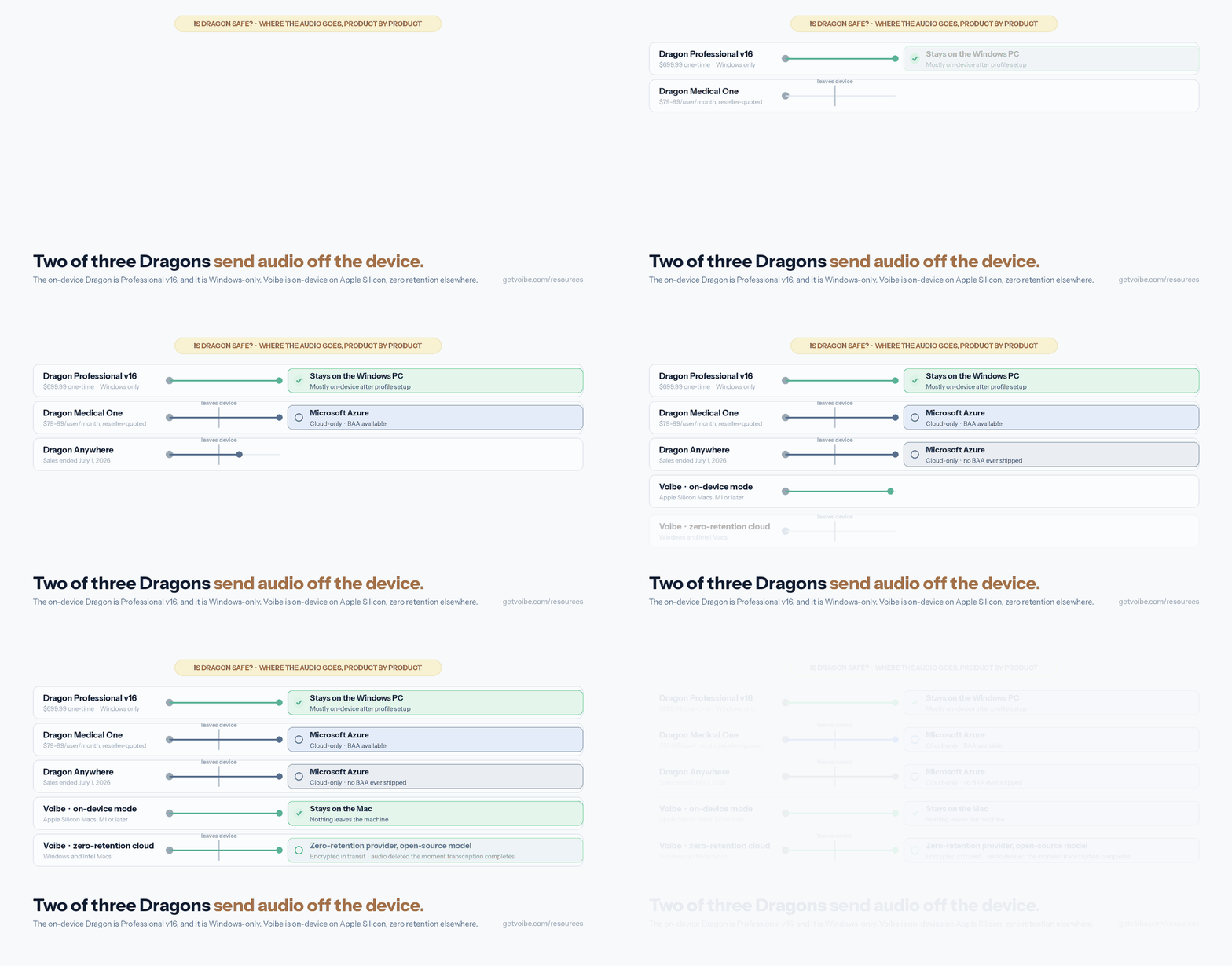
- Dragon Professional v16 ($699.99, Windows-only) runs speech recognition mostly on-device after profile creation. It's the most privacy-protective Dragon, and the only one sold to individual desktop users.
- Dragon Anywhere (mobile; end of sale July 1, 2026) was cloud-only, sending audio to Microsoft Azure with no on-device mode. Existing subscriptions can no longer be renewed.
- Dragon Medical One (reseller-quoted at $79–99/user/month on 1–3 year terms) is cloud-only, Azure-hosted, and ships with a Business Associate Agreement (BAA) for HIPAA-bound work. Microsoft Learn's Dragon Copilot security white paper documents the encryption, data residency, and compliance framework.
Two caveats hold across the line. Dragon for Mac died in 2018, so Apple Silicon users have no Dragon at all and a legacy install usually surfaces as a Dragon for Mac microphone that stops working. And Microsoft’s money is going to healthcare: Dragon Copilot (merged with DAX Copilot in March 2025) is where new development happens.
If you're on a Mac, or want on-device dictation without a Windows requirement, Voibe (ours; $149 lifetime, Mac and Windows) sits outside the Microsoft perimeter: an on-device mode on Apple Silicon Macs where nothing leaves the machine, and a zero-retention cloud on Windows and Intel Macs that deletes audio the moment transcription completes. Where Dragon is stronger, I say so below.
Key Takeaway
Dragon is three products with three architectures. Professional is mostly on-device (Windows only). Anywhere was cloud-only and its sale ended July 1, 2026. Medical One is cloud-only on Microsoft Azure with a BAA. The 2018 Mac discontinuation leaves Apple Silicon users without any Dragon.
The Dragon Safety Picture by Product
| Dimension | Dragon Professional v16 | Dragon Anywhere | Dragon Medical One |
|---|---|---|---|
| Platform | Windows only | iOS, Android | Windows + iOS (Mobile Recorder) |
| Architecture | Mostly on-device | Cloud-only (Azure) | Cloud-only (Azure) |
| Pricing | $699.99 one-time | Was $14.99/mo or $149.99/yr; end of sale July 1, 2026 | $79–99/user/mo on 1–3 yr terms (reseller-quoted, verified 2026-09-05) |
| Encryption | Local data; HTTPS/TLS for sync | HTTPS/TLS in transit; encrypted at rest | HTTPS/TLS in transit; encrypted at rest |
| HIPAA BAA | Not standard | Not standard | Standard, ships with deployment |
| SOC 2 / ISO / FedRAMP | Via Microsoft enterprise contracts | Via Microsoft / Azure | Full Microsoft compliance stack (SOC 2 Type 2, ISO 27001, HITRUST CSF, FedRAMP Gov where applicable) |
| Data residency | Local + sync regions | US Azure (default) | US, EU, Australia Azure regions |
| Training on user data | Local acoustic profile training; cloud sync optional | Per Microsoft Azure regulated-data terms | Per BAA — customer data not used to train foundation models without explicit opt-in |
| Owner | Microsoft (acquired Nuance Communications March 2022 for $19.7B) | ||
| Mac support | Discontinued 2018. No current Dragon Mac product. | ||
The five-step Dragon Safety Audit at the end is what I'd run before deploying any of them.
Dragon Is Three Different Products Now
Which Dragon you mean decides the answer, and the three variants belong in three separate boxes.
Dragon Professional v16
The descendant of Dragon NaturallySpeaking, sold as a one-time $699.99 license for Windows desktops (price re-verified September 5, 2026). It's the only Dragon that processes speech mostly on the local machine. After acoustic profile setup, the recognition engine, your vocabulary, and the trained model live on the PC, and audio is transcribed locally into the active text field. Cloud sync is opt-in, so a strict deployment keeps everything local. It fits you if you want macros, voice commands, and full voice control of Windows on a one-time license.
Dragon Anywhere
The mobile Dragon for iOS and Android, sold at $14.99/mo or $149.99/yr until its end of sale on July 1, 2026. It was entirely cloud-based, with no on-device mode: the app captured audio, encrypted it, sent it to Microsoft Azure, returned text, and discarded the local copy. Nuance sold it as a companion to Dragon Professional.
Its compliance posture was standard Azure: HTTPS/TLS in transit, encryption at rest, Microsoft’s general enterprise frameworks. No Business Associate Agreement ever shipped with it, so for PHI the right Dragon was always Dragon Medical One.
Dragon Medical One (and Dragon Legal Anywhere)
Both are cloud-only, Azure-hosted, and carry the contractual framework that makes them eligible for regulated deployments. Dragon Medical One, reseller-quoted at $79–99/user/month on 1–3 year terms plus a $525 setup fee (Nuance publishes no price), includes a BAA as standard, runs on Azure with regional data residency (US, EU, Australia), and inherits Microsoft’s healthcare compliance stack: SOC 2 Type 2, ISO 27001, HITRUST CSF, and FedRAMP for government Azure. Microsoft Learn's Dragon Copilot security white paper and its patient privacy and HIPAA documentation have the detail.
Dragon Legal Anywhere ($65/user/mo) is the legal-vocabulary counterpart on the same architecture. Instead of a BAA question it raises an attorney-client privilege question for a firm’s general counsel. One more thing to plan around: an authorized Nuance partner has announced end of sale for Dragon Professional Anywhere and Dragon Legal Anywhere on December 31, 2026 and end of life on December 31, 2027. I've found no Nuance or Microsoft advisory confirming it, so treat those as partner-announced dates. Our Dragon Professional Anywhere end-of-life guide lays out the timeline and the migration options.
One brand, three data paths. When someone tells you Dragon is on-device, ask which Dragon they mean.
Warning
"Dragon is on-device" is true only of Dragon Professional on Windows. Dragon Anywhere and Dragon Medical One are cloud-only on Microsoft Azure. The compliance and architecture analysis depends entirely on which Dragon product you mean.
What the Microsoft Acquisition Changed for Dragon Data
Microsoft closed its $19.7 billion acquisition of Nuance Communications in March 2022 and folded Nuance into its Health and Life Sciences division. That one choice explains most of what has happened to Dragon data since.
What changed:
- Processing moved to Microsoft Azure. Dragon services that ran on Nuance-owned data centers migrated to Azure regions, so audio for Dragon Anywhere (while it was sold) and Dragon Medical One runs under Azure’s compliance framework.
- Compliance attestations come from Microsoft. Dragon Medical One inherits SOC 2 Type 2, ISO 27001, ISO 27017, ISO 27018, HITRUST CSF, FedRAMP for government Azure, HITECH where applicable, and Microsoft’s country-specific certifications.
- The BAA sits under parent-subsidiary terms. Covered entities sign with Nuance Communications, Inc., now Microsoft-owned, and Microsoft holds its own BAA with Nuance as a subsidiary.
- Strategy shifted to Dragon Copilot. In March 2025 Microsoft merged DAX Copilot (ambient clinical documentation) with the Dragon Medical line to launch Dragon Copilot. New development goes there.
- Identity moved to Microsoft Entra ID. Health systems increasingly use Entra ID (formerly Azure Active Directory) for SSO, which pulls Dragon access into the Microsoft 365 identity perimeter.
What didn't change: Dragon Professional is a one-time-license Windows desktop product, and the acquisition moved neither its pricing model nor its recognition off the device. Dragon for Mac is gone, with no Apple Silicon build since 2018 and none signaled. Dragon Medical One pricing stayed in the same reseller-quoted $79–99/user/month band.
For a buyer today, the acquisition is a compliance story more than a product story. The perimeter is Azure, which most procurement teams treat as cleared. What decides your safety is which Dragon you pick.
Key Takeaway
The Microsoft acquisition moved Dragon's data perimeter to Azure under Microsoft's compliance framework. Dragon Professional stayed on-device on Windows; Dragon Anywhere (until its July 2026 end of sale) and Medical One are cloud-only on Azure; Dragon for Mac is still discontinued. Pick by architecture, not brand history.
HIPAA, the BAA, and What a Contract Cannot Do
Dragon Medical One is the Dragon built for HIPAA-bound work, and the Business Associate Agreement is what makes it HIPAA-eligible. A BAA is a contract, so know what it does and doesn't cover before procurement signs.
What the BAA covers:
- Permitted uses of PHI: what Nuance and Microsoft may do with it, including transcript retention.
- Required safeguards: access controls, encryption, audit logs, workforce training, breach response.
- Subcontractor flow-down: any Azure or third-party service touching PHI operates under BAA-equivalent terms.
- Breach notification: typically 60 days under the HIPAA Breach Notification Rule.
- Termination and data return: an export window when the contract ends, then secure deletion with attestation.
- Audit rights: usually exercised through SOC 2 Type 2 report review.
What the BAA doesn't change:
- The cloud-only architecture stays. Every dictation sends audio to Azure. The BAA makes that contractually acceptable under HIPAA without changing where the audio goes.
- Configuration is on you. Admin settings, retention windows, EHR paths, and user-access controls belong to the healthcare organization, and a signed BAA can't save a misconfigured deployment.
- The covered entity keeps its own HIPAA obligations. The BAA shifts some risk to the business associate and removes none of yours.
- Patient-side expectations sit outside it. HIPAA says nothing about patient consent for AI-assisted documentation, and some organizations now disclose that separately.
The Dragon Copilot wrinkle. Dragon Copilot adds ambient documentation: the system listens to the whole clinical encounter, not only the dictated note. The BAA framework extends to it, and the consent picture gets harder. A microphone capturing the full visit is a different thing from one capturing the doctor’s summary, which is why many health systems now get patient consent for ambient AI documentation separately.
See our dictation and HIPAA guide, and for other architectures, Dragon medical alternatives, Rev alternatives for doctors, and best offline dictation apps, where PHI never leaves the clinical device.
What Dragon Has, and What It Doesn't
Dragon has the most mature compliance footprint in dictation, and the Microsoft acquisition strengthened it. None of that paperwork helps if no variant fits the machine you work on.
What Dragon has:
- The strongest enterprise compliance stack in the category, through Azure: SOC 2 Type 2, ISO 27001, ISO 27017, ISO 27018, HITRUST CSF, FedRAMP, HIPAA BAA, HITECH, and Microsoft’s country-specific certifications.
- A mature healthcare BAA framework, with decades of deployments behind it.
- Decades of specialized vocabulary. Medical and legal terminology is built deep into Medical One and Legal Anywhere, and new entrants don't match it.
- An on-device option for Windows users, with local processing on a one-time license.
- Microsoft procurement ergonomics. Dragon Medical One slots into Enterprise Agreement structures.
- Multi-region data residency. US, EU, and Australia Azure regions cover the major regulated markets.
What Dragon doesn't have:
- A Mac product. Dragon Mac was discontinued in 2018, so Apple Silicon users get no Dragon variant natively.
- A cross-platform on-device option. Only Professional runs on-device, and only on Windows. There's no Mac, Linux, iOS, or Android on-device Dragon.
- Consumer-tier pricing. $699.99 for Professional and $79+ per user per month for Medical One, with Anywhere at $14.99/mo no longer sold.
- A free tier, or any trial of Professional. Medical One is contact-sales.
- A roadmap outside healthcare. The partner-announced sunset of Dragon Professional Anywhere and Dragon Legal Anywhere (end of sale December 31, 2026) points the same way as the Copilot investment.
Dragon is the right tool when your use case fits a variant and you can absorb the platform constraint: a Windows desktop, or healthcare cloud with a BAA. It's the wrong tool if you're on a Mac, need on-device dictation on more than one platform, or want private dictation for under $200.
Dragon’s three architectures land on three rungs of what we call the Retention Ladder, a five-level framework running from “nothing is collected” to “retained and trained on.”
Key Takeaway
Dragon has the strongest enterprise compliance stack in the dictation category, mature BAA framework, decades of specialized vocabulary, and an on-device Windows option. It doesn't have a Mac product, a sub-$200 license, or a cross-platform on-device option.
The Dragon Safety Decision Tree
Five questions, in order, take you from the Dragon brand to a specific variant or to an alternative. Most people fall out at question 1 or question 2.
- Are you on a Windows desktop? If no, Dragon Professional v16 is off the table; skip to question 4 (mobile) or 5 (healthcare), and see Dragon NaturallySpeaking alternatives for the Mac picks.
- Can you accept a $699.99 one-time license and an engine with no major release since 2023? If yes, Dragon Professional v16 is the on-device Windows option, with a strong privacy posture at a high one-time cost.
- Do you need strictly air-gapped operation? If yes, disable cloud profile sync in Dragon Professional’s settings and audit the network configuration. If no, cloud sync is fine for profile portability.
- Do you need mobile dictation (iOS or Android)? Dragon no longer has an answer. Dragon Anywhere (cloud-only, $14.99/mo or $149.99/yr) reached end of sale on July 1, 2026, and it never carried a BAA. See the Dragon Anywhere discontinued guide for replacements.
- Are you in healthcare with PHI dictation needs? If yes, Dragon Medical One is the Dragon built for it: cloud-only on Azure, a BAA as standard, reseller-quoted at $79–99/user/month on 1–3 year terms. If no, a non-Dragon tool will probably serve you better.
If you land on “none of the above,” three categories are worth your time: Voibe and VoiceInk for private on-device dictation on a Mac; Wispr Flow Enterprise with a BAA for cross-platform cloud; and the built-in Apple Dictation and Windows Voice Access for free.
Alternatives by Dragon User Segment
The right alternative depends on which Dragon you relied on. Four segments cover almost everyone.
Mac users orphaned by the 2018 Dragon Mac discontinuation
Your fix is Mac-native dictation that keeps audio on the machine:
- Voibe (ours) at $7.50/mo, $59/yr, or $149 lifetime. On-device on the Apple Silicon Neural Engine, or a zero-retention cloud that deletes audio the moment transcription completes. Its Dictionary does the job of Dragon’s Vocabulary Center, Memory shortcuts replace Auto-Texts, and spoken punctuation works. It runs on Windows too.
- VoiceInk at $29–69 one-time plus a free GPL v3 build. Fully on-device and open-source.
- Apple Dictation, free and mostly on-device on Apple Silicon, with the 30-second silence cutoff documented in our Apple Dictation privacy guide.
See also Dragon NaturallySpeaking alternatives and best offline dictation apps.
Healthcare users evaluating Dragon Medical One
Cloud plus BAA is the dominant pattern, and not the only architectural answer to HIPAA:
- Stay on Dragon Medical One if the BAA, Microsoft contracts, and decades of medical vocabulary match how your organization buys and charts. Reseller-quoted $79–99/user/month plus $525 setup.
- Voibe for clinicians on Mac: in on-device mode on Apple Silicon, PHI need not leave the clinical Mac. $149 lifetime per user. The gaps: no BAA, no SOC 2 report, no prebuilt medical vocabulary.
- Wispr Flow Enterprise with a signed BAA: a cloud architecture like Dragon Medical One, with locked Privacy Mode and explicit no-training contracts, on Mac, Windows, and iOS.
See Dragon medical alternatives, dictation and HIPAA, best dictation software for doctors, and Rev alternatives for doctors.
Legal users evaluating Dragon Legal Anywhere
Dragon Legal Anywhere ($65/user/month) has a partner-announced end of sale on December 31, 2026, and privilege drives the analysis:
- On-device dictation for privileged work. See our analysis of U.S. v. Heppner for the privilege framing.
- Voibe plus MacWhisper Pro on Mac: the two-tool on-device stack ($218 combined) covers live dictation and recorded-audio transcription, with audio staying on the Mac as long as Voibe is in on-device mode.
- The lawyer-specific roundups: best dictation software for lawyers and Rev alternatives for lawyers.
Former Dragon Anywhere mobile users
Its cloud-without-BAA posture only ever suited non-regulated dictation, and now the sale has ended:
- Apple Dictation on iPhone or iPad: free, system-level, on-device for most operations.
- Wispr Flow iOS: cloud, with the Enterprise BAA option for regulated mobile use.
- Willow Voice iOS: cross-platform with an optional Offline Mode on iOS.
Where Voibe Fits for a Dragon User
The largest underserved Dragon segment is Mac users, eight years after Nuance dropped the Mac product. Voibe is the app we build, so here is what it does with your audio and what Dragon does that it cannot.
Two modes, chosen at setup and switchable in Settings.
- On-device mode (Apple Silicon Macs, M1 or later). Whisper runs on the Neural Engine. Audio is transcribed locally, written into the active text field, and discarded. No network call is made for transcription, and it works with the Wi-Fi off. A network monitor like Little Snitch will confirm that on your own Mac.
- Zero-retention cloud mode (Windows, Intel Macs, or any Mac by choice). Audio is encrypted in transit, transcribed by open-source models on zero-retention providers, and deleted the moment transcription completes. Text is never stored, nothing trains any model, and no third-party AI lab sits in the audio path. The details are at getvoibe.com/cloud-ai-privacy.
Mapped against what a Dragon user gives up:
- Platform. All Macs (macOS 13+) and Windows on one plan. No emulation, no browser wrapper.
- Price. $7.50/month, $59/year, or $149 lifetime, which is $550.99 (about 79%) less than Dragon Professional’s $699.99 license. Against Dragon Medical One’s $948–$1,188 per user per year plus $525 setup, three years comes to $3,369–$4,089 against $149. 7-day free trial, 30-day money-back guarantee.
- Vocabulary. Dragon’s Vocabulary Center becomes Voibe’s Dictionary: names, drug names, and statute shorthand are injected into transcription itself rather than corrected afterwards, and an exported Dragon word list pastes straight in. You fill it yourself, because there's no prebuilt specialty vocabulary.
- Auto-Texts and habits. Memory shortcuts expand a spoken trigger into a signature block or boilerplate paragraph. Spoken punctuation works, Smart Formatting cleans up punctuation and filler words without rewriting what you said, and Hands-Free Mode plus Live Dictation on Mac cover the no-hands cases.
- Developer work. Developer Mode resolves file, folder, and variable names in Cursor, VS Code, and Windsurf.
- What Dragon does better. Voice command-and-control of Windows, per-user voice-profile training, decades-deep medical and legal vocabularies, and a signed BAA for Medical One. Voibe has none of those.
- Attestations. Voibe holds no SOC 2 or ISO attestation and offers no BAA. In on-device mode there's no data flow to audit; in cloud mode the protection is zero retention by design. If your procurement needs a SOC 2 report, Dragon Medical One is the cleared cloud option.
For healthcare organizations, the question is cloud-with-BAA (Dragon Medical One) or on-device-without-BAA (Voibe on Apple Silicon), and the answer depends on how you read HIPAA’s architectural minimums. Our dictation and HIPAA guide lays out that framing.
Try Voibe for Free: install, grant microphone and accessibility permissions, and dictate. In on-device mode on Apple Silicon, no audio leaves your Mac.
What I'd Do About Dragon in 2026
Dragon is the most mature dictation line in the enterprise category: the deepest compliance stack, the deepest specialty vocabularies, the longest track record. If you're a health system buying cloud dictation with a BAA, Dragon Medical One is the cleared default. On a Windows desktop, with a one-time license and full voice control, Dragon Professional v16 is the one to buy.
Dragon is the wrong tool if you're on a Mac, want on-device dictation beyond Windows, want to spend under $200, or want your audio to stay off the cloud. None of that's a security failure. These are segmentation choices, and they bite the moment your need doesn't match a variant Dragon sells.
Enterprise dictation has split into healthcare cloud and Windows-desktop on-device, leaving the private Mac segment to a newer generation: Voibe, VoiceInk, Apple Dictation. Nothing in the Microsoft era suggests that will reverse.
If Dragon is on your shortlist, run the Dragon Safety Audit: identify which variant fits your platform, request the BAA or relevant contract in advance, check the architecture (on-device for Professional with sync disabled, cloud for Medical One), verify the data residency region matches your requirement, and confirm the subcontractor flow-down covers every Azure region the deployment touches. If you end at “no Dragon variant fits,” the alternatives are credible, and our blog’s review of the 12 best Dragon dictation alternatives goes through each in depth.
For further reading, see our Dragon pricing breakdown, Dragon NaturallySpeaking alternatives, and Dragon medical alternatives. For the sibling "is X safe?" investigations, see Is Wispr Flow Safe?, Is Superwhisper Safe?, Is Aqua Voice Safe?, Is Willow Voice Safe?, Is Otter Safe?, Is Claude Code Safe? (the developer-tool parallel), Is Blip AI Safe?, Is VoiceDash Safe?, Is Voicy Safe? (the Groq-routed cloud peer), Is Wisprtype Safe? (local-by-default but closed-source), Is VoiceInk Safe? (the open-source GPL v3 on-device peer), and Is Handy Safe? (free, MIT-licensed, no cloud path at all). For the cross-product reference, see our AI Tool Privacy Tracker and Dragon review. For the architectural framing, see the voice data privacy guide, cloud vs. local dictation guide, offline dictation privacy on Mac, dictation and HIPAA guide, AI and attorney-client privilege, best dictation software for doctors, and best dictation software for lawyers. For comparisons, see Apple Dictation vs. Dragon and Dragon vs. Wispr Flow. For complete coverage, see the dictation privacy hub.
If this has settled it, the Dragon-to-Voibe migration guide covers the move, including exporting your Dragon vocabulary into Voibe’s Dictionary: about fifteen minutes, plus a week of habits.
Frequently Asked Questions
Is Dragon safe to use in 2026?
Did Microsoft change how Dragon handles my data after the Nuance acquisition?
Is Dragon Professional fully on-device?
Is Dragon Medical One HIPAA compliant?
Is Dragon Anywhere cloud or on-device?
Does Dragon train AI on my dictation?
What does the BAA actually cover for Dragon Medical One?
What's the safest dictation alternative if Dragon doesn't fit my Mac, healthcare, or legal needs?
What checks should I run before deploying Dragon for sensitive work?
Best AI Dictation and Meeting Notes for Confidential Work
Draft letters, notes and emails 5x faster. Get meeting notes without a bot joining your call. Nothing used to train AI.
- Mac + Windows
- No bot in your calls
- Nothing used to train AI
- 7-day free trial
Want to compare plans first? View pricing →
Related Articles
Switching From Dragon to Voibe: Your Word List Comes With You
Dragon exports your custom words in four clicks. Here's the whole move to Voibe on Mac or Windows, what maps to what, and the three things that don't.
Is DictaFlow Safe? Its Own Privacy Policy Answers That
DictaFlow's cloud step runs through OpenAI and NVIDIA, and its privacy policy says the $69 plan is not for medical dictation. Here is the full data path.
Dragon Anywhere Is Discontinued. Check Your Renewal Date.
Nuance stopped selling and renewing Dragon Anywhere on July 1, 2026. Monthly plans have lapsed, annual ones expire on renewal. What to run instead.