
Is Voicy Safe? Groq Cloud Path & Policy Gaps (2026)
Is Voicy safe? It's cloud-only — audio routes through Groq with immediate-deletion promises. But the no-training claim lives on marketing pages, not in policy.

Is Voicy Safe? The Direct Answer
TL;DR: Voicy makes some of the clearest deletion promises in the indie cloud dictation field — and they are worth crediting. Per its security policy (version 1.3, dated July 31, 2025): “No audio recordings are stored by Voicy or Groq - all audio data is permanently deleted immediately after processing,” and “all transcribed content is immediately deleted after delivery to the user.” Transcripts live only on your device. The privacy policy adds that Voicy has enabled Groq's Zero Data Retention setting, which — if enabled — switches off Groq's default up-to-30-day retention window.
The problems are about where those promises live, and what stands behind them:
- It is 100% cloud, across two perimeters. Every dictation crosses Voicy's Heroku-hosted servers (USA) and Groq's infrastructure (USA), where Whisper V3 transcription and AI-command post-processing run. There is no offline or on-device mode at any tier, and the ZDR claim is self-attested — no audit verifies it.
- The no-training promise sits on marketing pages, not in either policy. The homepage says “We do not use your recordings to train an AI model” — but neither the security policy nor the privacy policy contains any training language at all. The privacy policy also carries no version number, no effective date, and no entity name; and Voicy publishes no terms of service.
- The paperwork hasn't kept up with the product. The security policy's scope covers the Mac, Windows, Linux, and Chrome extension apps — but Voicy shipped iPhone and Android apps in spring 2026 that no published security policy covers, and the two app stores' disclosure labels disagree with each other about whether audio is collected. There is no SOC 2, ISO 27001, HIPAA claim, or BAA.
So: for everyday drafts, emails, and notes, Voicy is a defensible cloud dictation tool with better-documented deletion behavior than many indie peers. For regulated, privileged, or NDA-bound work, the missing audits and the scattered paperwork rule it out. And if you want the two-perimeter question to disappear entirely, on-device tools like Voibe never transmit audio at all — per Voibe's privacy policy, “the Voibe application processes your voice entirely on your device. No audio is transmitted to our servers at any point.”
Disclosure: Voibe is our product. This investigation credits Voicy's genuine documentation strengths and flags its verification limits as fairly as possible. Voicy's claims are quoted from its security policy (v1.3, July 31, 2025), its privacy policy, and its homepage at usevoicy.com as retrieved July 6, 2026; company facts are grounded in our Voicy review and pricing guide.
Key Takeaways: The Voicy Safety Picture
| Area | Current State (July 2026) | Source |
|---|---|---|
| Processing architecture | 100% cloud at every tier. No offline, local, or BYOK mode exists. | usevoicy.com + security policy v1.3 |
| Data path | Device → Voicy servers (Heroku, USA) → Groq (USA, Whisper V3 + AI-command post-processing) → transcript back to device. | Security + privacy policies |
| Audio retention | “No audio recordings are stored by Voicy or Groq - all audio data is permanently deleted immediately after processing.” | Security policy v1.3 |
| Transcript retention | “All transcribed content is immediately deleted after delivery to the user.” Transcripts stored locally on your device only. | Security policy v1.3 |
| Groq Zero Data Retention | Privacy policy states Voicy “enabled their Zero Data Retention settings.” Groq's own default is up-to-30-day retention; the ZDR claim is self-attested with no audit. | Privacy policy + Groq data docs |
| AI training | “We do not use your recordings to train an AI model” — homepage only. Both policies are silent on training. | usevoicy.com (marketing) |
| Named subprocessors | Groq (transcription + post-processing), Mixpanel (anonymous usage analytics, opt-out), Heroku (hosting). | Security policy v1.3 |
| Compliance attestations | None. No SOC 2, ISO 27001, HIPAA claim, or BAA. Policy cites “adherence to international data protection standards” without naming one; no GDPR/CCPA language. | Both policies (absence) |
| Policy freshness & scope | Security policy frozen at v1.3 (July 31, 2025) and scoped to Mac/Windows/Linux/Chrome — it does not cover the iOS (April 2026) or Android apps. Privacy policy is undated and unversioned. | usevoicy.com/legal-pages |
| Store-label consistency | Apple's privacy label declares Audio Data collected (not linked to identity); Google Play's Data Safety section declares no audio collected and no data shared — the two disclosures disagree. | App Store + Google Play listings |
| Legal entity | Pishi LLC FZ (UAE free zone; operations in London and Dubai) — named in the security policy only. No terms of service exists. Founder: Kourosh Ghaffari. | Security policy + app stores |
| Pricing | $8.49/month (annual), $260 lifetime, Teams $6.79/user/month (3-seat minimum), 30-minute free trial. | usevoicy.com/pricing |
| Third-party signal | Chrome Web Store 4.7/5 from 101 ratings (~10,000 users); Product Hunt 17 upvotes with 0 reviews; iOS App Store 0 ratings; no Trustpilot, G2, or Capterra presence; no independent security audit. | Chrome Web Store + Product Hunt |
| Public incidents | None reported. | Public sources, July 2026 |
| Privacy alternative | On-device dictation (Voibe, VoiceInk, Handy) removes both perimeters and the paperwork question entirely. | Architectural comparison |
Here is each row in detail: the two-hop Groq path, what each document actually commits to, why the placement of the no-training claim matters, and a decision tree for whether Voicy fits your work.
How Voicy Processes Your Voice: A Thin Client on Groq's Cloud
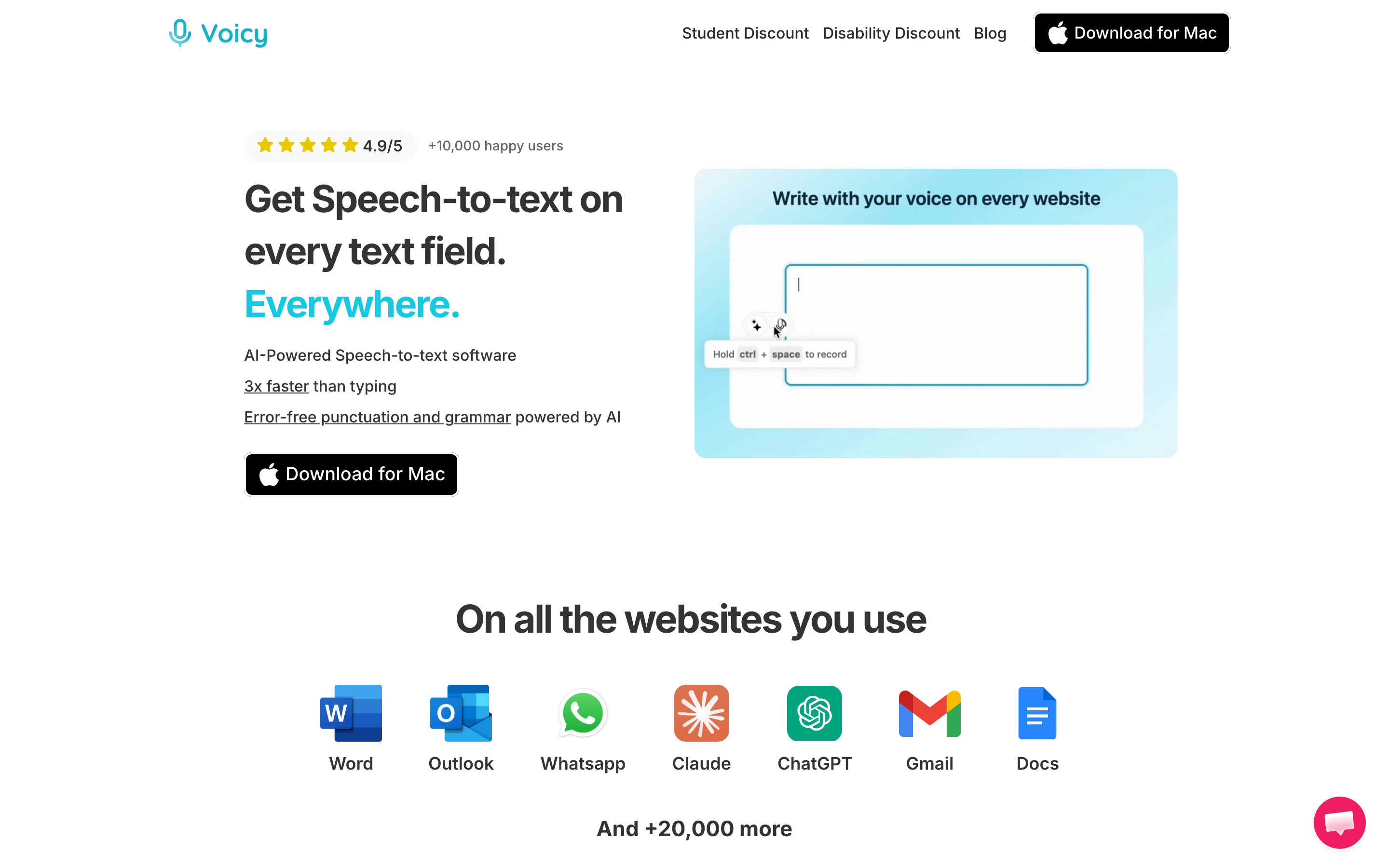
Voicy is a cross-platform dictation app (Mac, Windows, Linux, a Chrome extension, and — since spring 2026 — iPhone and Android) from solo founder Kourosh Ghaffari, operating through UAE free-zone entity Pishi LLC FZ. Architecturally, Voicy is a thin client over Groq's cloud inference: it does not run its own speech model, on your device or anywhere else.
Per the security policy (v1.3), the transcription path works like this:
- Capture: microphone audio is recorded locally on your device.
- First hop — Voicy: audio is encrypted in transit (TLS 1.3) and transmitted to Voicy's servers, hosted on Heroku in the USA.
- Second hop — Groq: audio is “immediately forwarded to Groq.com, which hosts the open-source Whisper V3 transcription model.” The privacy policy adds that AI-command post-processing runs on Groq too: “The transcription and post-processing steps are done through Groq.com.”
- Return: the transcript comes back through Voicy to your device, where it is typed into the active field. Per the homepage: “Your transcripts are only stored on your device locally.”
Alongside the dictation path, Voicy names Mixpanel for anonymous usage analytics (opt-out available) — a side-channel that carries usage events, not audio.
Two implications follow. First, your effective privacy is the intersection of Voicy's handling and Groq's handling — the same two-perimeter structure we flagged for VoiceDash, except Voicy's path crosses its own servers as well rather than going provider-direct. Second, there is no offline fallback and no on-device option at any price: when your connection drops, dictation stops, and when your content is sensitive, it still makes the round trip. For the architectural alternatives, see our cloud vs local dictation guide.
What Voicy's Policies Actually Say — and Where They Say It
Voicy's documentation splits across three surfaces, and the split is the story.
- The security policy (usevoicy.com/legal-pages/security) is the strongest document: versioned (1.3), dated (July 31, 2025), names the entity (Pishi LLC FZ), names the subprocessors (Groq, Mixpanel, Heroku), and carries the two deletion commitments quoted above. It also states that only email and name are collected for billing, and that account data lives on your device rather than in a central user database.
- The privacy policy (usevoicy.com/legal-pages/privacy-policy) repeats the no-storage commitments — “We do not store any recording or transcription data” — and adds the most important new claim since our original review: “The Groq API does not retain any information we send it as we have enabled their Zero Data Retention settings.” But the document has no version number, no effective date, no entity name, and no GDPR or CCPA language.
- The marketing surfaces carry the promise buyers ask about most — “We do not use your recordings to train an AI model” — which appears on the homepage but in neither policy.
The ZDR claim deserves a careful read, because it is both genuinely meaningful and structurally weak. Groq's own data documentation confirms that audio endpoints default to retaining data for up to 30 days for reliability and abuse monitoring, and that customers can enable Zero Data Retention in their account's data controls. So Voicy's claim maps to a real Groq feature — and if enabled, it makes the “deleted immediately” promise coherent end-to-end. But whether ZDR is actually switched on for Voicy's account is knowable only to Voicy and Groq: it is self-attested, unaudited, and could change without any visible sign. That is the recurring pattern in this investigation: the promises are good; the verification surface is thin.
Also worth stating plainly: Voicy publishes no terms of service at all — the site's legal pages are Privacy, Refund (7-day, no-questions-asked), and Support. For a paid product, the absence of terms is unusual and matters for anyone buying the $260 lifetime plan.
The Paperwork Gap: Strong Promises in the Wrong Places
Map each promise to the document that carries it and the pattern becomes visible: the commitments that would matter most in a dispute are the ones sitting furthest from binding text.
- The no-training claim is marketing-only. A privacy-conscious buyer's first question — does my voice train your models? — is answered on the homepage but in neither governing document. Marketing pages change without notice and carry no version history. The fix would take one sentence in the privacy policy; as of July 2026 that sentence does not exist.
- The security policy is frozen while the product moves. Version 1.3 is dated July 31, 2025 — eleven months old — and its scope section covers the Mac, Windows, Linux, and Chrome extension apps. Voicy shipped an iPhone app in April 2026 and an Android app alongside it. No published security policy covers either. The mobile privacy story exists only as app-store labels.
- And those store labels disagree. Apple's privacy label for Voicy declares Audio Data is collected (in the “Data Not Linked to You” category, which is consistent with transient processing). Google Play's Data Safety section declares no audio collected and “no data shared with third parties” — despite audio transiting Voicy's and Groq's servers by design. At least one of those disclosures is wrong, and neither is backed by a policy document.
- Health-adjacent marketing has drifted. To Voicy's credit, its policies make no HIPAA claim. But one Voicy blog FAQ (July 2026) asserts that general-purpose tools like Voicy “offer medical-grade security for healthcare applications,” while another Voicy post published the same day says the opposite — “do not treat it like a healthcare compliance product.” The second post is right: with no SOC 2, no ISO 27001, and no BAA, there is no such thing as medical-grade security here.
None of this pattern says Voicy is doing anything wrong with your audio. It says the documentation discipline hasn't kept up with the product's growth — and for a safety assessment, documentation is most of what an outsider can check.
The Voicy Safety Decision Tree
Use the Voicy Safety Decision Tree to decide whether Voicy is safe enough for your situation. Work through the five questions in order and stop at the first one where you cannot accept the answer Voicy currently gives.
- Are you dictating only general, non-sensitive content (drafts, emails, notes)? If yes — Voicy is a defensible cloud tool: the deletion promises are specific, the subprocessor is named, and no incidents are on record. Continue only if your content or environment is more demanding.
- Do you need offline, air-gapped, or no-transmission dictation? If yes — Voicy cannot do this at any tier. Every dictation requires the round trip to Voicy and Groq. Use an on-device tool. If no, continue.
- Are you comfortable trusting two US-hosted perimeters, with Groq's Zero Data Retention taken on Voicy's word? If yes — read both Voicy's policies and Groq's data documentation, since your effective privacy is their intersection. If you want the training promise in binding text before you trust it, note that it currently isn't there. If you want a single policy to evaluate, continue.
- Are you dictating from the iPhone or Android app? If yes — know that the published security policy predates and does not cover the mobile apps, and the two stores' disclosure labels disagree. Ask Voicy in writing which commitments apply to mobile before using it for anything sensitive. If you're on desktop, continue.
- Is your content under HIPAA, attorney-client privilege, NDA, or compliance audit? If yes — Voicy is disqualified: no SOC 2, no ISO 27001, no HIPAA BAA, and no terms of service to negotiate. Use the HIPAA pathway or on-device dictation. If no, Voicy is acceptable for your work.
The pattern: Voicy clears the everyday-use bar comfortably — better than several indie cloud peers — and stops hard at the verification and compliance bar, like every unaudited cloud tool.
Voicy's setup shows two of the six clauses at once: a no-training promise that lives only on the homepage, and a zero-retention setting held at a subprocessor rather than by the app itself. Both are covered in zero data retention explained.
Cross-Product Privacy Posture Comparison
Voicy sits on the cloud side of the dictation privacy spectrum, with better deletion documentation than most indie peers but weaker placement of the promises that matter. Here is the peer picture from this investigation series.
| Product | Data Path | Subprocessors | Training Stance | Verdict for Sensitive Work |
|---|---|---|---|---|
| Voibe | On-device on Apple Silicon | None | No training — nothing transmitted | Strong (no cloud surface) |
| VoiceInk | On-device by default (open-source GPL v3) | None by default; BYOK opt-in | No server path by design | Strong (auditable code) |
| Handy | On-device (open-source MIT) | None; no cloud STT path exists | No server path by design | Strong (auditable code) |
| Voicy | Cloud-only via Voicy servers → Groq | Groq + Mixpanel + Heroku (named) | Marketing-page claim only; both policies silent | Everyday use only; no audit, no BAA |
| VoiceDash | Cloud-only, provider-direct to OpenAI | OpenAI (named) | Written no-training claim in policy surfaces | Everyday use only; no audit |
| Blip AI | Cloud-only (GPT-powered) | Not named | Silent | Verify in writing before regulated use |
| Wispr Flow | Cloud-only | Disclosed (Baseten, OpenAI, Anthropic, Cerebras, AWS) | Opt-out available; audited controls | Acceptable with BAA (SOC 2 II + ISO 27001 + HIPAA BAA) |
The instructive contrast is Voicy vs VoiceDash: both are young, solo-founder, cloud-only tools with favorable deletion claims. VoiceDash puts its no-training commitment in its policy surfaces and routes provider-direct; Voicy's equivalent commitment lives on its homepage while its policies stay silent, and its path crosses its own servers first. Against the audited end of the field, Wispr Flow's SOC 2 and HIPAA BAA show what closing the verification gap actually looks like — see Is Wispr Flow Safe?. For the full cross-tool matrix across 30 AI tools, see our AI Privacy Tracker.
Compliance: No SOC 2, No HIPAA BAA, No Named Framework
Voicy's compliance posture is quickly summarized: there isn't one, and — in its binding documents — it doesn't claim one.
- No attestations. No SOC 2 Type II report, no ISO 27001 certificate, no HIPAA Business Associate Agreement, and no independent security audit of any kind is published or referenced anywhere on usevoicy.com.
- No named framework. The security policy's compliance section cites “adherence to international data protection standards” without naming GDPR, CCPA, or any other framework. The privacy policy contains no data-subject-rights language at all — no access, deletion, or portability process is described beyond emailing the founder.
- EU transfers are undocumented. Every dictation is a transfer to US infrastructure (Heroku, Groq). Neither policy documents a lawful-transfer mechanism — Standard Contractual Clauses, the EU-US Data Privacy Framework, or otherwise. EU users handling personal data under GDPR would need this clarified in writing before production use.
- For healthcare and legal work, the answer is already no. Without a BAA there is no lawful way to route PHI through Voicy, and without any attestation a law firm's security review has nothing to review. Our doctors and lawyers guides cover the tools that clear those bars — architecturally or contractually.
Credit where due: unlike some young cloud peers, Voicy's policies do not market compliance they can't back — no HIPAA badge, no “SOC 2 in progress.” The one blemish is the blog's “medical-grade security” line, which its own sibling post contradicts. Treat the policies as the truth: Voicy is a consumer-grade cloud tool, and it should carry consumer-grade content.
The Five-Step Voicy Safety Audit
Run this five-step audit before committing Voicy to any work where data handling matters. Each step takes 2–15 minutes.
- Read both Voicy documents and note which promise lives where. Open the security policy and the privacy policy, and confirm the deletion commitments still read as quoted here. Note that the no-training promise appears on the homepage only — if that placement matters to you, ask Voicy to confirm it in writing.
- Read Groq's data documentation too. Your audio's second perimeter runs on Groq. Confirm Groq's default retention (up to 30 days on audio endpoints) and understand that Voicy's Zero Data Retention claim is an account setting you cannot see. If ZDR matters for your use, request written confirmation from Voicy that it is enabled.
- If you're on mobile, ask what applies. The security policy's scope predates the iPhone and Android apps, and the Apple and Google disclosure labels disagree about audio collection. Email Voicy support and ask which security commitments cover the mobile apps before dictating anything sensitive from a phone.
- Opt out of analytics if that matters to you. Voicy names Mixpanel for anonymous usage analytics with an opt-out available. Usage events are not audio, but if minimal telemetry is your standard, exercise the opt-out.
- Apply the regulated-content disqualifier. PHI, privileged material, NDA-bound source, or compliance-audited content: Voicy is out — no SOC 2, no ISO 27001, no BAA, no terms of service. Use the HIPAA pathway or on-device dictation, and accept that a network monitor like Little Snitch will always show outbound traffic during Voicy dictation, because the architecture requires it.
If any step fails or feels uncomfortable, the fix is architectural: on-device tools have no Voicy perimeter and no Groq perimeter to audit, because the audio never leaves your machine.
Voibe: On-Device, No Second Perimeter
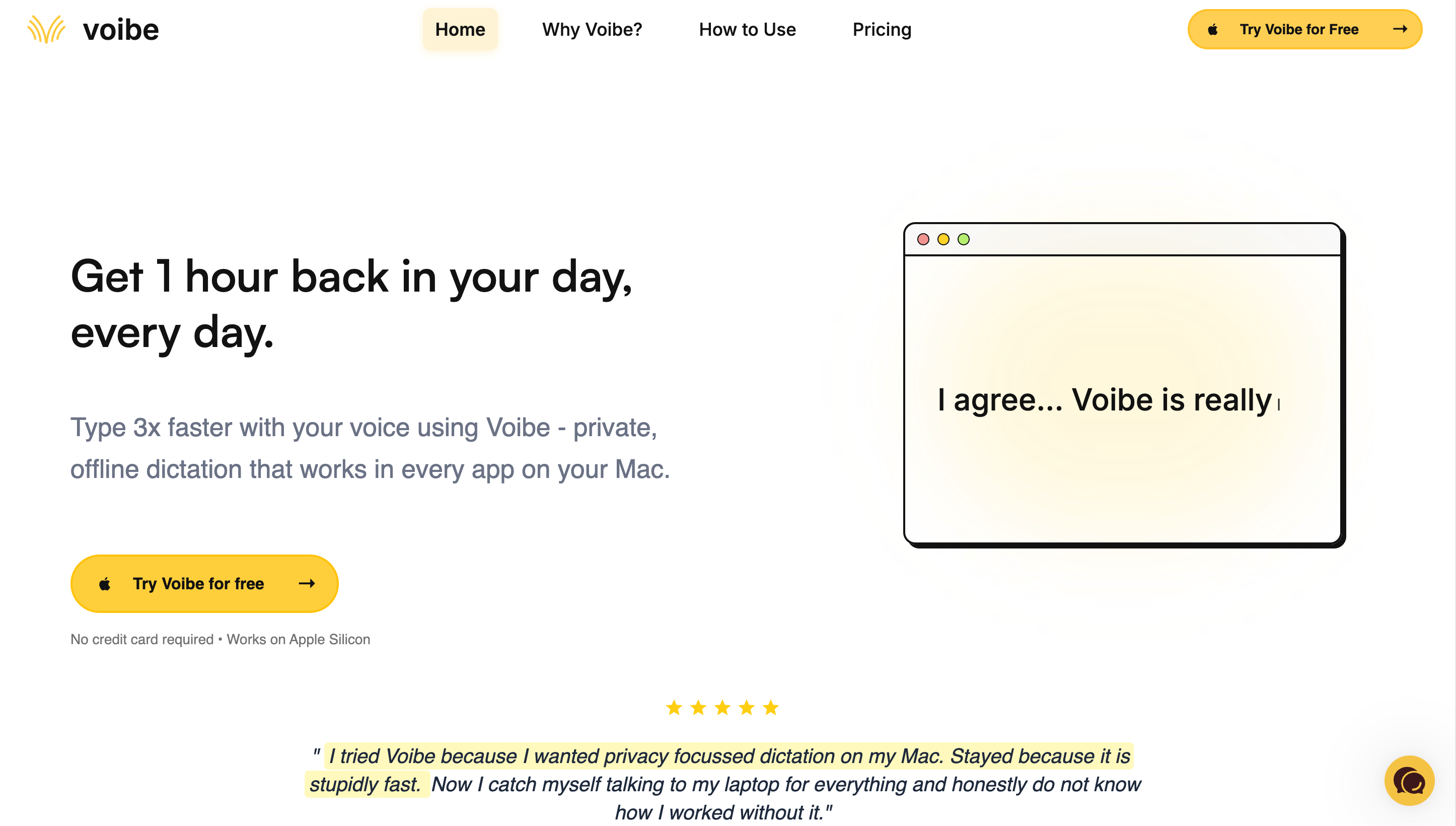
Voibe's on-device mode is built around one architectural principle: your audio never leaves the device. Voibe runs OpenAI Whisper models locally on Apple Silicon's Neural Engine — the same model family Groq hosts for Voicy, minus the network. When you press your hotkey, audio is captured into memory, transcribed on-device, typed into the active field, and discarded.
Mapped against the Voicy questions raised above:
- Perimeters. Zero. There is no Voicy-style server hop and no Groq in the path — no intersection of two policies to evaluate, and no self-attested ZDR setting to take on faith.
- Retention. Nothing is transmitted, so there is nothing server-side to delete. Per Voibe's privacy policy: “The Voibe application processes your voice entirely on your device. No audio is transmitted to our servers at any point.”
- Training. Voibe does not train AI on your dictation — committed in writing, not on a marketing page that both policies decline to repeat.
- Offline. Voibe's on-device mode works with no internet connection — planes, secure facilities, dead Wi-Fi — because the transcription model runs on your own Apple Silicon Mac and never makes a network call. Voicy's architecture cannot offer this at any price.
- Verification. Run Little Snitch during a Voibe dictation session: outbound traffic during transcription is zero. That is the test no cloud tool can pass.
Pricing: $7.50/month, $59/year, or $149 lifetime for unlimited on-device dictation on Apple Silicon Macs, all features at every tier. Against Voicy's $260 lifetime, Voibe's $149 lifetime is $111 less (43% cheaper) — with the privacy question removed rather than promised away. For the full cost math, see our Voicy pricing guide and Voicy alternatives.
Try Voibe for Free — install, grant microphone and accessibility permissions, and dictate. No account, no credit card, no cloud, no second perimeter.
Related Reading
- Voicy Review (2026) — Full hands-on review: the Groq backend, cross-platform reach, and the 7/10 verdict.
- Voicy Pricing (2026) — $8.49/mo, the $260 lifetime, the new Teams tier, and 3-year cost math.
- Best Voicy Alternatives (2026) — On-device and audited options with a decision tree.
- Voicy vs Wispr Flow — Head-to-head: indie cloud vs audited cloud.
- Is VoiceDash Safe? — Sibling investigation: the provider-direct indie cloud peer with policy-level commitments.
- Is Blip AI Safe? — Sibling investigation: strong claims with thin verification.
- Is Wispr Flow Safe? — Sibling investigation: the audited cloud peer (SOC 2 + HIPAA BAA).
- Is Wisprtype Safe? — Sibling investigation: local-by-default but closed-source.
- Is VoiceInk Safe? — Sibling investigation: the open-source on-device peer.
- Is Handy Safe? — Sibling investigation: the free MIT-licensed local tool.
- AI Privacy Tracker — Cross-tool privacy posture comparison across 30 AI tools, including Groq-adjacent providers.
- Cloud vs Local Dictation — Architectural framing for the privacy question.
- HIPAA Dictation Guide — The clinical pathway for protected health information.
- Voice Data Privacy — Pillar with deeper privacy frameworks.
- Zero Data Retention Explained — marketing-page promises, the subprocessor gap, and a ten-minute verification test.
Frequently Asked Questions
Is Voicy safe to use in 2026?
Does Voicy store your voice recordings or transcripts?
Does Voicy use your dictation to train AI?
Where does Voicy send your audio?
Does Voicy work offline or on-device?
Is Voicy HIPAA compliant?
Are the Voicy iPhone and Android apps covered by its security policy?
Who is behind Voicy, and is the company established?
How does Voicy compare to Voibe on privacy?
Best AI Dictation and Meeting Notes for Confidential Work
Draft letters, notes and emails 5x faster. Get meeting notes without a bot joining your call. Nothing used to train AI.
- Mac + Windows
- No bot in your calls
- Nothing used to train AI
- 7-day free trial
Want to compare plans first? View pricing →
Related Articles
Is Blip AI Safe? Cloud Privacy & HIPAA Verdict (2026)
Is Blip AI safe? It's cloud-only; its policy claims audio is deleted in seconds and HIPAA with a BAA on request, but no published SOC 2 audit backs it.
Is VoiceDash Safe? Cloud Privacy, OpenAI & Verdict (2026)
Is VoiceDash safe? It's cloud-only, routing audio through OpenAI's API. Its policy promises no storage and no training, but there's no SOC 2 or HIPAA audit.
Is VoiceInk Safe? Open-Source, On-Device Verdict (2026)
Is VoiceInk safe? Yes — GPL v3 open-source, on-device by default, zero telemetry found in a source audit. Nuances: BYOK cloud opt-in and local history.