
Is Blip AI Safe? Cloud Privacy & HIPAA Verdict (2026)
Is Blip AI safe? It's cloud-only; its policy claims audio is deleted in seconds and HIPAA with a BAA on request, but no published SOC 2 audit backs it.

Is Blip AI Safe? The Direct Answer
TL;DR: Blip AI's privacy policy makes strong, privacy-friendly commitments — it states that voice audio is deleted immediately after transcription (typically within seconds), that transcribed text is not stored on its servers and is only delivered to your device, and that Blip AI is HIPAA compliant with a Business Associate Agreement (BAA) available on request. Those are the right things to say. The problem is everything you cannot verify behind them.
Three structural facts keep Blip AI short of verifiably safe for sensitive work:
- It is cloud-only by architecture. Every dictation transmits your audio to remote servers for GPT-powered processing. There is no on-device or offline mode. The "deleted in seconds" promise is a policy commitment about what happens after your audio arrives — not a guarantee that it never leaves your Mac.
- The compliance claims have no published third-party backing. Blip AI markets HIPAA compliance but publishes no SOC 2 Type II report, no ISO 27001 certification, and no named auditor, and the BAA is "available on request" with no public terms. It is a bootstrapped product that launched in October 2025 with a 1–10-person team — roughly eight months of track record behind a healthcare-grade claim.
- The policy does not name its subprocessors or address AI training. Because Blip AI is GPT-powered, at least one third-party model provider sits in the audio path — the policy does not name it. And unlike Wispr Flow, Typeless, and Superwhisper, Blip AI's policy does not make an explicit commitment that your dictation is not used to train models.
So: for drafts, emails, notes, and AI prompts, Blip AI is a reasonable cloud dictation tool, and its retention claims are better than many peers'. For protected health information, attorney-client-privileged work, or NDA-bound material, the claims outrun the independent verification a regulated buyer needs — get the signed BAA and subprocessor list in writing first. If you want the question to disappear entirely, Voibe's on-device mode transmits no audio at all — per Voibe's privacy policy, “the Voibe application processes your voice entirely on your device. No audio is transmitted to our servers at any point.” — and its private cloud mode runs open-source models only with zero retention. Either way, your audio and text are never stored, sold, or used to train any AI model.
Disclosure: Voibe is our product. This investigation covers Blip AI's genuine privacy strengths and its specific verification gaps as fairly as possible. Blip AI's policy claims are attributed to its published privacy policy at blipai.app/privacy as retrieved June 2026; company and pricing facts are grounded in our own Blip AI review and pricing guide. Re-verify the live policy and any BAA before relying on it for regulated work.
Key Takeaway
Blip AI's privacy policy says the right things — audio deleted in seconds, transcripts not stored, HIPAA with a BAA on request — but it is cloud-only by architecture, has no published SOC 2 audit behind the HIPAA claim, does not name its subprocessors, and is silent on AI training. Fine for general content; verify in writing before any regulated use, or use an on-device tool that never transmits audio.
Key Takeaways: The Blip AI Safety Picture
| Area | Current State (June 2026) | Source |
|---|---|---|
| Processing architecture | Cloud-only. Every dictation transmits audio to remote servers. No on-device or offline mode. | blipai.app + our Blip AI review |
| Audio retention | Voice audio deleted immediately after transcription (typically within seconds) per policy. | blipai.app/privacy |
| Transcript storage | Transcribed text not stored on servers; only delivered to your device per policy. | blipai.app/privacy |
| Analytics retention | Anonymized usage statistics retained up to 2 years. | blipai.app/privacy |
| HIPAA | Marketed as HIPAA compliant; BAA "available on request." No public BAA terms. | blipai.app/privacy |
| SOC 2 Type II | Not published. Not referenced in policy. | blipai.app/privacy |
| ISO 27001 | Not published. Not referenced. | blipai.app/privacy |
| AI training stance | Not addressed in policy. No explicit no-training commitment (peers Wispr Flow / Typeless / Superwhisper do address it). | blipai.app/privacy |
| Subprocessors | Not named. Policy says third parties are "vetted" and bound by confidentiality. GPT-powered implies an LLM provider in the path. | blipai.app/privacy |
| Company entity | Bootstrapped, 1–10 employees, founded Oct 2025 (Ayush Bansal, Bilaspur, India). | our Blip AI review |
| Contact | privacy@blipai.app | blipai.app/privacy |
| Third-party ratings | AppSumo 5.0/5 (43 reviews, all 5-star); Trustpilot 4.0/5 (3 reviews) as of Apr 2026. No independent press. | AppSumo + Trustpilot |
| Public breach incidents | None reported. | Public sources, June 2026 |
| Privacy alternative | On-device dictation (Voibe, VoiceInk, MacWhisper) eliminates the cloud surface entirely. | Architectural comparison |
Here is each row: how Blip AI processes your voice, what the privacy policy does and does not commit to, the claim-versus-verification gap, a five-question Blip AI Safety Decision Tree, a cross-product comparison, and a five-step Blip AI Safety Audit you can run yourself.
How Blip AI Processes Your Voice: Cloud-Only by Architecture
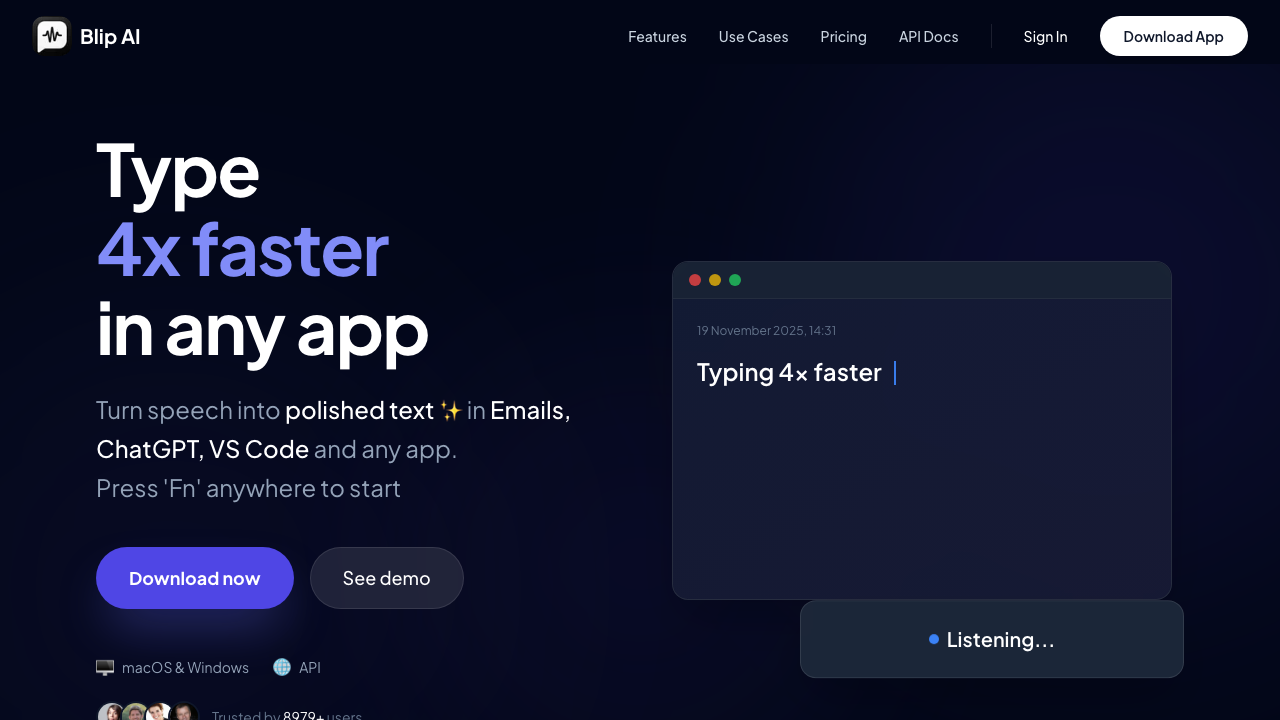
Blip AI is cloud-only. There is no on-device processing option and no way to dictate without an internet connection. Understanding the data path is the foundation for every safety question that follows.
On each dictation, the flow is:
- Capture. Your microphone records audio on your device when you trigger Blip AI's system-wide hotkey.
- Transmit. That audio is sent across the internet to Blip AI's cloud servers. This is the step on-device tools never take.
- Process. Blip AI's GPT-powered pipeline transcribes the audio, removes filler words, and applies smart formatting. Because the product is GPT-powered, at least one third-party model provider participates in this step.
- Return and discard. The transcribed text is returned to your device. Blip AI's privacy policy states the voice audio is then deleted immediately after transcription — typically within seconds — and that the transcribed text is not stored on its servers.
This architecture has three practical consequences:
- Your audio always leaves your device. Even with a strong deletion policy, the audio is transmitted and processed off-device on every use. The privacy guarantee is contractual (the policy), not architectural (the data never moving).
- No internet means no dictation. Planes, secure or air-gapped facilities, and low-connectivity areas break Blip AI entirely. On-device tools like Voibe and other offline dictation apps keep working because the speech model runs on your hardware.
- Trust extends to unnamed third parties. The GPT provider and any infrastructure hosts in the path each handle your audio. Blip AI's policy says third-party services are vetted and bound by confidentiality but does not name them, so you are extending trust to parties you cannot enumerate.
For the deeper architectural framing, see our cloud vs local dictation comparison and why offline dictation matters.
What Blip AI's Privacy Policy Actually Says
Blip AI's privacy policy is more favorable in its commitments than many indie dictation policies — and notably thinner in its third-party verification. Here is what it documents and what it leaves silent, attributed to the policy as retrieved in June 2026.
What the Policy Documents
- Audio is deleted immediately after transcription. Blip AI states voice audio is deleted typically within seconds of being transcribed. This is the load-bearing favorable claim.
- Transcripts are not stored on the servers. The transcribed text is delivered to your device and, per the policy, not retained server-side.
- HIPAA compliance with a BAA on request. The policy states Blip AI is HIPAA compliant for healthcare professionals and that a Business Associate Agreement is available upon request.
- Third parties are "vetted." The policy states third-party services are vetted for security and privacy compliance and are bound by confidentiality agreements.
- Analytics retention. Anonymized usage statistics are retained for up to two years.
- Contact.
privacy@blipai.app.
What the Policy Does Not Document
- No named subprocessors. The policy references third-party services generically but does not name them. The product is GPT-powered, so at least one LLM model provider processes your audio — that provider, and any infrastructure hosts, are not enumerated.
- No AI-training commitment. The policy does not state whether your dictation is used to train models. Peers Wispr Flow, Typeless, and Superwhisper address training explicitly; Blip AI's policy is silent.
- No SOC 2 / ISO 27001 / external audit. No third-party attestation is referenced, and no auditor is named — notable specifically because HIPAA is marketed.
- No public BAA terms. The BAA is "available on request" with no published scope, so a buyer cannot evaluate it before contacting the company.
- No corporate entity or jurisdiction in the policy text. The privacy policy provides a contact email but does not, in its text, establish a named legal entity or country of registration; company details come from Blip AI's own marketing and our review (founded October 2025, Bilaspur, India).
- No retention windows beyond analytics. "Deleted within seconds" and "not stored" frame retention, but processing-window and log-retention specifics are not quantified.
What the Gaps Mean in Practice
The combination of favorable retention claims, a marketed HIPAA posture, and the absence of any external audit or named subprocessor produces a documentation posture that is:
- Adequate for general consumer dictation — drafts, emails, notes, AI prompts, casual messages.
- Insufficient on its own for regulated or compliance-audited work — HIPAA-covered PHI, attorney-client privilege, NDA-bound source code, SOC 2-required procurement — until the BAA, audit, and subprocessor list are obtained in writing.
- Dependent on vendor youth. An eight-month-old, 1–10-person bootstrapped company has not yet demonstrated how it handles a breach, a subpoena, a policy revision, or an acquisition.
Warning
Blip AI's privacy policy says favorable things — audio deleted in seconds, transcripts not stored, HIPAA with a BAA on request — but names no subprocessors, publishes no SOC 2 or ISO audit, and is silent on AI training. For regulated work, request the signed BAA, the audit documentation, and the subprocessor list in writing at privacy@blipai.app before dictating any sensitive content.
The Claim-vs-Verification Gap: Three Structural Caveats
Blip AI's safety question is not "does the policy say good things" — it does. The question is how much of what the policy claims you can independently verify. Three structural caveats define that gap.
Caveat 1: Cloud-Only Means the Promise Is Contractual, Not Architectural
Because Blip AI transmits audio to remote servers on every dictation, the "deleted in seconds" and "not stored" commitments are promises about server behavior you cannot observe. They may well be honored — but they are enforced by the privacy policy and the company's controls, not by the data physically never leaving your Mac. On-device dictation inverts this: with Voibe, VoiceInk, or MacWhisper, there is no server-side copy to delete because the audio is never transmitted. Contractual privacy depends on the contract holding; architectural privacy does not.
Caveat 2: HIPAA and BAA Are Claimed Without Published Audit
Blip AI markets HIPAA compliance and a BAA on request. For a cloud vendor, HIPAA compliance is established by a signed BAA plus the security program behind it — and the standard evidence of that program is a SOC 2 Type II report from a named auditor. Blip AI publishes neither a SOC 2 report nor an ISO 27001 certification, and the BAA terms are not public. Combined with the company's youth (launched October 2025, 1–10 people), this means a healthcare buyer is being asked to accept a healthcare-grade claim on the vendor's word. That is not a reason to assume the claim is false — it is a reason to require the documentation before trusting it with PHI. For a cloud peer that does publish SOC 2 Type II, ISO 27001:2022, and a HIPAA BAA, see our is Wispr Flow safe investigation; for the clinical pathway, see our dictation and HIPAA guide.
Caveat 3: Unnamed Subprocessors and Silence on Training
Blip AI is GPT-powered, which means your audio passes through at least one third-party model provider. The privacy policy does not name that provider or any other subprocessor, and it does not state whether your dictation is used to train AI models. The favorable retention claims would, if accurate, limit training exposure — but silence is a documentation gap, not a commitment. This mirrors the training-silence finding in our is Aqua Voice safe investigation, where a cloud dictation policy similarly declined to address training while peers addressed it directly. The mitigation is the same: ask, in writing, which providers process your audio and whether it trains any model.
The Company-Maturity Context
None of these caveats means Blip AI is unsafe — it means the claims rest on a young vendor's word rather than on independent verification. Per our Blip AI review, the product launched in October 2025, is bootstrapped with a 1–10-person team, and has thin and skewed third-party validation (a perfect 5.0/5 across 43 AppSumo reviews, which is unusual for a product this new, and 4.0/5 from three Trustpilot reviews as of April 2026, with no independent tech-press coverage). Maturity is the variable that turns favorable claims into trustworthy ones over time; Blip AI has not had that time yet.
The Blip AI Safety Decision Tree
Use the Blip AI Safety Decision Tree to decide whether Blip AI is safe enough for your specific situation. Work through the five questions in order and stop at the first one where you cannot accept the answer Blip AI currently provides.
- Are you dictating only general, non-sensitive content (drafts, emails, notes, AI prompts, casual messages)? If yes — Blip AI is a reasonable cloud dictation tool, and its retention claims are favorable. Continue only if your content is sensitive or your environment is constrained.
- Do you need to dictate offline, in an air-gapped facility, or without transmitting audio off your device? If yes — Blip AI cannot do this. It is cloud-only with no offline mode. Use an on-device tool (Voibe, VoiceInk, MacWhisper). If no, continue.
- Is your content covered by HIPAA (PHI)? If yes — do not rely on the marketed HIPAA claim alone. Request the signed BAA, the SOC 2 report, and the subprocessor list in writing at
privacy@blipai.appfirst. If you cannot obtain them, Blip AI is disqualified for PHI. If your content is not HIPAA-covered, continue. - Is your content under attorney-client privilege, an NDA, or compliance audit (e.g., proprietary source code, legal drafts)? If yes — the cloud-only path plus unnamed subprocessors and training silence make Blip AI hard to clear; prefer on-device dictation that removes the disclosure surface. If no, Blip AI is acceptable for your work.
- Do you want the safety question to disappear entirely? If yes — on-device dictation tools like Voibe never transmit audio, so there is no policy to trust, no subprocessor to audit, and no BAA to chase. Audio is processed on Apple Silicon and discarded locally.
The pattern: Blip AI answers questions 1 well and degrades as the content gets more sensitive or the environment gets more constrained. By question 3, the absence of published audit documentation turns the marketed HIPAA claim into a homework assignment; by question 5, architecture beats policy.
Blip AI's claims are strong and its verification is thin, which is exactly the pattern the five-question zero-retention test is designed to surface — starting with whether the promise lives in a dated policy or only on the marketing page.
Cross-Product Privacy Posture Comparison
Blip AI sits firmly on the cloud side of the dictation privacy spectrum. Here is how it compares against the peer postures we have investigated across this series.
| Product | Data Path | Subprocessors | Compliance | Verdict for Sensitive Work |
|---|---|---|---|---|
| Voibe | On-device (Apple Silicon) or private cloud — your choice | None on-device; open-weight models only in cloud | Zero retention, never trained on | Strong (fully on-device mode available) |
| VoiceInk | On-device on Apple Silicon | None | Open-source GPL v3 | Strong (auditable code) |
| Blip AI | Cloud only (GPT-powered) | Not named in policy | HIPAA marketed; no SOC 2 / ISO published; training silence | Verify in writing before regulated use |
| Wispr Flow | Cloud only | Disclosed publicly (Baseten + OpenAI + Anthropic + Cerebras + AWS) | SOC 2 II + ISO 27001:2022 + HIPAA BAA available | Acceptable with BAA / Privacy Mode |
| Willow Voice | Cloud-first (Offline Mode optional) | Not publicly disclosed | Private Mode default opt-out; HIPAA marketed but not in policy | Strong default; documentation gaps |
| Aqua Voice | Cloud only | SOC 2 named partners | SOC 2 Type II; training silence in policy | Acceptable for general work; policy gaps |
| Superwhisper (on-device) | On-device on Apple Silicon | None | No external attestation | Strong; local audio recording default ON is a separate issue |
The standout difference: Blip AI markets HIPAA without publishing the audit trail that peers like Wispr Flow do, and unlike Wispr Flow it does not name its subprocessors. That places Blip AI's documented posture weaker than the audited cloud peers, even though its headline retention claims (audio deleted in seconds, transcripts not stored) read favorably. For the full cross-tool matrix across 30 AI tools, see our AI Privacy Tracker.
Architecture vs Audit: Why a Cloud Policy Is Only as Strong as Its Documentation
Blip AI is a clear case of the deeper category lesson behind every "is X safe?" question: there is a difference between architectural privacy and audited privacy — and Blip AI currently offers neither in full. It is not architectural, because audio leaves the device. And it is not fully audited, because no SOC 2 or ISO report backs the marketed compliance. What it offers is policy privacy: favorable claims you are asked to take on trust.
Five things architectural privacy delivers that policy privacy cannot:
- Survives a policy change. A privacy policy can be revised with notice. Audio that never crosses your network boundary cannot be re-classified by a future revision. Blip AI's favorable claims are roughly eight months old, with no history of revisions to judge them by.
- Survives a subprocessor incident. The unnamed GPT provider and any hosting partners each represent a separate breach surface. On-device processing has zero subprocessors for dictation audio.
- Survives an acquisition. A bootstrapped, 1–10-person company can change hands, and new ownership can bring new data postures. On-device data has nothing to transfer.
- Survives a documentation gap. The current policy does not name subprocessors, address training, or publish BAA terms. Decisions made under that uncertainty depend on the gap staying benign. On-device dictation has nothing to document.
- Survives legal compulsion. A subpoena can compel a vendor to preserve data it would normally discard. On-device processing removes the vector — there is no transmitted copy to preserve, and the vendor cannot produce what it never received.
None of this makes Blip AI unusable — for general content it is a reasonable, affordable, cross-platform tool, and its retention claims are better than several peers'. It means Blip AI's privacy is contract-and-trust-driven, and the contract is only as strong as the documentation behind it. For confidential, privileged, regulated, or compliance-audited work, architecture is the stronger guarantee. See our cloud vs local dictation guide for the full framing.
The Five-Step Blip AI Safety Audit
Run this five-step audit before committing Blip AI to any work where data handling matters. Each step takes 2–15 minutes.
- Read the current privacy policy and note its effective date. Open blipai.app/privacy and confirm the retention claims (audio deleted in seconds, transcripts not stored) and the HIPAA language still read as described here. Policies for young products change; verify rather than assume.
- If your work is HIPAA-covered, demand the documentation before any PHI. Email
privacy@blipai.appand request the signed Business Associate Agreement and any SOC 2 Type II report or security documentation in writing. A marketed HIPAA claim is not a substitute for a signed BAA and the controls behind it. If you cannot obtain them, do not dictate PHI into Blip AI. - Ask which third parties process your audio and whether it trains models. Because Blip AI is GPT-powered, at least one model provider sees your audio. Ask Blip AI to name its subprocessors and to confirm, in writing, that your dictation is not used for AI training. Treat silence as an open risk, not a clearance.
- Apply the regulated-content disqualifier. If your dictation includes PHI, attorney-client-privileged material, NDA-bound source code, or compliance-audited content, and steps 2 and 3 do not produce satisfactory documentation, treat Blip AI as disqualified for that work. Use Dragon Medical One (signed BAA), a dedicated medical-scribe product, or on-device dictation instead.
- Accept that there is no offline fallback. Blip AI cannot operate without transmitting audio, so a network monitor like Little Snitch will always show outbound calls during dictation — that is expected for a cloud tool, and it is exactly the surface on-device tools remove. If your environment requires zero transmission, Blip AI is the wrong tool regardless of the policy.
If any step fails or feels uncomfortable, on-device dictation tools like Voibe eliminate the audit — there is no policy to trust, no subprocessor to enumerate, and no BAA to chase, because the audio never leaves your Mac.
Voibe: On-Device by Architecture, No Cloud to Trust
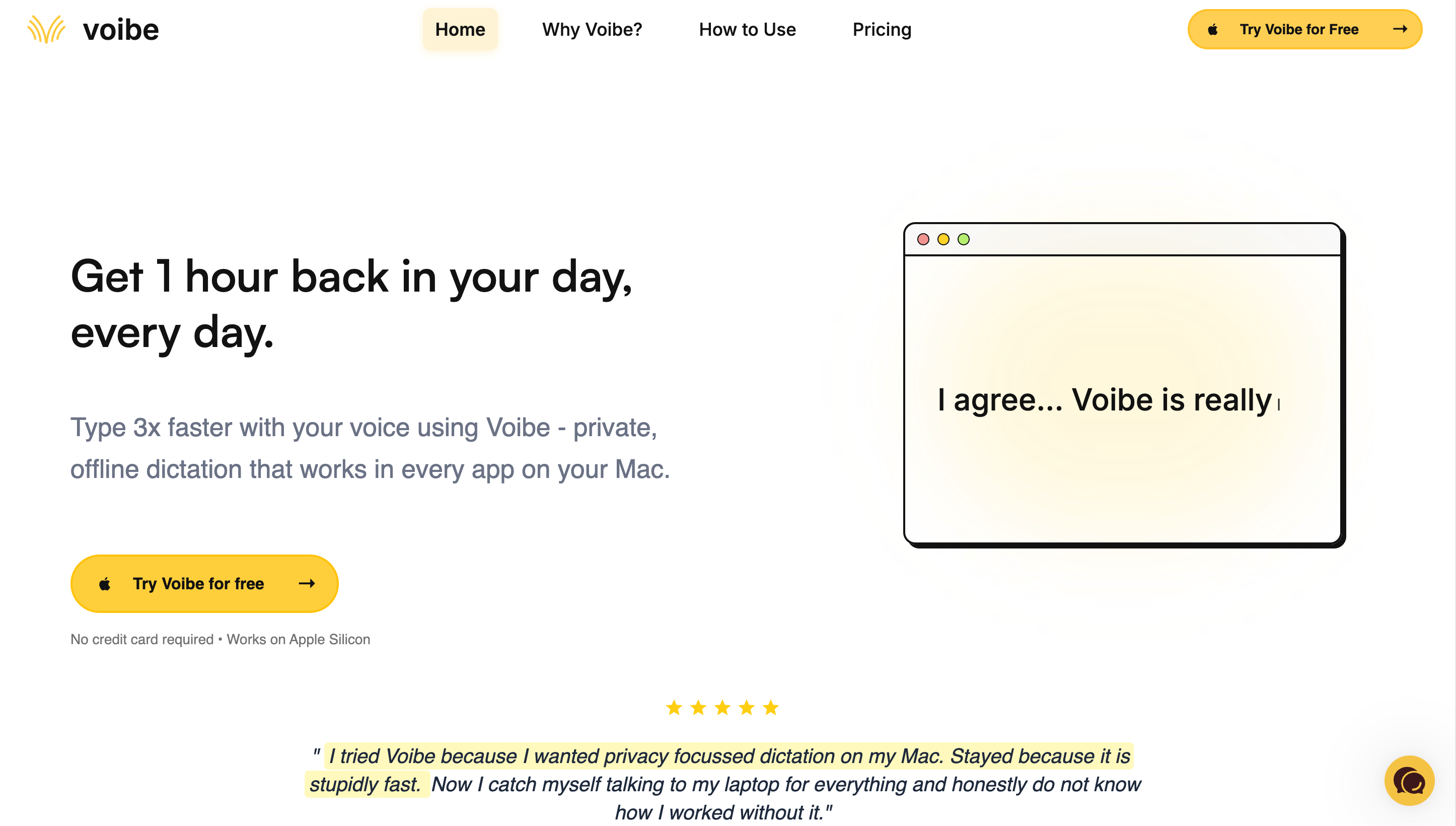
Voibe is a dictation app for Mac and Windows built around user choice: a fully on-device mode where your audio never leaves the Mac, or a private cloud mode that runs only open-source models and is never trained on. In on-device mode, Voibe runs OpenAI Whisper models on Apple Silicon's Neural Engine — audio is captured into memory, transcribed by the local model, written into the active text field, and discarded, with nothing leaving the Mac. In private cloud mode, audio travels over an encrypted connection to Voibe's own infrastructure, runs only open-weight models (Whisper Large Turbo for transcription; GPT-OSS for text refinement), and is deleted the moment transcription completes. No account is required to dictate.
Mapped against the Blip AI questions raised above:
- Architecture. On-device mode processes audio on Apple Silicon locally, with no cloud servers or subprocessor in the path. Private cloud mode uses only open-weight models on Voibe's own infrastructure — no proprietary models from the major labs.
- Retention. Your audio and text are never stored, sold, or used to train any AI model. In on-device mode, nothing is transmitted at all. Per Voibe's privacy policy: “The Voibe application processes your voice entirely on your device. No audio is transmitted to our servers at any point.”
- Training. Voibe never uses your dictation to train any AI model.
- PHI. Voibe's durable promise is zero retention — your audio and text are never stored, sold, or used to train any AI model — with a fully on-device mode available so PHI need not leave the clinical device. See our dictation and HIPAA guide.
- Subprocessors. On-device mode uses none for dictation data; private cloud mode uses only open-weight models on Voibe's own infrastructure.
- Offline. Voibe's on-device mode works with no internet connection — on planes, in secure facilities, anywhere.
- Network monitor. Run Little Snitch during an on-device Voibe dictation session; outbound traffic during transcription is zero.
Pricing: $9.90/month, $99/year, or $199 lifetime for unlimited dictation, with all features included at every paid tier, plus Voibe Free ($0, limited words on one device). Voibe runs on all Macs (Intel and Apple Silicon) and on Windows; the fully on-device mode requires an Apple Silicon Mac (M1 or later). Where Blip AI is a recurring or word-capped cloud plan whose economics depend on per-word server costs, Voibe is a one-time license whose price funds active development — not ad or data revenue. For the full pricing comparison, see our Blip AI pricing guide and Blip AI alternatives.
Try Voibe for Free — install, grant microphone and accessibility permissions, and dictate. No account, no credit card, and your choice of a fully on-device mode or a private, zero-retention cloud that is never trained on.
Related Reading
- Blip AI Review (2026) — Full hands-on review: Action Mode, AppSumo tiers, known bugs, and the honest verdict.
- Blip AI Pricing (2026) — Free tier, Pro, AppSumo lifetime tiers with word caps, and the 3-year cost comparison.
- Best Blip AI Alternatives (2026) — Offline and privacy-first options with a decision tree.
- Blip AI vs Wispr Flow — Head-to-head comparison of the two cloud tools.
- Is VoiceDash Safe? — Sibling investigation for the other young indie cloud peer (opposite documentation approach: transparent, no-training, but no HIPAA claim).
- Is Wispr Flow Safe? — Sibling investigation for the audited cloud peer (SOC 2 + HIPAA BAA).
- Is Aqua Voice Safe? — Sibling investigation for the cloud-only peer with training silence.
- Is Willow Voice Safe? — Sibling investigation for the HIPAA-marketed-vs-policy cloud peer.
- Is Superwhisper Safe? — Sibling investigation for the on-device + cloud peer.
- Is Spokenly Safe? — Sibling investigation for the multi-architecture peer.
- Is Otter Safe? — Sibling investigation for the meeting-transcription peer.
- Is Dragon Safe? — Sibling investigation for the legacy enterprise peer.
- Is Voicy Safe? — Sibling investigation for the Groq-routed cloud peer (no-training promise on marketing pages only).
- Is Wisprtype Safe? — Sibling investigation for the local-by-default, closed-source peer (telemetry shipped on despite the policy).
- Is VoiceInk Safe? — Sibling investigation for the open-source GPL v3 on-device peer (zero telemetry, verified in source).
- Is Handy Safe? — Sibling investigation for the free MIT-licensed local tool (no cloud transcription path at all).
- AI Privacy Tracker — Cross-tool privacy posture comparison across 30 AI tools.
- Cloud vs Local Dictation — Architectural framing for the privacy question.
- HIPAA Dictation Guide — The clinical pathway for protected health information.
- Voice Data Privacy — Pillar with deeper privacy frameworks.
- Zero Data Retention Explained — what the term means, the six clauses that undo it, and a ten-minute test for any voice app.
Frequently Asked Questions
Is Blip AI safe to use in 2026?
Does Blip AI store your voice recordings?
Does Blip AI work offline or process audio on-device?
Is Blip AI HIPAA compliant?
Is Blip AI SOC 2 certified?
Does Blip AI use your dictation to train AI models?
Who is behind Blip AI, and is the company established?
How does Blip AI compare to Voibe on privacy?
What should I check before trusting Blip AI with sensitive data?
Best AI Dictation and Meeting Notes for Confidential Work
Draft letters, notes and emails 5x faster. Get meeting notes without a bot joining your call. Nothing used to train AI.
- Mac + Windows
- No bot in your calls
- Nothing used to train AI
- 7-day free trial
Want to compare plans first? View pricing →
Related Articles
Is Voicy Safe? Groq Cloud Path & Policy Gaps (2026)
Is Voicy safe? It's cloud-only — audio routes through Groq with immediate-deletion promises. But the no-training claim lives on marketing pages, not in policy.
Is VoiceDash Safe? Cloud Privacy, OpenAI & Verdict (2026)
Is VoiceDash safe? It's cloud-only, routing audio through OpenAI's API. Its policy promises no storage and no training, but there's no SOC 2 or HIPAA audit.
Is VoiceInk Safe? Open-Source, On-Device Verdict (2026)
Is VoiceInk safe? Yes — GPL v3 open-source, on-device by default, zero telemetry found in a source audit. Nuances: BYOK cloud opt-in and local history.