
Is VoiceDash Safe? Cloud Privacy, OpenAI & Verdict (2026)
Is VoiceDash safe? It's cloud-only, routing audio through OpenAI's API. Its policy promises no storage and no training, but there's no SOC 2 or HIPAA audit.

Is VoiceDash Safe? The Direct Answer
TL;DR: VoiceDash is among the more transparent indie cloud dictation tools on the privacy question — and that transparency is worth crediting. VoiceDash's privacy policy and its founder's public AppSumo statements say plainly that it does not store audio or transcripts on its servers, that it does not use your data for training, and that audio is sent directly to the OpenAI API for processing. Those are specific, favorable, checkable commitments — clearer than several peers (Blip AI's policy, for example, is silent on training and names no subprocessor).
The limits are structural, not deceptive:
- It is cloud-only, with two trust perimeters. Your audio always leaves your device and passes through VoiceDash's pipeline and OpenAI's API. Your effective privacy is the weaker of the two companies' policies — and you are trusting both, not auditing either.
- No compliance attestation. There is no SOC 2 Type II, no ISO 27001, and no HIPAA Business Associate Agreement. To VoiceDash's credit, it does not market a HIPAA claim it cannot back — but the absence of a BAA rules it out for regulated work regardless of the favorable claims.
- Young, bootstrapped vendor. VoiceDash was founded in February 2025 in Dubai — roughly 14 months old — and is sold as an AppSumo lifetime deal whose economics depend on OpenAI's per-call API pricing.
So: for drafts, emails, notes, and AI prompts, VoiceDash is a defensible cloud dictation tool, and its written no-storage / no-training stance is better than much of the indie field. For protected health information, attorney-client-privileged work, or NDA-bound material, the lack of any audit or BAA rules it out. If you want the question to disappear, on-device tools like Voibe give you a fully on-device mode in which nothing leaves your Mac — per Voibe's privacy policy, “the Voibe application processes your voice entirely on your device. No audio is transmitted to our servers at any point.” Across every mode, Voibe's audio and text are never stored, sold, or used to train AI.
Disclosure: Voibe is our product. This investigation covers VoiceDash's genuine privacy strengths and its specific verification limits as fairly as possible. VoiceDash's claims are attributed to its privacy policy at voicedash.ai/privacy-policy and its founder's AppSumo product Q&A as retrieved June 2026; company facts are grounded in our own VoiceDash review and pricing guide.
Key Takeaway
VoiceDash is unusually transparent for an indie cloud dictation tool — it names OpenAI as its processor and commits in writing to no storage and no training. But it is still cloud-only with two trust perimeters (VoiceDash + OpenAI), has no SOC 2/HIPAA attestation, and is a ~14-month-old bootstrapped vendor. Fine for general content; ruled out for regulated work; on-device removes both perimeters.
Key Takeaways: The VoiceDash Safety Picture
| Area | Current State (June 2026) | Source |
|---|---|---|
| Processing architecture | Cloud-only. Audio sent directly to the OpenAI API. No on-device or offline mode. | voicedash.ai + AppSumo Q&A |
| Audio storage | Not stored on VoiceDash servers per policy and founder statement. | voicedash.ai/privacy-policy |
| Transcript storage | Not stored on VoiceDash servers (text returned to the app). | voicedash.ai/privacy-policy |
| AI training | "We do not use your data for any training purposes." OpenAI API excludes inputs from training by default. | AppSumo Q&A + voicedash.ai |
| Named subprocessor | OpenAI (the only named processor; audio sent directly to its API). | AppSumo Q&A |
| Second perimeter | OpenAI API retention/abuse-monitoring applies to the data path; ZDR is an enterprise OpenAI arrangement, not buyer-controlled. | OpenAI API data-usage policy |
| SOC 2 Type II | Not published. | voicedash.ai |
| HIPAA / BAA | Not offered. No BAA path. No HIPAA claim made. | voicedash.ai |
| GDPR Right to Erasure | Honored operationally via emailed deletion request (account + metadata deleted). | voicedash.ai + AppSumo Q&A |
| BYOK | Not available yet; planned for Tier 2 and above per founder. | AppSumo Q&A |
| Company entity | Bootstrapped, founded Feb 2025 in Dubai (Amir Bornaee). ~14 months old. | our VoiceDash review |
| Third-party ratings | AppSumo 4.6/5 across 150+ reviews. No SOC 2 / independent security audit. | AppSumo |
| Latency | Multi-second delays reported by AppSumo reviewers (cloud round-trip + AI post-processing). | AppSumo reviews |
| Public breach incidents | None reported. | Public sources, June 2026 |
| Privacy alternative | On-device dictation (Voibe, VoiceInk, MacWhisper) removes both perimeters entirely. | Architectural comparison |
Here is each row: how VoiceDash routes your voice through OpenAI, what the policy and founder actually commit to, the two-perimeter trust model that defines VoiceDash's privacy, a five-question VoiceDash Safety Decision Tree, a cross-product comparison, and a five-step VoiceDash Safety Audit.
How VoiceDash Processes Your Voice: A Thin Client to OpenAI
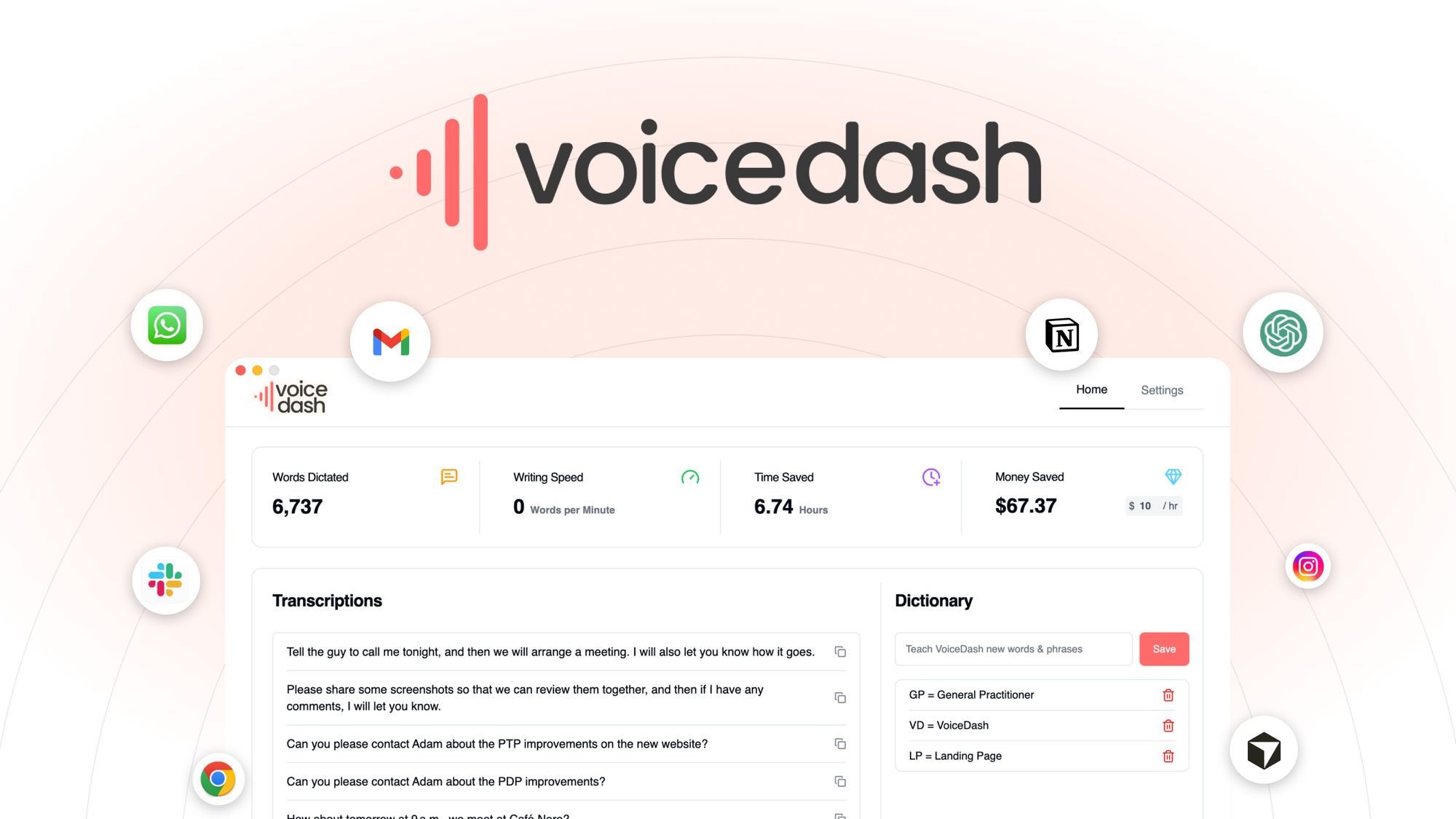
VoiceDash is cloud-only, and unusually direct about how that works: its founder states that “your audio is sent directly to the OpenAI API for processing.” In practice, VoiceDash functions as a polished thin client to OpenAI's transcription and language models. Understanding that path is the foundation for every safety question.
On each dictation, the flow is:
- Capture. Your microphone records audio on your device when you trigger VoiceDash's system-wide hotkey.
- Transmit. The audio leaves your device for VoiceDash's pipeline and is sent directly to the OpenAI API. This is the step on-device tools never take.
- Process. OpenAI transcribes the audio; VoiceDash's AI editing then cleans grammar, removes filler words, and structures the text. AI email replies are also generated by sending content to OpenAI.
- Return and discard. The text is returned to the app. VoiceDash states it does not store the audio or the transcript on its servers.
This architecture has two defining consequences:
- Your audio always leaves your device. Even with a strong no-storage policy, the audio is transmitted on every use. The privacy guarantee is contractual (the policy), not architectural (the data never moving).
- There are two trust perimeters, not one. Your audio is governed by VoiceDash's policy and OpenAI's API data-usage policy. That is more transparent than tools that hide their backend — but it also means you are trusting two companies, and your privacy is the weaker of their two postures.
AppSumo reviewers also report multi-second latency, consistent with the cloud round-trip plus AI post-processing. For the deeper architectural framing, see our cloud vs local dictation comparison and why offline dictation matters.
What VoiceDash's Privacy Policy and Founder Actually Say
VoiceDash's privacy commitments come from two sources that agree with each other: the privacy policy and the founder's answers in the AppSumo product Q&A. Here is what they document and what they leave open, attributed as retrieved in June 2026.
What VoiceDash Documents
- No audio or transcript storage. The founder states: “we do not store any audio recordings or transcriptions on our servers. Your audio is sent directly to the OpenAI API for processing.”
- No training on your data. The founder states: “We do not use your data for any training purposes,” and the policy notes that because VoiceDash uses the OpenAI API, submitted data is not used to train or improve OpenAI's models unless you explicitly opt in.
- OpenAI named as the processor. Audio is sent directly to the OpenAI API; email-reply content is also sent to OpenAI to generate the reply but, per VoiceDash, not stored.
- Right to Erasure. A GDPR-style deletion request by email results in permanent deletion of your account and associated metadata.
- BYOK is planned. Bring-your-own-key is not available yet; the founder says it is planned for Tier 2 and above.
What VoiceDash Leaves Open
- No SOC 2 / ISO 27001 / HIPAA / BAA. No external audit framework, no certification, and no Business Associate Agreement. VoiceDash does not claim HIPAA — which is honest — but the absence rules out regulated work.
- The second perimeter is not fully specified. “Sent directly to the OpenAI API” tells you the processor, but VoiceDash's policy does not detail OpenAI's retention (OpenAI's API may retain inputs for a limited abuse-monitoring window unless a zero-data-retention arrangement applies — an enterprise OpenAI arrangement, not buyer-controlled).
- No quantified retention windows. “Not stored” frames VoiceDash's posture, but processing-window and log-retention specifics are not enumerated.
- No published company entity beyond the founder. Company details (Dubai, February 2025, Amir Bornaee) come from VoiceDash's marketing and our review rather than a formal legal-entity disclosure in the policy text.
What the Picture Means in Practice
VoiceDash's documentation is, on balance, more forthcoming than much of the indie cloud field — it names its processor, commits to no training, and offers deletion on request. The honest qualifier is that all of it is policy privacy: favorable claims from two vendors, neither independently audited for a consumer buyer. That is adequate for general content and insufficient for regulated or compliance-audited work.
Warning
VoiceDash's no-storage and no-training claims are clearer than most indie peers' — but they are unaudited commitments, and your audio is also governed by OpenAI's API data-usage policy. Read both policies before routing sensitive content, and treat the lack of a SOC 2 audit or HIPAA BAA as disqualifying for regulated work.
The Two-Perimeter Trust Model: VoiceDash + OpenAI
The defining structural fact about VoiceDash's privacy is that there are two trust perimeters, not one. Most “is X safe?” investigations evaluate a single vendor's policy. With VoiceDash, your audio is governed by two stacked policies, and your real privacy is the weaker of the two.
Perimeter 1: VoiceDash
VoiceDash commits to not storing audio or transcripts and not training on your data. These are the favorable claims, and VoiceDash states them clearly. They are commitments you trust rather than controls you can audit — there is no SOC 2 report demonstrating the no-storage claim holds under load, after an incident, or during a legal request.
Perimeter 2: OpenAI's API
Because audio is sent directly to the OpenAI API, OpenAI's API data-usage policy applies to the same data. OpenAI does not train on API inputs by default, which supports VoiceDash's no-training stance. But OpenAI's standard API terms allow limited retention of inputs for abuse monitoring, and zero-data-retention is an enterprise arrangement negotiated with OpenAI — not something a VoiceDash AppSumo buyer controls or can verify. So the second perimeter adds a retention surface that VoiceDash's own “not stored” claim does not cover.
Why Two Perimeters Matter
- Your privacy is the intersection of two policies. If either VoiceDash or OpenAI changes its terms, your posture changes. You are tracking two policies, not one.
- Verification is doubled and still absent. Neither perimeter offers a consumer-facing audit for this data path. Transparency about who processes your audio is genuinely better than hiding it — but naming OpenAI is not the same as proving the chain is safe for sensitive content.
- On-device mode collapses both perimeters to zero. A local tool like Voibe has no VoiceDash pipeline and no OpenAI API in the path — in on-device mode there is no second policy to read because nothing leaves your Mac.
For OpenAI's current data posture as a backend, see our AI Privacy Tracker, which tracks OpenAI alongside 30 AI tools.
The VoiceDash Safety Decision Tree
Use the VoiceDash Safety Decision Tree to decide whether VoiceDash is safe enough for your situation. Work through the five questions in order and stop at the first one where you cannot accept the answer VoiceDash currently provides.
- Are you dictating only general, non-sensitive content (drafts, emails, notes, AI prompts)? If yes — VoiceDash is a defensible cloud tool, and its written no-storage / no-training stance is better than most indie peers. Continue only if your content is sensitive or your environment is constrained.
- Do you need offline, air-gapped, or no-transmission dictation? If yes — VoiceDash cannot do this. It is cloud-only and routes audio to OpenAI. Use an on-device tool. If no, continue.
- Are you comfortable trusting two policies — VoiceDash's and OpenAI's API data-usage terms? If yes — read both before routing anything sensitive, since your privacy is their intersection. If you want a single policy to evaluate, continue.
- Is your content under HIPAA, attorney-client privilege, NDA, or compliance audit? If yes — VoiceDash is disqualified: no SOC 2, no ISO 27001, no HIPAA BAA. Use Dragon Medical One, a dedicated medical-scribe product, or on-device dictation. If no, VoiceDash is acceptable for your work.
- Do you want zero perimeters to trust? If yes — on-device tools like Voibe have no VoiceDash pipeline and no OpenAI API in the path. Audio is processed on Apple Silicon and discarded locally — no policy to read, no second vendor to track.
The pattern: VoiceDash answers the everyday-content question well, and its transparency is a genuine plus. But by question 3 you are evaluating two policies, and by question 4 the absence of any compliance attestation is a hard blocker for regulated work.
The two-perimeter structure here is the subprocessor gap in action — an app's retention promise binds the app, not the vendors behind it. It's one of six clauses covered in zero data retention explained.
Cross-Product Privacy Posture Comparison
VoiceDash sits on the cloud side of the dictation privacy spectrum, but toward the more-transparent end of it. Here is how it compares against the peer postures we have investigated across this series.
| Product | Data Path | Subprocessors | Compliance | Verdict for Sensitive Work |
|---|---|---|---|---|
| Voibe | On-device (Apple Silicon) or private zero-retention cloud — your choice | None to audit in either mode | Never stored, sold, or trained on | Strong (on-device mode, or open-source cloud) |
| VoiceInk | On-device on Apple Silicon | None | Open-source GPL v3 | Strong (auditable code) |
| VoiceDash | Cloud only (thin client to OpenAI) | OpenAI (named) | No SOC 2 / HIPAA; written no-store + no-train claims | Fine for general; ruled out for regulated |
| Blip AI | Cloud only (GPT-powered) | Not named in policy | HIPAA marketed; no SOC 2; training silence | Verify in writing before regulated use |
| Wispr Flow | Cloud only | Disclosed (Baseten + OpenAI + Anthropic + Cerebras + AWS) | SOC 2 II + ISO 27001:2022 + HIPAA BAA available | Acceptable with BAA / Privacy Mode |
| Willow Voice | Cloud-first (Offline Mode optional) | Not publicly disclosed | Private Mode default opt-out; HIPAA marketed but not in policy | Strong default; documentation gaps |
| Aqua Voice | Cloud only | SOC 2 named partners | SOC 2 Type II; training silence in policy | Acceptable for general work; policy gaps |
The notable contrast: VoiceDash and Blip AI are both young indie cloud tools, but they take opposite documentation approaches. VoiceDash names its processor (OpenAI) and commits in writing to no training, but makes no HIPAA claim. Blip AI markets HIPAA but does not name its subprocessors and is silent on training. VoiceDash is the more transparent of the two on the questions that matter most for everyday privacy — though neither carries the audit that would clear it for regulated work. For the full cross-tool matrix across 30 AI tools, see our AI Privacy Tracker.
Architecture vs Audit: Why Transparency Isn't Verification
VoiceDash is a useful case study in the difference between transparency and verification. VoiceDash is transparent: it tells you exactly where your audio goes (the OpenAI API) and commits in writing to not storing or training on it. That is genuinely better than the indie tools that obscure their backend. But transparency about the data path is not the same as an audited guarantee that the path is safe for sensitive content — and VoiceDash offers policy privacy, not architectural privacy.
Five things architectural privacy delivers that policy privacy — even transparent policy privacy — cannot:
- Survives a policy change. Either VoiceDash or OpenAI can revise its terms with notice. Audio that never crosses your network boundary cannot be re-classified by a future revision of either policy.
- Survives a subprocessor change. VoiceDash routes to OpenAI today; a future version could route elsewhere, adding a perimeter you would need to re-evaluate. On-device processing has no subprocessor to change.
- Survives an acquisition. A 14-month-old bootstrapped company can change hands, and new ownership can bring new data postures. On-device data has nothing to transfer.
- Survives the second perimeter. Even if VoiceDash never stores anything, OpenAI's API retention applies to the same audio, and a VoiceDash buyer cannot negotiate zero-data-retention with OpenAI. On-device dictation removes the second perimeter entirely.
- Survives legal compulsion. A subpoena can compel either vendor to preserve data it would normally discard. On-device processing removes the vector — there is no transmitted copy at either perimeter to preserve.
None of this makes VoiceDash a bad product — for general content it is a reasonable, affordable, transparent cloud tool, and it earns credit for naming OpenAI and committing to no training. It means VoiceDash's privacy is contract-driven across two vendors, and a contract is only as strong as the documentation and the continuity behind it. For confidential, privileged, regulated, or compliance-audited work, architecture is the stronger guarantee. See our cloud vs local dictation guide for the full framing.
The Five-Step VoiceDash Safety Audit
Run this five-step audit before committing VoiceDash to any work where data handling matters. Each step takes 2–15 minutes.
- Read VoiceDash's privacy policy and confirm the claims. Open voicedash.ai/privacy-policy and confirm the no-storage and no-training commitments still read as described here. Policies for young products change; verify rather than assume.
- Read OpenAI's API data-usage policy too. Because your audio is sent directly to the OpenAI API, your privacy is the combination of both policies. Confirm OpenAI's no-training-by-default stance and its abuse-monitoring retention window, and note that zero-data-retention is an enterprise arrangement a VoiceDash buyer does not control.
- Apply the regulated-content disqualifier. If your dictation includes PHI, attorney-client-privileged material, NDA-bound source code, or compliance-audited content, VoiceDash is disqualified — there is no SOC 2, no ISO 27001, and no HIPAA BAA. Use Dragon Medical One, a dedicated medical-scribe product, or on-device dictation instead.
- Test the deletion path before you rely on it. VoiceDash honors a GDPR-style Right to Erasure by emailed request. Send a deletion request and confirm the process works and the timeline is acceptable for your needs.
- Accept that there is no offline fallback. VoiceDash cannot operate without transmitting audio to OpenAI, so a network monitor like Little Snitch will always show outbound calls during dictation. If your environment requires zero transmission, VoiceDash is the wrong tool regardless of its favorable claims.
If any step fails or feels uncomfortable, on-device dictation tools like Voibe eliminate the audit — there is no VoiceDash policy and no OpenAI policy to read for your audio, because it never leaves your Mac.
Voibe: On-Device, Zero Perimeters to Trust
Voibe is a dictation app for Mac and Windows built around one durable promise: your audio and text are never stored, never sold, or used to train any AI model. Voibe gives you two user-selectable modes. In on-device mode, Voibe runs OpenAI Whisper on Apple Silicon's Neural Engine — locally, not through OpenAI's API — so audio is captured into memory, transcribed on the Mac, written into the active field, and discarded, and nothing leaves the Mac (this mode requires an Apple Silicon Mac, M1 or later). In private cloud mode, audio goes over an encrypted connection to Voibe's own infrastructure, runs only open-weight models, and is deleted the moment transcription completes.
Mapped against the VoiceDash questions raised above:
- Perimeters. There is no VoiceDash-style pipeline and no OpenAI API call in the dictation path — so there is no second vendor policy to read and no intersection of two postures to evaluate.
- Retention. In on-device mode nothing is transmitted; in private cloud mode audio is deleted the moment transcription completes. Per Voibe's privacy policy: “The Voibe application processes your voice entirely on your device. No audio is transmitted to our servers at any point.”
- Training. Voibe does not train AI on your dictation in either mode — and in on-device mode there is no pipeline that could, because audio never reaches a server.
- Regulated content. For PHI and other regulated dictation, Voibe's on-device mode keeps audio on the clinical device so nothing leaves the Mac; the durable promise across both modes is that your audio and text are never stored, sold, or used to train any AI model. See our dictation and HIPAA guide.
- Offline. Voibe's on-device mode works fully offline — on planes, in secure facilities, anywhere — because in that mode the transcription model runs on your own Mac and never makes a network call.
- Network monitor. Run Little Snitch during a Voibe on-device dictation session; outbound traffic during transcription is zero.
Pricing: $9.90/month, $99/year, or $199 lifetime for unlimited dictation, with all features included at every paid tier, plus a free plan with limited words on one device. Voibe runs on all Macs and on Windows; on-device mode requires an Apple Silicon Mac (M1 or later). Where VoiceDash is an AppSumo lifetime deal whose economics depend on OpenAI's per-call API pricing, Voibe is a one-time license with no per-word cloud cost — which is also why it has no word caps. For the full pricing comparison, see our VoiceDash pricing guide and VoiceDash alternatives.
Try Voibe for Free — install, grant microphone and accessibility permissions, and dictate. No account, no credit card, and no OpenAI API in the path.
Related Reading
- VoiceDash Review (2026) — Full hands-on review: AppSumo tiers, latency testing, and the 6.5/10 verdict.
- VoiceDash Pricing (2026) — AppSumo lifetime tiers, word caps, and the 3-year cost comparison.
- Best VoiceDash Alternatives (2026) — Offline and privacy-first options with a decision tree.
- VoiceDash vs Wispr Flow — Head-to-head comparison of the two cloud tools.
- Is Blip AI Safe? — Sibling investigation for the other young indie cloud peer (opposite documentation approach).
- Is Wispr Flow Safe? — Sibling investigation for the audited cloud peer (SOC 2 + HIPAA BAA).
- Is Aqua Voice Safe? — Sibling investigation for the cloud-only peer with training silence.
- Is Willow Voice Safe? — Sibling investigation for the HIPAA-marketed-vs-policy cloud peer.
- Is Superwhisper Safe? — Sibling investigation for the on-device + cloud peer.
- Is Spokenly Safe? — Sibling investigation for the multi-architecture peer.
- Is Voicy Safe? — Sibling investigation for the Groq-routed cloud peer (no-training promise on marketing pages only).
- Is Wisprtype Safe? — Sibling investigation for the local-by-default, closed-source peer (telemetry shipped on despite the policy).
- Is VoiceInk Safe? — Sibling investigation for the open-source GPL v3 on-device peer (zero telemetry, verified in source).
- Is Handy Safe? — Sibling investigation for the free MIT-licensed local tool (no cloud transcription path at all).
- AI Privacy Tracker — Cross-tool privacy posture comparison across 30 AI tools, including OpenAI.
- Cloud vs Local Dictation — Architectural framing for the privacy question.
- HIPAA Dictation Guide — The clinical pathway for protected health information.
- Voice Data Privacy — Pillar with deeper privacy frameworks.
- Zero Data Retention Explained — the subprocessor gap and five other ways a retention promise comes apart.
Frequently Asked Questions
Is VoiceDash safe to use in 2026?
Does VoiceDash store your voice recordings?
Does VoiceDash use my dictation to train AI?
Which third parties process my VoiceDash audio?
Is VoiceDash HIPAA compliant?
Does VoiceDash work offline or on-device?
Who is behind VoiceDash, and is the company established?
How does VoiceDash compare to Voibe on privacy?
What should I check before trusting VoiceDash with sensitive data?
Best AI Dictation and Meeting Notes for Confidential Work
Draft letters, notes and emails 5x faster. Get meeting notes without a bot joining your call. Nothing used to train AI.
- Mac + Windows
- No bot in your calls
- Nothing used to train AI
- 7-day free trial
Want to compare plans first? View pricing →
Related Articles
Is Voicy Safe? Groq Cloud Path & Policy Gaps (2026)
Is Voicy safe? It's cloud-only — audio routes through Groq with immediate-deletion promises. But the no-training claim lives on marketing pages, not in policy.
Is Blip AI Safe? Cloud Privacy & HIPAA Verdict (2026)
Is Blip AI safe? It's cloud-only; its policy claims audio is deleted in seconds and HIPAA with a BAA on request, but no published SOC 2 audit backs it.
Is VoiceInk Safe? Open-Source, On-Device Verdict (2026)
Is VoiceInk safe? Yes — GPL v3 open-source, on-device by default, zero telemetry found in a source audit. Nuances: BYOK cloud opt-in and local history.