
Recovering From Hand Surgery: Typing, Voice, and Continuity (2026)
Phased recovery timeline by procedure (carpal tunnel release, trigger finger, Dupuytren's, fracture pinning), when typing safely resumes, and a step-by-step walkthrough of Voibe's Hands-Free Mode for one-handed dictation.
If you just had hand surgery and need to keep working, the most important thing to know is that you can. Modern hand procedures are designed to get patients back to most activities relatively quickly, but typing is one of the activities that comes back later — often weeks after you are otherwise feeling fine. Voice dictation is the standard continuity tool that bridges the gap. This guide covers what to expect by procedure, when typing safely resumes, and how to set up the dictation workflow that respects both the surgical site and your unaffected hand. Medical care stays with your surgeon and hand therapist; we are not a substitute for medical advice.
TL;DR: Most hand procedures have a phased recovery: a protected phase where typing is off-limits, a progressive phase where light typing returns, and a sustained phase where full keyboard volume resumes. Voibe's Hands-Free Mode (double-tap to start, no key held during speech, included in the 7-day free trial with no account or card) is the dictation tool designed for one-handed setup and use through that recovery window. Read on for the phase-by-phase pattern, when typing safely resumes for your procedure, and the step-by-step Hands-Free walkthrough.
Key Takeaways: The 4-Phase Recovery Framework at a Glance
| Phase | What it covers | What you can do |
|---|---|---|
| Phase 1: Protected (Days 0–14) | Immediate post-op; cast or splint on; surgical block wearing off; pain medication active | No typing. Dictation with unaffected hand or foot switch. Voice memos from phone during rest. |
| Phase 2: Protected Motion (Weeks 2–6) | Hand therapy begins for most procedures; controlled motion under supervision; light hand use cleared | Light typing for short bursts (varies by procedure). Dictation remains the primary input. Hotkey may stay remapped. |
| Phase 3: Progressive Loading (Weeks 6–12) | Strength returns; sustained typing usually possible by mid-phase; clinician guidance on return-to-work pace | Typing volume rises gradually. Dictation continues for high-volume tasks. Hybrid workflow standard. |
| Phase 4: Sustained (Months 3–6+) | Full strength typically returns; complete healing of soft tissues; surgical scar matures | Full typing volume returns for most procedures. Many users keep dictation permanently for ergonomic load reduction. |
These phases are typical for outpatient hand surgery and may differ for tendon repair, fracture pinning, or CMC arthroplasty (which extend Phase 1 and 2 substantially). Your treating hand surgeon will give you the specific timeline for your procedure.
Understand the 4-Phase Recovery Framework
Recovery from hand surgery does not happen in a single step. The body needs time to heal soft tissues, the surgical scar needs time to mature, and the rehabilitation team — surgeon plus hand therapist — guides the patient through progressive return-to-activity in defined phases. Knowing which phase you are in is the foundation for knowing which input method to use.
Phase 1: Protected (Days 0–14)
The immediate post-operative phase. The surgical site is fresh, sutures are in (or steri-strips are in place), swelling is at its peak, and the surgical block from anesthesia is wearing off. Most procedures involve a cast or splint during this phase. Typing is contraindicated for the operated hand because of the immobilization itself; the unaffected hand can do limited work, but compensating with full single-handed typing volume creates the contralateral overuse problem.
Dictation is the standard input during this phase. Voice memos from a phone work for early thinking; once you are back at the desk, Hands-Free dictation with a remapped hotkey is the high-volume tool. The free tier of most dictation apps covers this phase, and Voibe's 7-day free trial is unlimited during the trial window, so week 1 post-op output is easily within it.
Phase 2: Protected Motion (Weeks 2–6)
Hand therapy begins for most procedures during this phase. Sutures come out, the splint may be replaced with a softer brace, and controlled motion under supervision starts. Light hand use is typically cleared by the end of Phase 1 or beginning of Phase 2 — meaning your surgeon has said the operated hand can resume basic activities of daily living without significant discomfort. Typing during this phase is procedure-dependent: endoscopic CTR patients are often doing light keyboard work; tendon repair patients are still in strict no-load mode.
Dictation remains the dominant input during this phase. The hotkey configuration you chose during Phase 1 usually stays in place. The 7-day free trial typically ends around this point, and with daily output volume back to normal, this is the most common time to move to a paid plan ($7.50/month, $59/year, or $149 lifetime for Voibe).
Phase 3: Progressive Loading (Weeks 6–12)
Strength returns gradually. Most outpatient hand procedures have most patients back to sustained typing by mid-Phase 3, though tendon repair, fracture pinning, and CMC arthroplasty often extend further. Hand therapy moves from protected motion to strengthening; the patient typically resumes their full work schedule (with continued ergonomic adaptations as needed). Many patients describe Phase 3 as “mostly fine” with intermittent soreness as activity volume increases.
This is the phase where the typing/dictation balance shifts back toward typing for most users. The hybrid pattern — typing for short tasks, dictation for long-form output — is the sustainable default that most users adopt for the rest of recovery and often permanently.
Phase 4: Sustained (Months 3–6+)
Full strength returns for most procedures. The surgical scar matures over 6–12 months; sensation continues to refine over the same window. The user's typing volume is usually at or near pre-op baseline by the start of Phase 4. The question shifts from “how do I keep working” to “should I keep using dictation.” Most users say yes — the typing-load reduction is a sustained ergonomic benefit, and the dictation workflow is already built. Whether to keep your remapped hotkey or revert to default is a personal preference at this point.
Key Takeaway
The 4-Phase Recovery Framework is a planning structure, not a strict timeline. Patient procedures, individual healing rates, and complication risks all shift the boundaries — but the pattern of dictation as the constant input through the recovery window is consistent across them.
When Typing Actually Resumes by Procedure
Generic recovery framework aside, the practical question for most patients is “when can I actually use the keyboard again?” The answer is procedure-specific:
- Endoscopic carpal tunnel release: Light keyboard work usually within 1–2 weeks; full typing volume typically by 4 weeks. The AAOS OrthoInfo Carpal Tunnel Syndrome page notes light hand use is permitted soon after surgery as long as it is comfortable; grip and pinch strength typically return within 2–3 months.
- Open carpal tunnel release: Add roughly 2 weeks to the endoscopic timeline to allow the palmar incision to heal — light keyboard work usually by week 4, full typing volume by week 6.
- Trigger finger release: Outpatient procedure with a small palmar incision; light typing within 1–2 weeks, full typing volume usually within 3 weeks.
- De Quervain's release: Thumb spica splint for 1–2 weeks; light typing once the splint comes off, full typing volume around weeks 3–4.
- Dupuytren's contracture release (needle aponeurotomy): Minimally invasive; light hand use within days, light typing within 1 week, full typing volume by 2–3 weeks.
- Dupuytren's contracture release (open fasciectomy): More involved; splint and hand therapy for several weeks; full typing volume often not until weeks 6–12.
- Flexor or extensor tendon repair: Strict protected-motion protocol with custom splints; typing typically prohibited for the first 4–6 weeks; gradual return over 8–12 weeks under hand therapy supervision.
- Hand or wrist fracture pinning: Cast or splint for 4–8 weeks depending on fracture site (scaphoid, metacarpal, distal radius); typing often prohibited until pin removal or radiographic union; full typing volume sometimes not until 10–12+ weeks.
- CMC (basal joint) arthroplasty for thumb arthritis: Cast for 4 weeks; splint for additional weeks; hand therapy through 3–6 months; thumb use restricted throughout. Typing returns gradually starting around weeks 8–10.
These windows are typical and should be confirmed with your hand surgeon for your specific procedure. The point is not to memorize each one — it is to understand that the keyboard-light period varies from days (needle aponeurotomy, trigger finger) to several months (Dupuytren's open fasciectomy, fracture pinning, CMC arthroplasty), and dictation tooling that fits the longest case will fit the shorter ones too. For the comparison of which dictation app fits each procedure best, see our companion best dictation software after hand surgery listicle.
Set Up Voibe Hands-Free Mode (One-Handed Walkthrough)
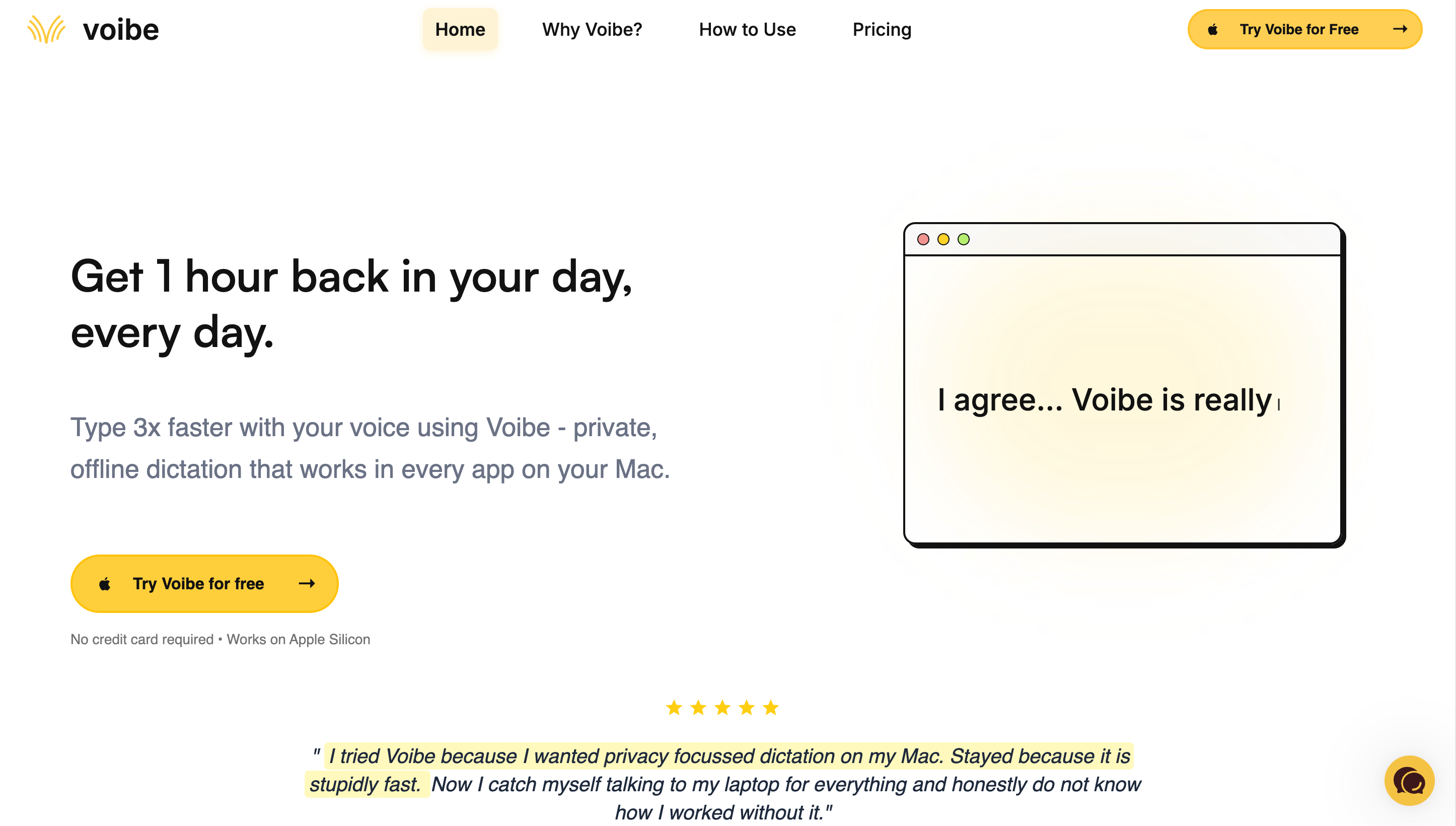
This walkthrough is written for users completing setup with one hand. The whole process takes about three minutes on a trackpad. Voibe is designed without an account-creation step specifically so that this works.
1. Download Voibe
Visit getvoibe.com on your Mac. Click the download button. The .dmg file lands in your Downloads folder. Voibe runs on Mac (macOS 13 or later; on-device mode needs Apple Silicon, M1–M4) and on Windows via a native app — these steps cover the Mac install.
2. Drag Voibe into Applications
Open the .dmg by clicking it. Drag the Voibe app icon to the Applications folder using the trackpad with your unaffected hand. The trackpad drag works one-handed because tap-and-drag is supported on Apple trackpads. If a one-handed drag is awkward, the alternative is to right-click the Voibe icon (Control + click on a trackpad) and select Copy, then navigate to your Applications folder and paste.
3. Grant microphone permission
Open the Voibe app from Applications. On first launch, macOS prompts for microphone access. Click “OK” with the trackpad. You can verify or change this later under System Settings → Privacy & Security → Microphone.
4. Choose your activation hotkey for one-handed use
Open Voibe Settings → Hotkey. The default is double-tap. For most post-op users, the more important decision is what to remap it to. The recommended remap depends on which hand had surgery:
- Dominant hand surgery (right-handed user, right hand operated): Remap activation to F12 — reachable with the left hand at the right side of the keyboard. Single press to start dictation.
- Dominant hand surgery (left-handed user, left hand operated): Remap to F5 — reachable with the right hand at the left side of the keyboard.
- Non-dominant hand surgery: Default double-tap usually works as shipped because the dominant hand can still tap.
- Bilateral surgery or rigid bilateral immobilization: Remap to a USB foot switch, Stream Deck button, or accessibility switch. Foot activation removes both hands entirely.
5. Try Hands-Free Mode in a text field
Open any app with a text field — Apple Notes, Pages, a browser tab on Google Docs, Slack, Gmail, your patient portal, your insurance claim form. Place your cursor where you want text to appear by clicking with the trackpad. Trigger your chosen hotkey. A small floating window appears at the bottom of your screen.
6. Speak naturally and watch Continuous Transcription
Speak the sentence or paragraph you want to write. Your words appear live in the floating window as you speak — this is Continuous Transcription. There is no session-length cap; you can speak for as long as you need.
7. Commit text with Enter or trigger your hotkey again
When you are done speaking, press Enter (or trigger your hotkey again to stop and commit). The text from the floating window inserts into your active app at the cursor position.
8. Add Custom Vocabulary for procedure and medication terms
If you find yourself correcting the same words repeatedly — procedure names (carpal tunnel release, trigger finger release, Dupuytren's fasciectomy), medication names (acetaminophen with codeine, oxycodone, gabapentin), surgeon or hand therapist names — Voibe's Custom Vocabulary feature (paid plans: $7.50/month, $59/year, or $149 lifetime) lets you add those terms. Recognition accuracy on those specific words improves. The vocabulary stays local on your Mac — there is no server-side training.
Key Takeaway
Pre-op tip: install Voibe and set your hotkey remap before surgery, while both hands still work. Doing it post-op one-handed is feasible, but doing it pre-op is easier.
Build a Dictation-Dominant Recovery Workflow
Dictation will not eliminate every keystroke during recovery — and you do not want it to. The pattern most post-op users settle into is dictation-dominant: voice for long-form output, keyboard for short edits and shortcuts on the unaffected hand or hand-therapy-cleared activities. The goal is to keep total typing load well below the threshold your recovering hand can tolerate without compensating with overuse of the unaffected hand.
A typical knowledge-worker day reshaped for post-op recovery:
- Email and Slack messages over a sentence or two → dictate. The single biggest source of typing volume in most workdays.
- Documents, notes, project plans → dictate. Long-form output benefits the most.
- Workers' compensation correspondence and FMLA paperwork → dictate. High-volume recovery-specific writing.
- Insurance claim documentation, surgeon-portal messages, hand therapy notes → dictate with Custom Vocabulary for procedure and medication names.
- Short replies, hotkey-driven navigation, quick edits → keep on the keyboard with your unaffected hand, but watch for any new soreness from the increased single-hand load.
- Forms with many small fields → mix. Dictate long free-text fields, click into short ones, use autofill for credentials and addresses.
The contralateral overuse risk is the biggest reason this matters. If your dominant hand is in a cast and you do twice your normal volume of typing with the non-dominant hand for six weeks, you finish recovery with a strained unaffected side and a new problem. Dictation prevents that pattern by spreading the work to the vocal apparatus instead of doubling it on one hand.
Coordinate With Your Hand Surgeon and Therapist
This guide is a workflow guide, not a medical guide. The interventions above are the standard non-clinical adaptations that occupational and hand therapists recommend for computer users recovering from hand surgery. They are not a substitute for clinical care.
The most useful conversations to have with your care team about computer adaptation:
- Specific return-to-typing timeline. Your surgeon will tell you when typing is cleared for your specific procedure. The phase framework in this guide is typical; your individual timeline may differ.
- Hand therapy coordination. Hand therapists are familiar with dictation as a recovery tool and will often integrate it into your overall protocol. Ask whether your therapist has specific recommendations for the gradual reintroduction of typing as you progress through phases.
- Brace and splint compatibility. If you are wearing a cast, splint, or sling, your surgeon or therapist can clarify which finger movements are safe — useful when choosing your remapped hotkey.
- Contralateral overuse monitoring. If the unaffected hand starts hurting during recovery, that is a flag to either reduce overall load or shift more work to dictation. Mention any new symptoms to your therapist promptly.
- ADA accommodation documentation. Your surgeon can document the medical basis for a workplace accommodation request — including a specific recommendation for dictation software. JAN's Cumulative Trauma Conditions page covers post-surgical recovery from hand conditions.
- Workers' compensation and FMLA timing. If your surgery is work-related or you need FMLA leave, the surgeon's documentation drives the paperwork timeline. Dictation makes the paperwork easier on the patient side; the documentation itself stays a clinical task.
Indications that warrant prompt clinical attention rather than self-management include sudden severe surgical-site pain, fever, redness or warmth around the incision (signs of infection), drainage from the incision, new numbness or weakness, or any concern that the surgical hardware (pins, sutures, splints) has shifted. These are not adaptation questions — they are clinical questions.
Warning
If you have sudden severe surgical-site pain, fever, redness or warmth around the incision, drainage from the incision, or any signs of infection, contact your hand surgeon's office promptly rather than relying on adaptation strategies. The same applies for any sudden change in sensation or function in either the operated or unaffected hand.
Related Reading
- Best Dictation Software After Hand Surgery — The companion BOFU listicle comparing six dictation apps for post-op use, with specific recommendations by procedure and hand side.
- Accessibility Dictation Hub — Overview of dictation options for users with hand pain, covering carpal tunnel, arthritis, tendinitis, post-surgery recovery, and more.
- Best Dictation Software for Carpal Tunnel — Useful both pre-op (if you're considering CTR) and post-op for the longer recovery window.
- How to Type With Carpal Tunnel — A similar guide for users managing CTS without surgery yet, with ergonomic adaptations that often delay or prevent the need for surgery.
- Best Dictation Software for Tendinitis — Useful for users recovering from de Quervain's release or trigger finger surgery where tendon involvement is the surgical target.
- RSI Prevention for Computer Users — The three-lever prevention guide (setup, pacing, load) for computer users who want to stay ahead of symptoms.
- Best Dictation Software for Arthritis — Useful for users recovering from CMC arthroplasty or other arthritis-driven hand procedures.
- Why Offline Dictation Matters — Why processing speech on your Mac matters when correspondence touches workers' comp, FMLA, or insurance.
- Dictation as a Reasonable Accommodation — HR request template and forwardable IT-security brief for requesting dictation as a return-to-work accommodation.
- Job Accommodation Network: Cumulative Trauma Conditions — JAN's resource covering post-surgical recovery from hand and wrist procedures as ADA accommodations.
- AAOS OrthoInfo: Carpal Tunnel Syndrome — American Academy of Orthopaedic Surgeons patient guidance including post-operative recovery.
- AAOS OrthoInfo: De Quervain's Tendinosis — AAOS coverage including surgical release and recovery.
Frequently Asked Questions
How soon after hand surgery can I start using a computer?
When exactly can I start typing again after hand surgery?
How do I set up dictation software when my dominant hand just had surgery?
Will dictation actually work with my cast or splint on?
Can I overdo it with my unaffected hand if it has to do all the work?
Should I keep using dictation after my hand has fully recovered?
What if hand therapy is part of my recovery plan?
What about workers' compensation paperwork or FMLA?
Best AI Dictation and Meeting Notes for Confidential Work
Draft letters, notes and emails 5x faster. Get meeting notes without a bot joining your call. Nothing used to train AI.
- Mac + Windows
- No bot in your calls
- Nothing used to train AI
- 7-day free trial
Want to compare plans first? View pricing →
Related Articles
Best Dictation Software After Hand Surgery (2026): 6 Apps for One-Handed Recovery
Compared 6 dictation apps for one-handed post-op use. Voibe's Hands-Free Mode + configurable hotkey let you keep working through carpal tunnel release, trigger finger, or Dupuytren's recovery without re-aggravating the surgical site.
Best Dictation Software for ADHD (2026): 8 Tools Compared
Compared 8 dictation tools for ADHD writers. Voibe captures thought at the speed of speech with Continuous Transcription and an on-device mode; honest takes on Wispr Flow, Superwhisper, Otter, Apple Dictation, and more.
Voice Typing for ADHD Writers: A Practical Guide (2026)
How to use voice typing for ADHD: set up low-friction dictation on a Mac, run the Capture-First Draft to beat the blank page and working-memory drop, and tame rambling.