
Voibe vs Handy (2026): Paid Polish vs Free Open-Source Dictation
Voibe vs Handy head-to-head: Handy is free, MIT open-source, on-device dictation on Mac, Windows, and Linux. Voibe has a limited free plan and paid tiers ($199 lifetime) with Developer Mode, a cloud accuracy option, and Live Dictation. Different fits.

Voibe
Mac and Windows dictation app that runs OpenAI Whisper on-device on Apple Silicon's Neural Engine, or over a zero-retention cloud with open-source models — your choice, with no BYO API keys, no model picking, and no vendor accounts. On Apple Silicon Macs you get both modes: in on-device mode nothing leaves your Mac, and in cloud mode audio goes over an encrypted connection to zero-retention cloud providers running open-source Whisper Large Turbo, then is deleted the moment transcription completes. Windows and Intel Macs run cloud mode only. Ships Developer Mode for Cursor, VS Code, and Windsurf with local workspace file and folder name resolution, plus Live Dictation (Mac only), Smart Formatting, spoken punctuation, a custom dictionary, and Memory text shortcuts. Pricing: Voibe Free at $0 (limited words on one device), or $9.90/month, $99/year, or $199 lifetime, with a 7-day trial of every feature and a 30-day money-back guarantee on paid plans.
Free (limited), $9.90/mo, $99/yr, or $199 lifetime
Pros
- + Two modes, your choice — on-device on Apple Silicon (nothing leaves your Mac) or a zero-retention cloud with open-source models; no BYO API keys or vendor accounts to manage
- + Developer Mode for Cursor, VS Code, and Windsurf resolves spoken file names, folder paths, and variable identifiers against your local workspace
- + Live Dictation (Mac only) streams words on-screen in real time so you can edit before insertion
- + Smart Formatting adds punctuation, capitalization, and filler-word removal automatically — polished output, not raw transcription
- + Runs on Mac and Windows with a ground-up native Windows app (not an Electron port)
- + Custom dictionary teaches names, jargon, and acronyms; Memory expands spoken triggers into signatures, URLs, and prompts
- + $199 one-time lifetime option locks in cost forever with no recurring subscription
- + 90+ languages, transcript history with an off switch, and a disclosed privacy policy at getvoibe.com/privacy
Cons
- - Free plan is limited (limited words on one device); unlimited use starts at $9.90/month (there is a 7-day free trial and a 30-day money-back guarantee)
- - Closed source — you verify privacy by policy and behavior, not by reading the code (Handy's MIT source is auditable)
- - No Linux app, and no iOS or Android — Mac and Windows desktop only
- - On-device mode requires an Apple Silicon Mac (M1 or later); Intel Macs and Windows are cloud-only and need internet
- - Live Dictation and on-device mode are Mac-only — Windows users do not get either
- - No published SOC 2, ISO 27001, or HIPAA BAA — consumer-tier on formal compliance
Handy
Free, MIT-licensed, open-source speech-to-text app created by CJ Pais. Runs natively on macOS, Windows, and Linux using Tauri (Rust + React/TypeScript) and performs all speech recognition on-device — there is no cloud option, no account, and no internet required after the initial model download. Press a configurable shortcut, speak, release, and Handy pastes the transcription into the active app. Supports multiple local models including Whisper Small/Medium/Turbo/Large, Parakeet V2/V3, Moonshine, and Cohere Transcribe, plus custom GGML model loading. Ships CLI automation flags, a Raycast extension on Mac, Silero Voice Activity Detection, and a custom-words dictionary. Approximately 20,000 GitHub stars, 1,600 forks, and biweekly releases. The trade-off is raw output: minimal auto-punctuation, no AI editing, and a 2-5 second processing delay on most hardware. Funded by GitHub Sponsors and donations. Pricing: $0 forever.
Free — MIT license, no paid tier
Pros
- + Completely free under the MIT license — no tiers, subscriptions, word limits, or upsell, and free for commercial use
- + 100% offline by architecture — no cloud option, no account, no internet after model download; your voice never leaves your computer
- + Open source with approximately 20,000 GitHub stars and 1,600 forks — architecture is auditable rather than promised
- + Cross-platform including native Linux via AppImage — the only offline dictation app in this class with Linux support
- + Multiple local models: Whisper Small/Medium/Turbo/Large, Parakeet V2/V3, Moonshine, Cohere Transcribe, plus custom GGML loading
- + CLI automation flags and Linux signal-based control enable scripting; Raycast extension controls Handy from the launcher on Mac
- + Silero Voice Activity Detection filters silence; active biweekly releases with multiple community contributors
Cons
- - No AI text rewriting, tone matching, or formatting — output is near-verbatim raw transcription with minimal auto-punctuation
- - 2-5 second processing delay after you stop speaking on most hardware with Whisper models
- - No cloud accuracy option and no real-time on-screen dictation — you edit raw output by hand
- - No dedicated IDE integration — does not resolve file or folder names in VS Code, Cursor, or Windsurf
- - No mobile app (no iOS, no Android), no batch file transcription, and no formal support channels or SLA
- - Linux Wayland has limitations (requires wtype or dotool; recording overlay disabled by default on many compositors), plus occasional first-word clipping and wrong-app auto-paste
Voibe vs Handy: The Verdict
Different fits. Voibe and Handy both run OpenAI Whisper on-device on Apple Silicon, and both aim at people who want to talk instead of type. But they answer the same question with opposite philosophies. Handy is the free, open-source, on-device position — MIT-licensed, cross-platform across Mac, Windows, and Linux, and private by construction, with raw near-verbatim output as the trade-off. Voibe is the paid, polished position — Smart Formatting, a cloud accuracy option, Developer Mode for Cursor, VS Code, and Windsurf, Live Dictation on Mac, and a native Windows app — at $9.90/month or $199 lifetime.
Pick Handy if you want:
- Genuinely free dictation — $0 forever under the MIT license, no tiers or limits
- Open-source, source-auditable architecture you can read on GitHub
- Native Linux support (the only offline dictation app in this class with it)
- 100% offline by architecture — no cloud option to misconfigure
- Comfort editing raw, near-verbatim transcription by hand
Pick Voibe if you want:
- Polished output out of the box — Smart Formatting, spoken punctuation, filler-word removal
- A cloud accuracy option (zero-retention cloud with open-source models) on top of on-device mode
- Developer Mode for Cursor, VS Code, and Windsurf with local file and folder name resolution
- Live Dictation on Mac and a ground-up native Windows app
- Lifetime pricing that locks in cost forever ($199), with no BYO API keys to manage
The honest tie zone: on-device Whisper accuracy on Apple Silicon (both inherit Whisper's accuracy band), and formal compliance (neither carries SOC 2, HIPAA BAA, or ISO 27001 — both are consumer-tier). And two dimensions where Handy simply wins outright: price (free beats $199) and open source (Voibe is closed source). We say so plainly.
Disclosure: Voibe is our product. Handy facts on this page are drawn from our researched Handy review and Handy vs Superwhisper comparison, grounded in handy.computer and github.com/cjpais/Handy. Where Handy is genuinely stronger than Voibe — free, open source, Linux — we say so.
Quick Comparison: 13 Dimensions Side-by-Side
| Dimension | Voibe | Handy | Winner |
|---|---|---|---|
| Price | Free (limited), $9.90/mo, $99/yr, $199 lifetime | Free ($0 forever) | Handy |
| Free plan | Limited (Voibe Free: limited words, one device; plus 7-day trial) | Yes (free forever, no limits) | Handy |
| Open source | No (closed source) | Yes (MIT license) | Handy |
| Architecture | On-device (Apple Silicon) or zero-retention cloud | On-device only (no cloud option) | Tie (different opinions) |
| Cloud accuracy option | Yes (open-source models) | No | Voibe |
| Output quality | Smart Formatting, spoken punctuation | Near-verbatim, minimal punctuation | Voibe |
| Platforms | Mac + Windows (no Linux) | Mac + Windows + Linux | Handy (Linux) |
| Developer Mode (IDE) | Cursor / VS Code / Windsurf, file-name resolution | None (CLI automation instead) | Voibe |
| Real-time on-screen dictation | Live Dictation (Mac only) | None | Voibe |
| Trigger modes | Push-to-talk, Hands-free (double-tap), Live Dictation | Push-to-talk and toggle | Voibe |
| Processing latency | Low; auto-fallback to local if cloud drops | 2-5 second delay on most hardware | Voibe |
| Compliance attestations | None | None | Tie (neither) |
| Third-party validation | Featured in Macworld, PCMag, Cult of Mac | ~20k GitHub stars, 5.0/5 Product Hunt | Tie (different signals) |
The honest tally: Voibe wins on 6 dimensions (cloud option, output quality, Developer Mode, real-time dictation, trigger modes, latency), Handy wins on 4 (price, free plan, open source, Linux), and 3 are ties. This is a 'different fits' comparison — neither product dominates.
Why These Get Compared
Voibe and Handy land on the same shortlist for three structural reasons — and then diverge sharply on philosophy.
1. Both Run Whisper On-Device on Apple Silicon
Voibe's on-device mode runs OpenAI Whisper on Apple Silicon's Neural Engine. Handy runs Whisper (Small, Medium, Turbo, or Large) plus Parakeet, Moonshine, and Cohere Transcribe locally on the same hardware. On identical audio, the underlying transcription accuracy is in the same band — the comparison hinges on what wraps the Whisper layer, not on the model itself.
2. Both Prioritize Privacy — By Different Means
Handy is private by architecture: there is no cloud option at all, no account, and the MIT-licensed source lets anyone verify that audio never leaves the machine. Voibe is private by design and policy: an on-device mode where nothing leaves your Mac, plus an optional zero-retention cloud mode that runs only open-source models and deletes audio the moment transcription completes. Both attract users who care about where their voice goes — they just draw the line in different places.
3. Both Are Indie / Small-Team Whisper Wrappers
Handy is a solo project by CJ Pais, funded through GitHub Sponsors and donations, with roughly 20,000 stars and biweekly releases. Voibe is a small commercial team with a disclosed privacy policy. Neither has the venture-backed posture of a Wispr Flow. The result: Mac users comparing on-device dictation frequently end up with Voibe and Handy on the same list — one free and open, one paid and polished. This page is for users at that decision point. For the broader landscape, see our Handy review and Voibe review.
Voibe: Polished On-Device or Zero-Retention Cloud Dictation
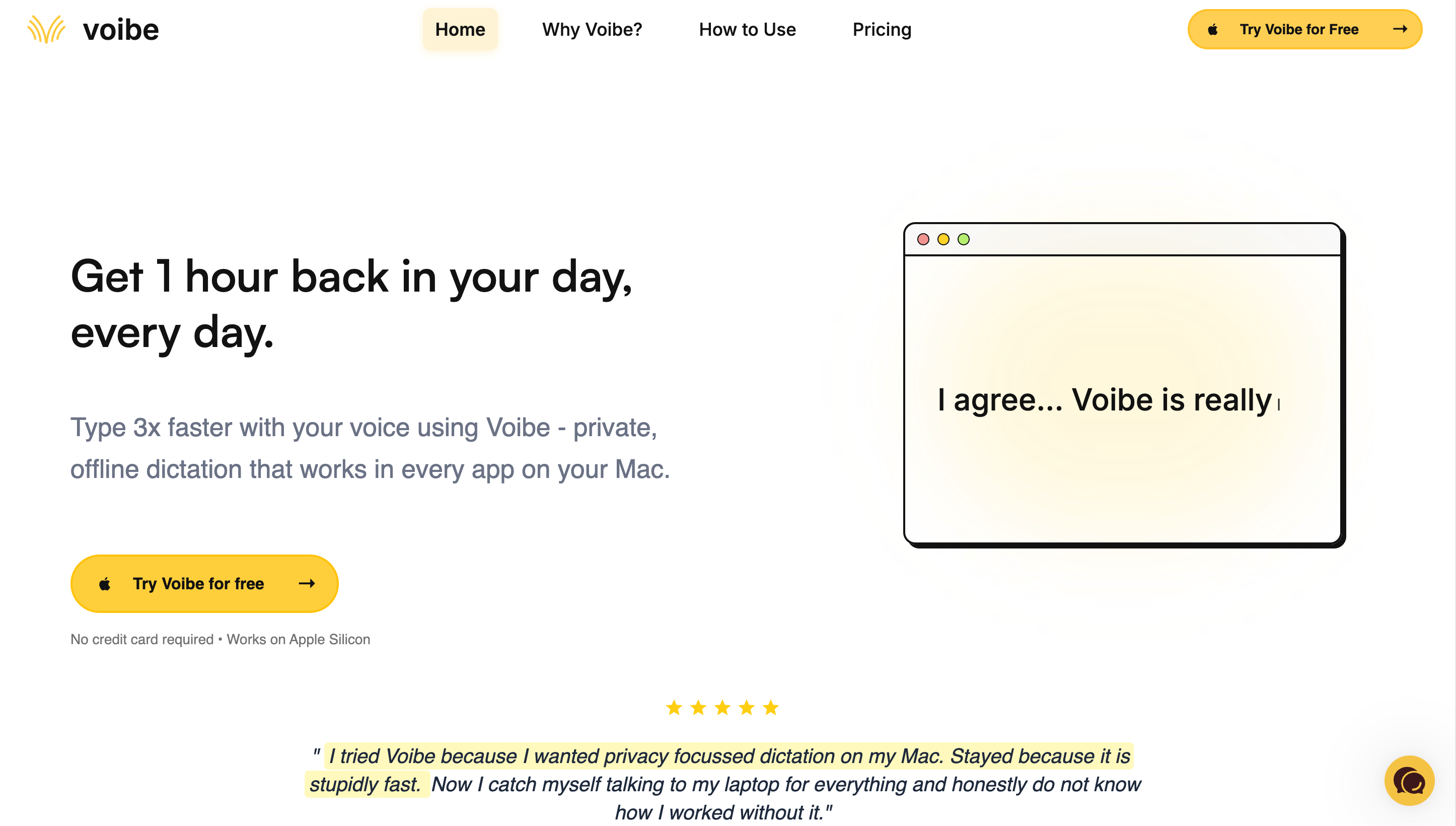
Voibe is a Mac and Windows dictation app built on two principles: your audio is never stored, sold, or used to train AI, and the output should be clean enough to send without editing. You choose the mode; there are no BYO API keys, no model picking, and no vendor accounts.
What Voibe Does
- Two transcription modes, your choice. On Apple Silicon Macs, on-device mode runs Whisper on the Neural Engine and nothing leaves your Mac. In zero-retention cloud mode, audio goes over an encrypted connection to zero-retention cloud providers running open-source Whisper Large Turbo, and is deleted the moment transcription completes. On Windows and Intel Macs, only cloud mode is available. If the cloud drops mid-session on Apple Silicon, Voibe auto-falls back to the local model.
- Developer Mode. For Cursor, VS Code, and Windsurf. It scans your active workspace locally and resolves spoken file names, folder paths, and variable identifiers into the transcription, and can auto-attach referenced files to the AI prompt. “Open the auth dot tee ess file” becomes “Open the auth.ts file.” Requires installing the IDE extension.
- Smart Formatting. Automatic punctuation, capitalization, and filler-word removal — so output arrives polished, not raw.
- Spoken Punctuation. Say “comma,” “new line,” “open paren,” or “at sign” and Voibe types the symbol.
- Three trigger modes. Push-to-talk (hold hotkey), Hands-free (double-tap), and Live Dictation — a Mac-only mode that streams words on-screen in real time so you can edit before insertion.
- Custom Dictionary and Memory. Teach names, jargon, and acronyms with bulk edit; Memory expands spoken triggers into preset text like signatures, URLs, and prompts.
- Transcript history with an off switch, hotkey customization, and 90+ languages.
Voibe Pricing
- Voibe Free: $0 forever, limited words on one device
- $9.90 per month
- $99 per year (~$8.25/month)
- $199 one-time lifetime (limited-time badge)
- Every new account gets a 7-day trial of every feature; paid plans carry a 30-day money-back guarantee
Voibe System Requirements
- Mac: macOS 13 Ventura or later; on-device mode needs an Apple Silicon Mac (M1 or later). Cloud mode works on any Mac.
- Windows: any modern PC plus internet (cloud mode), runs in the system tray. The Windows app is a ground-up native app, not an Electron port.
- ~275 MB app; the on-device Whisper model adds ~2 GB.
Voibe Validation
- Press features in Macworld, PCMag, Mashable, Popular Science, Cult of Mac, and MacHow2
- Listed on Product Hunt with public 5/5 reviews
- Vendor figures: 12M words dictated, ~12,000 hours saved, 3,000+ professionals (Voibe's own stats)
- Disclosed privacy policy at getvoibe.com
Handy: Free, Open-Source, 100% On-Device Dictation
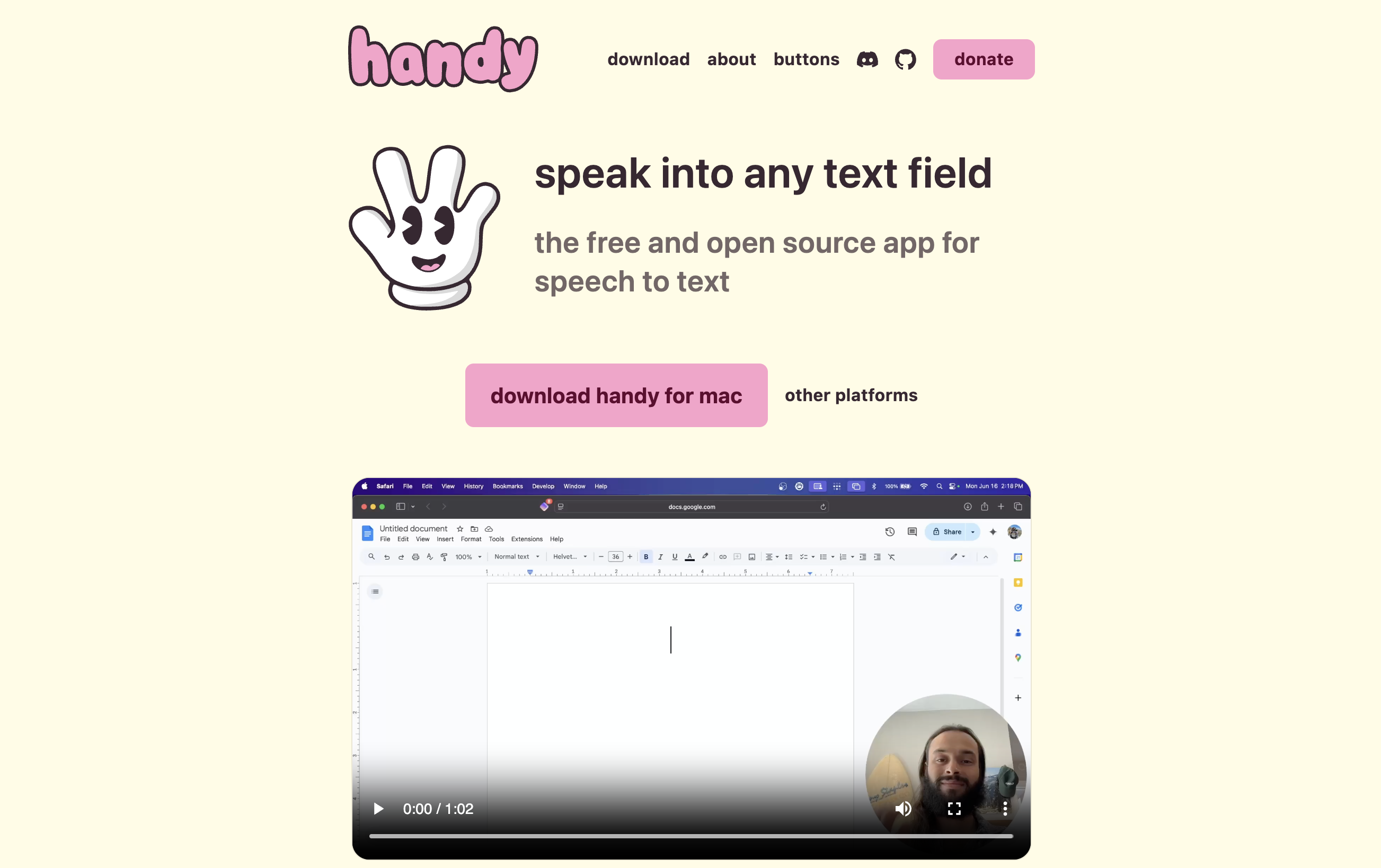
Handy is a free, open-source speech-to-text app created by CJ Pais. It runs natively on macOS, Windows, and Linux using Tauri (Rust + React/TypeScript) and performs all speech recognition on-device — there is no cloud option, no account, and no internet required after the initial model download.
What Handy Does
- Push-to-talk transcription. Press a configurable shortcut, speak, release, and Handy pastes the transcription into the active app. Toggle mode is also supported.
- Multiple local models. Whisper Small (487 MB), Medium (492 MB), Turbo (1600 MB), Large (1100 MB), plus Parakeet V2/V3 with automatic language detection, Moonshine, and Cohere Transcribe. Custom GGML models load too.
- CLI automation. Flags like
--toggle-transcription,--toggle-post-process,--cancel, and--start-hiddenenable scripting; Linux adds signal-based control. - Raycast extension (Mac). Start/stop recording, browse transcript history, manage the dictionary, and switch models from the Raycast launcher.
- Silero Voice Activity Detection. Filters silence so only speech segments are processed.
- Custom-words dictionary. User-configurable vocabulary for specialized terms.
What Handy deliberately does not offer: AI text rewriting, tone matching, filler-word removal, app-specific formatting, dedicated IDE integration, mobile apps, batch file transcription, or a cloud accuracy option.
Handy Pricing
- $0 forever under the MIT license — no tiers, subscriptions, or word limits
- Optional support via GitHub Sponsors or direct donation
Handy Architecture and Limitations
Handy is on-device by construction — the MIT-licensed source at github.com/cjpais/Handy lets anyone verify there is no cloud transmission. The honest trade-offs: a 2-5 second processing delay after you stop speaking on most hardware, near-verbatim output with minimal auto-punctuation, occasional first-word clipping, and auto-paste that can target the wrong app if you switch windows before processing finishes. Linux Wayland has limitations (wtype or dotool required; recording overlay disabled by default on many compositors).
Handy Validation
- Approximately 20,000 GitHub stars and 1,600 forks, with biweekly releases
- 5.0/5 rating on Product Hunt (small review count)
- Received 247 points on Hacker News with positive reception
- Sponsors listed on handy.computer include Wordcab, Epicenter, and Bolt AI
Feature-by-Feature: Where Each Product Wins
Price and Free Plan — Handy Wins
Handy is free forever under the MIT license — no tiers, no subscription, no word limits, and free for commercial use. Voibe Free is limited to a set number of words on one device; unlimited use starts at $9.90/month, with a 7-day free trial and a 30-day money-back guarantee. On absolute cost, nothing beats $0. If price is your only criterion, Handy wins by definition.
Open Source — Handy Wins
Handy's full source is public on GitHub under MIT, so its privacy and behavior are auditable rather than promised. Voibe is a closed-source commercial product — you verify its privacy by policy and observed behavior, not by reading the code. For users who require source-auditable software, Handy is the clear pick and Voibe does not compete on this axis.
Output Quality — Voibe Wins
Voibe's Smart Formatting adds punctuation, capitalization, and filler-word removal automatically, and spoken punctuation lets you dictate symbols by name — so the output is closer to send-ready. Handy delivers near-verbatim raw transcription with minimal auto-punctuation and no AI editing; you clean it up by hand. For emails, docs, and messages you want polished on the first pass, Voibe saves editing time.
Cloud Accuracy Option — Voibe Wins
Voibe lets you switch to a zero-retention cloud mode running open-source Whisper Large Turbo when you want maximum accuracy, with audio deleted the moment transcription completes and auto-fallback to the local model if the cloud drops. Handy has no cloud option at all — accuracy depends entirely on which local model your hardware can run. This is a genuine capability gap, though Handy's no-cloud design is also exactly what privacy-by-architecture users want.
Developer Integration — Voibe Wins
Voibe's Developer Mode is purpose-built for Cursor, VS Code, and Windsurf: it scans your workspace locally and resolves spoken file names, folder paths, and variable identifiers, and can auto-attach referenced files to the AI prompt. Handy has no dedicated IDE integration — it pastes raw text into your editor like any other app. Handy's CLI flags are a different kind of developer utility (scripting and automation), useful but not code-aware dictation.
Real-Time Dictation and Latency — Voibe Wins
Voibe's Live Dictation (Mac only) streams words on-screen as you speak so you can edit before insertion, and processing latency is low with auto-fallback. Handy has a 2-5 second processing delay after you stop speaking on most hardware and no on-screen streaming. For fast back-and-forth workflows, Voibe feels more immediate.
Cross-Platform Reach — Handy Wins
Handy ships native binaries for macOS, Windows, and Linux from a single Tauri codebase — the only offline dictation app in this class with native Linux support. Voibe runs on Mac and Windows only, with no Linux, iOS, or Android. If you need Linux, Handy is the only choice here. Caveat: Handy's Linux Wayland support has limitations. Voibe's Windows app is a native app rather than an Electron port, but it is cloud-only.
Compliance — Tie (Neither)
Neither product carries SOC 2, HIPAA BAA, or ISO 27001 attestations. Both are consumer-tier on formal compliance. For regulated work requiring a BAA, neither is the right tool — see our broader dictation guides for compliance-focused options.
Key Takeaway
Handy wins on price, open source, and cross-platform reach (Linux). Voibe wins on output polish, the cloud accuracy option, Developer Mode, real-time Live Dictation, and latency. Compliance is a tie — neither carries SOC 2, HIPAA, or ISO.
Pricing Breakdown: 3-Year Math
| Horizon | Handy | Voibe Lifetime | Voibe Annual | Voibe Monthly |
|---|---|---|---|---|
| 1 month | $0 | $199.00 | $8.25 | $9.90 |
| 3 months | $0 | $199.00 | $24.75 | $29.70 |
| 6 months | $0 | $199.00 | $49.50 | $59.40 |
| 12 months | $0 | $199.00 | $99.00 | $118.80 |
| 24 months | $0 | $199.00 | $198.00 | $237.60 |
| 36 months | $0 | $199.00 | $297.00 | $356.40 |
| 60 months | $0 | $199.00 | $495.00 | $594.00 |
The 3-Year Story
- Handy ($0) vs Voibe lifetime ($199): Handy is $199 cheaper over 3 years — free wins on price by definition. The question is whether Voibe's polish, cloud option, Developer Mode, and Windows app are worth $199 to you.
- Voibe lifetime ($199) vs Voibe annual ($297): Lifetime saves $98 over 3 years and pays back around month 25 versus annual.
- Voibe lifetime ($199) vs Voibe monthly ($356.40): Lifetime saves $157.40 over 3 years — pays back around month 21 versus monthly.
There is no lifetime deal to buy for Handy, because there is nothing to buy — it is free and open source at $0 forever. No one-time license can beat free on price. If Handy's raw output, 2-5 second delay, and lack of a cloud option or IDE integration cost you real editing time, Voibe's $199 lifetime is the upgrade path. For the full breakdown, see our Voibe pricing page and our Handy review.
Pros and Cons Side-by-Side
Voibe
Pros:
- On-device (Apple Silicon) or zero-retention cloud with open-source models — your choice, no BYO API keys
- Smart Formatting and spoken punctuation deliver polished, send-ready output
- Developer Mode for Cursor, VS Code, and Windsurf with local file and folder name resolution
- Live Dictation (Mac only) streams words on-screen in real time
- Native Windows app plus Mac; low latency with auto-fallback if cloud drops
- $199 lifetime locks in cost forever; custom dictionary and Memory shortcuts; 90+ languages
Cons:
- Free plan is limited (limited words, one device) — unlimited use from $9.90/month (7-day trial, 30-day money-back guarantee)
- Closed source — not auditable like Handy's MIT code
- No Linux, iOS, or Android — Mac and Windows desktop only
- On-device mode and Live Dictation are Mac-only; Windows and Intel Macs are cloud-only
- No SOC 2, ISO 27001, or HIPAA BAA
Handy
Pros:
- Free forever under MIT — no tiers, subscriptions, or word limits; commercial use allowed
- 100% offline by architecture with source-auditable code (~20k GitHub stars)
- Cross-platform including native Linux via AppImage
- Multiple local models (Whisper, Parakeet V2/V3, Moonshine, Cohere) plus custom GGML loading
- CLI automation flags and a Raycast extension for power users
- Silero VAD silence filtering; active biweekly releases
Cons:
- Raw, near-verbatim output with minimal auto-punctuation and no AI editing
- 2-5 second processing delay on most hardware; no cloud accuracy option
- No dedicated IDE integration (no file or folder name resolution)
- No mobile app, no batch file transcription, no formal support or SLA
- Linux Wayland limitations; occasional first-word clipping and wrong-app auto-paste
Which One Should You Pick?
Five questions, in order. Stop at the first one where you have a clear answer — that determines the right product for you.
- Do you need it to be free? If yes — Handy. It is $0 forever under MIT with no tiers or limits. Voibe's free plan is limited to a set number of words on one device. No paid license can beat free on price.
- Do you need open-source, source-auditable software or native Linux support? If yes — Handy. It is the only option here that is MIT-licensed and runs on Linux (via AppImage). Voibe is closed source and Mac + Windows only.
- Do you want polished, send-ready output instead of editing raw transcription? If yes — Voibe. Smart Formatting and spoken punctuation clean up the text as you dictate; Handy delivers near-verbatim output you fix by hand.
- Do you want zero-config voice-to-code in Cursor, VS Code, or Windsurf, or Live Dictation on Mac? If yes — Voibe. Developer Mode resolves spoken file and folder names, and Live Dictation streams words on-screen. Handy has neither.
- Do you want a cloud accuracy option or a native Windows app? If yes — Voibe. Its zero-retention cloud mode runs open-source models when you need maximum accuracy, and its Windows app is a native build. Handy is on-device only and has no Windows-specific accuracy path beyond local models.
The pattern: Handy wins on free, open source, and Linux. Voibe wins on polish, developer features, the cloud option, real-time dictation, and Windows. Both are real products with real engineering behind them — the choice is about fit, not quality.
Final Verdict: Different Fits
Voibe wins for:
- Users who want polished, send-ready output without editing raw transcription
- Developers using Cursor, VS Code, or Windsurf who want file and folder name resolution
- Anyone who wants a cloud accuracy option alongside on-device mode, with no BYO API keys
- Mac users who want Live Dictation streaming on-screen, and Windows users who need a native app
- Buyers who prefer lifetime pricing ($199) that locks in cost forever
Handy wins for:
- Users who want genuinely free dictation — $0 forever under MIT
- Open-source advocates who want source-auditable architecture
- Linux users (Handy is the only offline dictation app in this class with native Linux)
- Privacy-by-architecture users who want no cloud option to misconfigure
- Developers who value CLI automation and custom GGML model loading over polished output
Honest tie zones: on-device Whisper accuracy on Apple Silicon (both inherit the same accuracy band), and formal compliance (neither carries SOC 2, HIPAA BAA, or ISO 27001). And two clean Handy wins that $199 cannot buy back: it is free, and it is open source. We say so plainly.
If you cannot pick from the bullets above, try both. Handy is free — install it and use it for a week. Voibe ships a 7-day free trial with full feature access — install it and use it for a week. The one that fits your workflow will be obvious within an hour: if you find yourself hand-editing every transcript or wishing it named your files, Voibe is your upgrade; if raw output and $0 forever suit you, Handy is the honest winner.
Disclosure: Voibe is our product. The comparison above is our honest reading of where each product wins and ties, grounded in our researched Handy review and primary sources at handy.computer and github.com/cjpais/Handy. Handy genuinely beats Voibe on price, open source, and Linux; Voibe genuinely beats Handy on polish, developer features, the cloud option, and Windows. Pick the one whose strengths match your needs.
Related Comparisons
- Voibe Review (2026) — Hands-on review of Voibe's on-device and zero-retention cloud modes, Developer Mode, and Live Dictation.
- Handy Review (2026) — Full review of the free, MIT-licensed, open-source on-device dictation app for Mac, Windows, and Linux.
- Voibe vs VoiceInk — Voibe head-to-head against the closest open-source Mac peer.
- Voibe vs Spokenly — Two on-device Mac peers with different opinions on developer features and pricing.
- OpenWhispr vs Handy — Handy against its closest open-source rival, which took the opposite stance on the cloud.
- All Dictation Comparisons — The compare pillar with the full set of head-to-head reviews.
Frequently Asked Questions
Voibe vs Handy — which should I choose?
Is Voibe or Handy more private?
Is Handy really free and open source? Does that beat Voibe?
How much does each cost over 3 years?
Does Voibe work on Windows, Linux, iPhone, or Android?
Can I use Voibe or Handy for voice coding in Cursor and VS Code?
Why should I trust this comparison if Voibe wrote it?
I'm switching from Handy to Voibe — how do I migrate?
Best AI Dictation and Meeting Notes for Confidential Work
Draft letters, notes and emails 5x faster. Get meeting notes without a bot joining your call. Nothing used to train AI.
- Mac + Windows
- No bot in your calls
- Nothing used to train AI
- 7-day free trial
Want to compare plans first? View pricing →