
Is OpenWhispr Safe? Three Data Paths, Three Different Answers
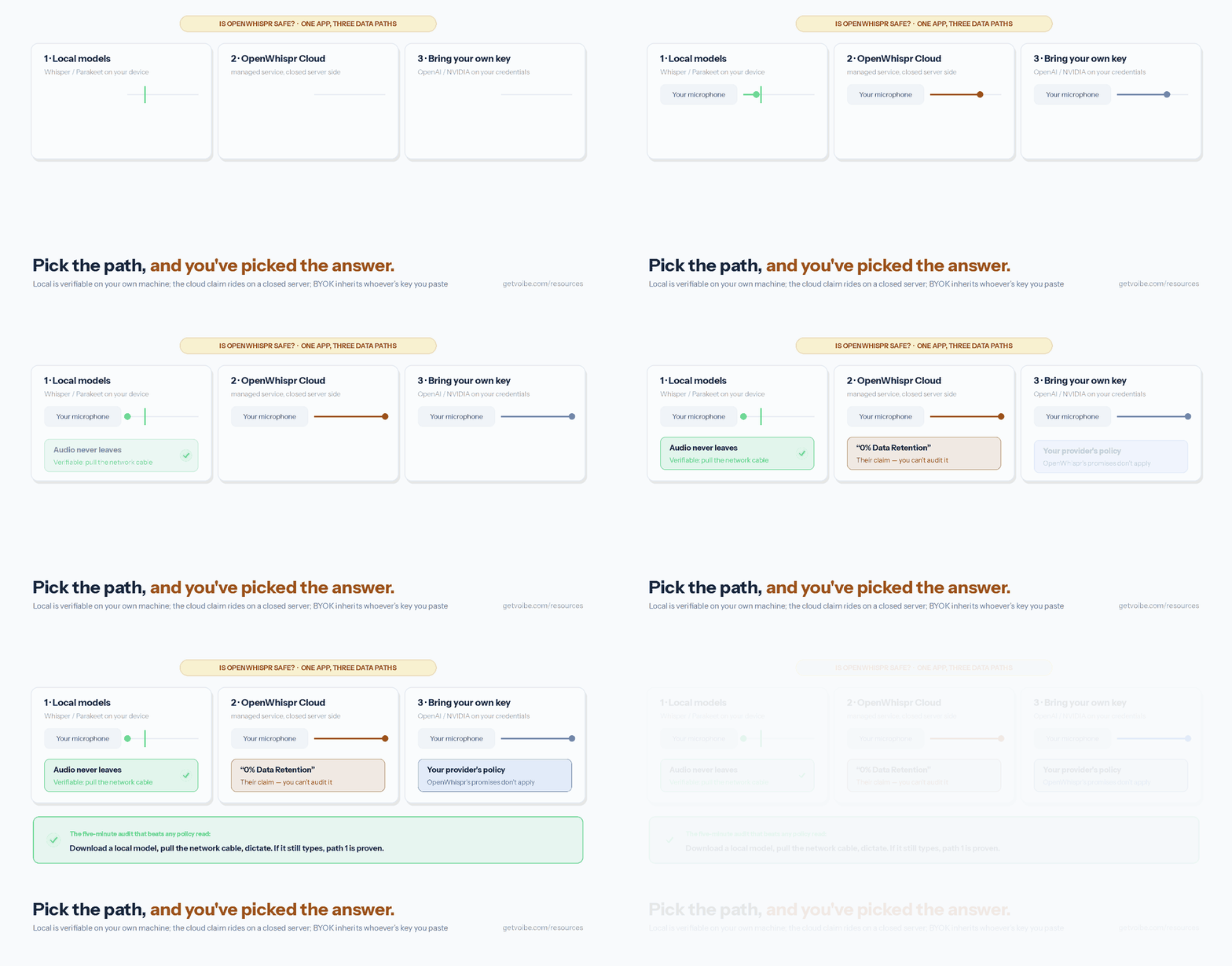
Is OpenWhispr safe? Local mode keeps audio on-device. OpenWhispr Cloud rests on vendor claims about a closed server. BYOK inherits your provider's policy.

Is OpenWhispr Safe? The Direct Answer
Paste an API key into a dictation app and you've made a privacy decision — you just made it for every sentence you'll ever dictate through it. That's the frame OpenWhispr deserves, because "is OpenWhispr safe?" has no single answer: it has three, one per data path.
Local mode: yes. Whisper or NVIDIA Parakeet run on your device, the MIT-licensed client at github.com/OpenWhispr/openwhispr is publicly auditable, and the vendor's own claim for this mode — "Your voice never reaches us" — is the kind an open client lets the community check.
OpenWhispr Cloud: probably, on their word. The company claims "0% Data Retention" and SOC 2/ISO 27001 verification — meaningful claims, but about a closed-source server you cannot audit the way you can audit the client.
BYOK mode: whatever your provider's policy says. Audio sent with your OpenAI or NVIDIA key is governed by that provider's retention and training terms, not OpenWhispr's promises.
Key Takeaway
OpenWhispr's safety is path-dependent: local mode is verifiably private (open client, on-device models); OpenWhispr Cloud rests on vendor claims about a closed server; BYOK inherits whichever retention policy your API provider applies.
Key Takeaways: The OpenWhispr Safety Picture
| Question | Local mode | OpenWhispr Cloud | BYOK |
|---|---|---|---|
| Does audio leave your device? | No | Yes — deleted after transcription, per vendor | Yes — to your chosen provider |
| Who can you verify? | The open-source client (MIT, ≈5,500 stars) | No one — server side is closed | Your provider's published policy |
| Retention claim | N/A — nothing sent | "0% Data Retention" (vendor claim) | Provider-dependent |
| Training claim | N/A | "Not used to train models" (vendor claim) | Provider- and tier-dependent |
| Account required | No | Yes | No OpenWhispr account; provider account yes |
All claims quoted from openwhispr.com and the project README, retrieved August 17, 2026.
What the Open Code Can Prove — and What It Can't
OpenWhispr's strongest safety asset is that the desktop client is MIT-licensed and public: roughly 5,500 stars, 778 forks, and 1,955 commits as of August 17, 2026. An auditable client means the community can verify what runs on your machine — which local models process audio, what the app phones home for, where transcripts are written (the stack includes a local better-sqlite3 database).
What the open code cannot prove is anything about OpenWhispr Cloud. The server that receives cloud-mode audio is closed — its retention behavior, logging, and subprocessors are exactly as visible as any proprietary SaaS, which is to say: you read the policy and decide whether to believe it. The README's headline claim, "No data collection, no telemetry, fully open source," was written for the 2025-era product; it sits awkwardly beside a 2026 product line with hosted accounts, device sync, and per-seat billing. That's not an accusation — it's the honest observation that "fully open source" now describes the client, not the product.
One more verifiable gap: the README does not document where BYOK API keys are stored on disk. Open code means you can find out; undocumented means most users won't.
The Vendor's Claims, Quoted Exactly

Because cloud-mode safety rests on OpenWhispr's word, that word should be quoted, not paraphrased. From openwhispr.com, retrieved August 17, 2026:
- Local processing: "Your voice never reaches us."
- Cloud retention: "0% Data Retention" — "Switch the cloud on and your audio goes out to be transcribed, then it's gone the moment the words come back."
- Training: "Your transcriptions are not used to train models or improve the product. If that ever changes, it will be opt-in and we will ask first."
- Compliance: "AICPA SOC 2 & ISO 27001 — Independently verified," and on health data: "Whether you use local or cloud processing, we keep your health information safe."
These are better commitments than much of the category makes — an explicit opt-in promise on future training is stronger language than most of the category ships. Two caveats keep them in perspective: the claims describe a server no one outside the company can inspect, and we could not locate a published BAA offer on the public site — so regulated users should treat the HIPAA-adjacent sentence as marketing shorthand until OpenWhispr's compliance team puts specifics in writing. Our dictation and HIPAA guide explains why no app badge settles that question.
Warning
A '0% retention' claim about a closed server is a promise, not a property. It may well be true — but unlike OpenWhispr's local mode, you cannot verify it, only weigh the vendor's credibility and certifications.
BYOK Mode: Whose Key, Whose Rules
Bring-your-own-key is OpenWhispr's most distinctive path and its most misunderstood one. The mental model that matters: in BYOK mode, OpenWhispr is the pipe, not the policy. Your audio travels on your credentials to the speech-to-text provider you configured (OpenAI and NVIDIA appear as options), and its retention, logging, and training treatment are whatever that provider's terms say for your account tier. OpenWhispr's "0% Data Retention" claim covers OpenWhispr Cloud — not traffic you route elsewhere with your own key.
The same logic applies twice over to the LLM formatting layer, which can send transcribed text to GPT-5, Claude, Gemini, Groq, or OpenRouter with your keys. Text is more sensitive than audio in one respect: it's already parsed, searchable, and quotable. Provider policies differ meaningfully by tier — API traffic is typically handled under different retention rules than consumer chat products, and some providers offer zero-retention arrangements for qualifying accounts. We maintain a worked example in our Claude API data retention guide, and the AI Privacy Tracker compares retention and training terms across 30+ tools.
Practical BYOK hygiene, regardless of provider: scope keys narrowly, set hard spending caps, rotate periodically, and read the retention section of the specific tier you're on — not the marketing page.
The OpenWhispr Safety Decision Tree
Match the path to your threat model:
- Dictating sensitive material (health, legal, unreleased work)? Stay in local mode — or use an app where local is the whole design. On this tier, Handy (no cloud path exists) and Voibe's on-device mode (Apple Silicon) are the strongest positions.
- General writing, weak hardware, want cloud accuracy? OpenWhispr Cloud is a reasonable bet if the vendor's SOC 2/ISO 27001 claims satisfy you — the free tier's 2,000 words/week lets you evaluate before paying.
- Developer with existing API relationships? BYOK is fine if you've read your provider's retention terms. You're not adding a new party you don't already trust — you're reusing one.
- Compliance-bound (HIPAA, client confidentiality)? Get documentation and a BAA in writing from whichever vendor touches audio, or keep every path on-device. No public marketing page — OpenWhispr's included — settles this for you.
How OpenWhispr's Privacy Posture Compares
Where OpenWhispr sits among the tools privacy-minded users actually cross-shop:
| Tool | Strictest available mode | Cloud path in the app? | Can you audit the client? |
|---|---|---|---|
| Handy | On-device, always | No — none exists | Yes (MIT, Rust) |
| OpenWhispr | On-device (local mode) | Yes — managed + BYOK | Yes (MIT client); cloud server closed |
| Voibe | On-device (Apple Silicon) | Yes — private cloud, zero retention, self-hosted open-source models | No (client closed); no third-party AI provider in path |
| Wispr Flow | Cloud only | Yes — cloud is the product | No |
The honest summary: Handy occupies the strictest position — nothing to toggle, nothing to trust. OpenWhispr's local mode ties it in practice but shares an app with two cloud paths. Voibe trades an open client for a controlled data relationship: on-device on Apple Silicon, and a private cloud on Mac and Windows where audio is never stored, sold, or used to train AI — with no OpenAI, Google, or other Big Tech AI lab in the pipeline. Wispr Flow, whose privacy record we examine in is Wispr Flow safe, is the fully managed pole of the spectrum.
A Five-Minute OpenWhispr Safety Audit You Can Run Yourself
Before trusting any dictation app — this one included — five checks, in order:
- Confirm your active path. Open settings and note whether transcription is set to a local model, OpenWhispr Cloud, or a BYOK provider. Everything else follows from this.
- Download a local model and pull the network cable. If dictation still works offline, you've verified the local path end-to-end — the strongest test there is.
- Check what's stored locally. Transcript history lives in a local database; know where it is and clear it on your schedule if your machine is shared.
- If using BYOK: read your provider's retention terms for your tier — not the homepage. Set a spending cap on the key.
- If using OpenWhispr Cloud for work data: request the SOC 2 report. "Independently verified" is checkable — a vendor with a real attestation will share it under NDA.
Key Takeaway
The offline test is the one that matters: a dictation app that keeps working with the network cable pulled has proven its local path — no policy reading required.
Verdict: Safe in the Mode You Choose
OpenWhispr is a safe dictation app when you use it deliberately. Local mode is verifiably private and free without limits — for many users that's the whole story, and it's a good one. The cloud paths are where deliberateness matters: OpenWhispr Cloud asks for the same trust as any SaaS (backed by better-than-average claims), and BYOK quietly moves the privacy decision to whichever provider's key you paste.
If you'd rather the app make the private choice for you: Handy removes the cloud entirely, and Voibe — the app we build — pairs on-device processing on Apple Silicon with a zero-retention private cloud on Mac and Windows, so there's no key to manage and no third-party AI provider to vet. Try Voibe free if that's the trade-off you want.
Related Reading
Continue the investigation:
- OpenWhispr Review — the full product picture, including the freemium pivot
- OpenWhispr vs Handy — configuration vs architecture, head to head
- OpenWhispr Pricing — what each path costs
- Is Handy Safe? — the no-cloud benchmark this page keeps citing
- Cloud vs Local Dictation — the architecture question underneath every 'is X safe' page
- Why Offline Dictation Matters — our privacy hub
- Is FluidVoice Safe? — the same open-source-but-not-all-the-way problem, with a closed model instead of a closed server.
- OpenWhispr Alternatives — ranked replacements if the setup burden or the closed-model gap is a dealbreaker.
Frequently Asked Questions
Is OpenWhispr safe to use in 2026?
Is OpenWhispr open source?
Does OpenWhispr send my voice anywhere?
Does OpenWhispr train AI models on my dictation?
Is OpenWhispr HIPAA compliant?
Where does OpenWhispr store my API keys?
Does OpenWhispr have telemetry?
Is OpenWhispr safer than Handy?
How does OpenWhispr compare to Voibe on privacy?
Best AI Dictation and Meeting Notes for Confidential Work
Draft letters, notes and emails 5x faster. Get meeting notes without a bot joining your call. Nothing used to train AI.
- Mac + Windows
- No bot in your calls
- Nothing used to train AI
- 7-day free trial
Want to compare plans first? View pricing →
Related Articles
Is FluidVoice Safe? I Went Looking for What's Actually Open
Is FluidVoice safe? I dictated confidential work into it for three weeks, then read the repo properly. Your audio stays put — one piece of it you can't see.
7 OpenWhispr Alternatives for When You're Done Managing Keys and Caps
The best OpenWhispr alternatives by exit reason: strict no-cloud (Handy), managed simplicity (Voibe), polish (Wispr Flow), pay-once OSS (VoiceInk) and more.
Is Handy Safe? Free, Open-Source, On-Device (2026)
Is Handy safe? Yes — MIT-licensed, all transcription on-device, zero telemetry in the code, no cloud STT path at all. Caveats: young project, donation-funded.