
OpenWhispr vs Handy: Two MIT Dictation Apps, Opposite Ideas About the Cloud
OpenWhispr vs Handy compared: both free, MIT-licensed, cross-platform dictation apps — one is strictly local, one added a managed cloud. Which fits you?

OpenWhispr
MIT-licensed cross-platform dictation app (Electron) with three transcription paths: local Whisper/Parakeet, managed OpenWhispr Cloud, or bring-your-own-key.
Free (local unlimited); Pro $6.67/user/mo ($80/user/yr); Business $160/user/yr
Pros
- + Local, managed-cloud, and BYOK paths in one app
- + Unlimited free local transcription
- + Managed cloud option for weak hardware
- + LLM formatting layer (GPT-5, Claude, Gemini, Groq via your keys)
- + Near-weekly releases (v1.8.3 on Aug 13, 2026)
Cons
- - Free cloud tier capped at 2,000 words/week
- - Electron footprint heavier than native rivals
- - OpenWhispr Cloud server side is closed source
- - API-key storage location undocumented
Handy
Free, MIT-licensed, Rust-based dictation app for Mac, Windows, and Linux with no cloud path at all — every transcription runs on-device.
Free (open source, MIT license)
Pros
- + No cloud code path exists — strongest possible privacy guarantee
- + ≈29,800 GitHub stars — the category's largest OSS community
- + Lightweight Rust/Tauri build
- + Completely free: no tiers, caps, or account
- + Multiple local engines: Whisper, Parakeet, Moonshine
Cons
- - No cloud fallback for weak hardware
- - Near-verbatim output — minimal auto-punctuation, no AI formatting
- - 2–5 second processing delay on most hardware
- - No mobile app
Voibe
Native private dictation app — on-device transcription on Apple Silicon Macs, zero-retention private cloud on Mac and Windows, with Smart Formatting and Developer Mode.
$7.50/mo, $59/yr, or $149 lifetime
Pros
- + On-device on Apple Silicon; zero-retention cloud on Mac and Windows
- + Native app — no Electron weight, no model management
- + Smart Formatting cleans output without paraphrasing
- + $149 lifetime option — no subscription required
Cons
- - Not open source
- - No Linux version
- - Fully on-device mode is Mac-only
TL;DR: One Question Decides It
Two MIT licenses, three desktop platforms each, zero dollars to start — on paper, OpenWhispr and Handy are the same app. They are not. They are opposite answers to one question: should a private dictation app even have a cloud option?
Choose Handy if your answer is no — it has no cloud code path at all, which is the strongest privacy guarantee software can make. Choose OpenWhispr if you want the flexibility: local models by default, a managed cloud when your laptop wheezes, your own API key when you'd rather pay per minute than per month. And if what you actually want is local-grade privacy with none of the setup, that's the lane Voibe — the app we build — occupies.
Key Takeaway
Handy = privacy by architecture (no cloud path exists, ≈29,800 stars, pure local). OpenWhispr = privacy by configuration (local default, managed cloud + BYOK optional, freemium since 2026). Same license, opposite philosophies.
Key Takeaways: OpenWhispr vs Handy at a Glance
| Dimension | OpenWhispr | Handy | Edge |
|---|---|---|---|
| License / price | MIT; free local, cloud from $80/user/yr | MIT; 100% free, no tiers | Handy |
| Privacy model | Local by default, cloud optional | No cloud path exists | Handy |
| Flexibility | Local + managed cloud + BYOK | Local only | OpenWhispr |
| Runtime | Electron (React 19 / Electron 41) | Rust / Tauri — lighter | Handy |
| Community | ≈5,500 stars, 778 forks | ≈29,800 stars, 2,600 forks | Handy |
| AI formatting | GPT-5 / Claude / Gemini via your keys | None — near-verbatim output | OpenWhispr |
| Extras | Meetings, MCP, device sync (paid) | CLI flags, Raycast extension | Depends on you |
All figures retrieved August 17, 2026 from each project's GitHub repository and website.
Quick Comparison: Where Each App Stands
The philosophical split shows up in every row of a side-by-side. Handy answers "where does my audio go?" with a property of the codebase; OpenWhispr answers it with a settings panel. Neither answer is wrong — they serve different users. A hospital-adjacent professional and a developer with an OpenRouter balance need different tools.
| Spec | OpenWhispr | Handy |
|---|---|---|
| Platforms | macOS, Windows, Linux | macOS, Windows, Linux |
| Local engines | Whisper (Tiny–Turbo), NVIDIA Parakeet | Whisper (Small–Large), Parakeet V2/V3, Moonshine |
| Cloud engines | OpenWhispr Cloud; BYOK (OpenAI, NVIDIA) | None |
| GPU support | Metal, CUDA, Vulkan | Apple Silicon / GPU-accelerated local models |
| Latest release | v1.8.3 — August 13, 2026 | Biweekly cadence (active, May 2026 check) |
| Account required | Only for OpenWhispr Cloud | Never |
What Is OpenWhispr?

OpenWhispr is an MIT-licensed dictation app for macOS, Windows, and Linux, built on Electron, with the client source at github.com/OpenWhispr/openwhispr (≈5,500 stars as of August 17, 2026). It launched in 2025 as a pure local/BYOK tool and pivoted to freemium in 2026: local transcription remains free and unlimited, while the managed OpenWhispr Cloud runs $0 (2,000 words/week) to $80/user/year on Pro and $160/user/year on Business. It has also grown meeting recording, MCP integration, and an LLM formatting layer. Our full OpenWhispr review covers the pivot in detail.
Key Takeaway
OpenWhispr in one line: the open-source dictation client that grew a managed cloud — maximum flexibility, with a freemium meter on the convenient path.
What Is Handy?
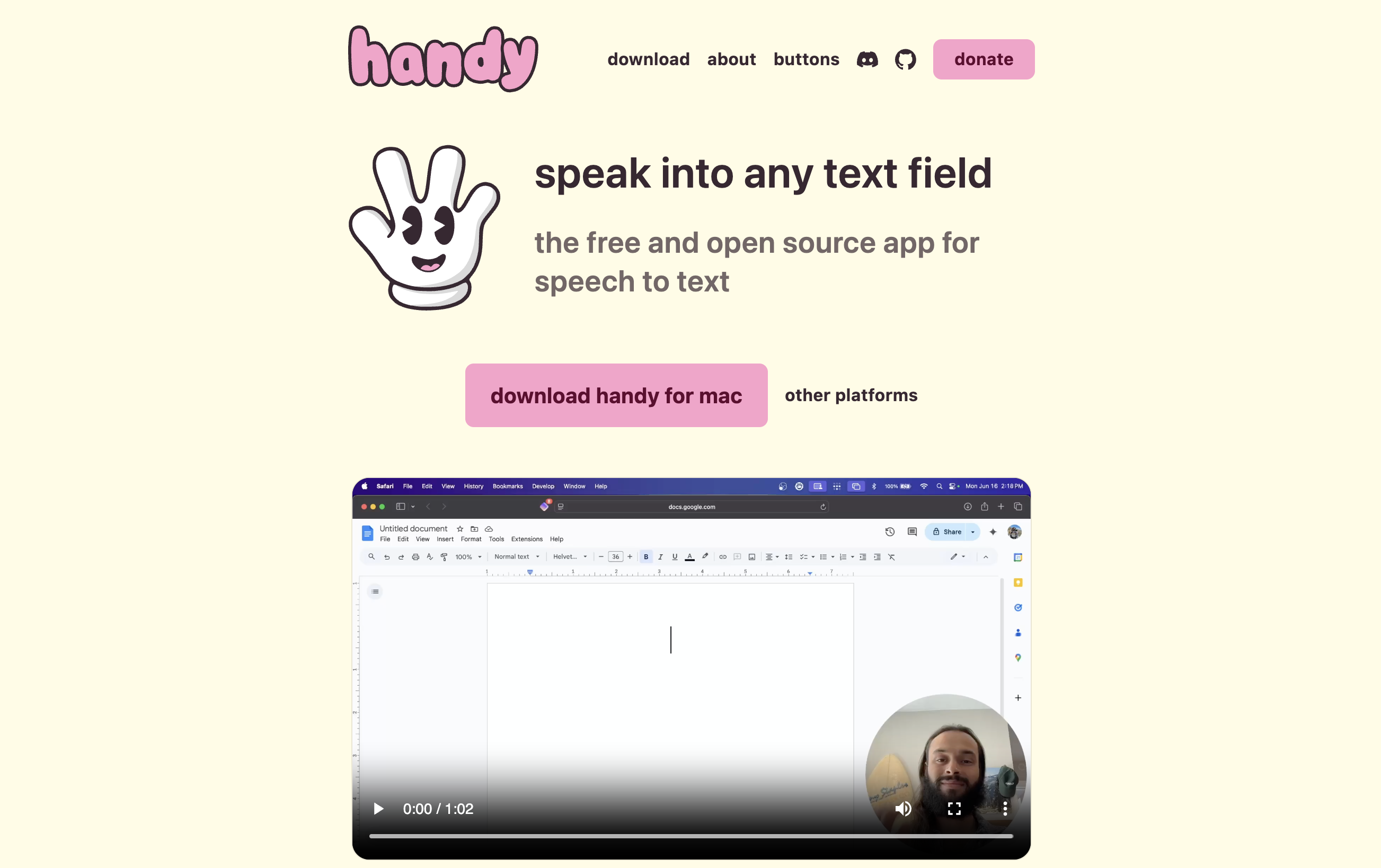
Handy is a free, MIT-licensed dictation app written in Rust by maintainer cjpais, with the code at github.com/cjpais/Handy — roughly 29,800 stars and 2,600 forks as of August 17, 2026, the largest community of any open-source dictation project. Its description is exact: "a free, open source, and extensible speech-to-text application that works completely offline." There is no cloud mode, no account, and no paid tier; local engines include Whisper, Parakeet V2/V3, and Moonshine. Our Handy review and Handy pricing breakdown go deeper.
Key Takeaway
Handy in one line: the category's most-starred open-source dictation app, deliberately incapable of sending your audio anywhere.
Feature-by-Feature: Where They Actually Differ
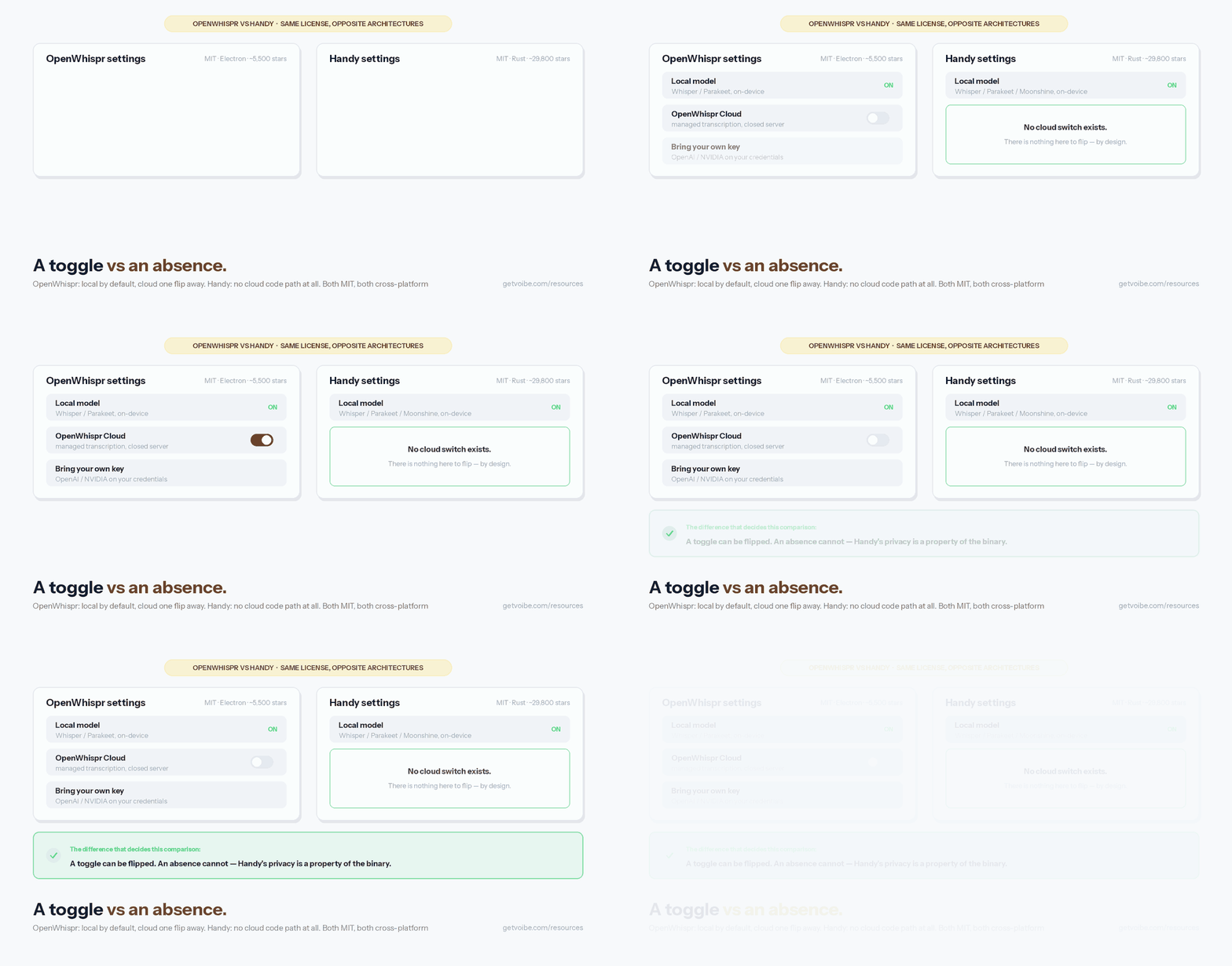
Privacy and data handling. Handy wins on guarantee: with no cloud code path, "does my audio leave the device?" is answered by the architecture, not a setting you must keep an eye on. OpenWhispr's local mode offers the same practical privacy, but the app also ships two cloud paths, and its cloud's "0% Data Retention" claim rides on a closed server you can't audit. Full analysis in is OpenWhispr safe and is Handy safe.
Transcription engines. Close to a tie, with different depth: Handy supports more local engines (Whisper, Parakeet V2/V3, Moonshine, plus Silero voice-activity detection); OpenWhispr supports fewer local engines but adds two cloud paths Handy refuses on principle.
Output quality and formatting. OpenWhispr wins if you want AI cleanup — its LLM layer can format transcripts via GPT-5, Claude, Gemini, Groq, or OpenRouter using your keys. Handy's output is deliberately near-verbatim with minimal auto-punctuation; its users treat that as a feature, not a gap.
Runtime weight. Handy wins: a Rust/Tauri build is materially lighter than Electron 41 for an app that sits resident all day.
Maintenance and community. Handy has the star count (≈29,800 vs ≈5,500) and multi-year contributor base; OpenWhispr counters with a faster-moving product surface — v1.8.3, a Linux text monitor, and a Windows paste engine all shipped within one August 2026 week.
Beyond dictation. OpenWhispr alone offers meeting recordings, speaker labels (Business), device sync, and MCP integration. Handy alone offers CLI flags and a Raycast extension. Tinkerers may reasonably want both installed.
Pricing Breakdown: Free vs Freemium
Handy's pricing is a single number: $0, forever, for everything. OpenWhispr's is a matrix (all figures from openwhispr.com/pricing, August 17, 2026):
| Cost over… | Handy | OpenWhispr (local only) | OpenWhispr Pro | Voibe |
|---|---|---|---|---|
| 1 year | $0 | $0 | $80 | $59 (or $149 lifetime) |
| 3 years | $0 | $0 | $240 | $149 lifetime |
| What you give up | Cloud fallback, AI formatting | Cloud fallback | Nothing in-app; $80/yr recurs | Open source, Linux |
Stated plainly: staying local-only on either app costs $0. The moment you want a managed cloud, OpenWhispr Pro costs $80/user/year — and Voibe's $59/year is 26% less, while Voibe's $149 lifetime beats three years of Pro by $91 (38% less). BYOK sidesteps the subscription but replaces it with metered per-minute billing from your provider.
What Users and Reviewers Say
Neither app has a meaningful review-platform footprint, so community signals carry the weight. Handy's ≈29,800 GitHub stars make it the most-starred open-source dictation project we track — ahead of Buzz (≈19,400 in May 2026) and far ahead of OpenWhispr — and it holds a 5.0/5 rating on Product Hunt from its launch reviews. OpenWhispr's Product Hunt launch collected 190 upvotes with zero written reviews — no star rating exists to cite. Known user friction, from each project's issue tracker: Handy users report occasional first-word clipping and Wayland input quirks on Linux; OpenWhispr's 158 open issues skew toward platform-specific paste and permissions behavior — consistent with an Electron app iterating fast across three OSes.
Which Should You Choose?
Choose Handy if:
- Your privacy requirement is a guarantee, not a setting — no cloud path should exist at all
- You want the biggest OSS community and the lightest resident footprint
- Near-verbatim output is fine (or preferred) — you don't need AI rewriting
- You're on Linux and want the proven option
Choose OpenWhispr if:
- You want local by default with a cloud escape hatch for weak hardware or big jobs
- You already hold API keys and prefer metered billing to subscriptions
- You want LLM-powered formatting, meeting capture, or MCP integration from one app
- You like fast-moving projects and don't mind Electron
Choose Voibe if:
- You want local-grade privacy with zero model management — it's a native app, on-device on Apple Silicon, zero-retention private cloud on Mac and Windows
- You want cleanup without a cloud LLM: Smart Formatting is a bounded local pass that never paraphrases
- You'd rather pay once ($149 lifetime) than manage keys or subscriptions
Final Verdict: Different Fits, Honestly
There is no single winner between OpenWhispr and Handy — they optimize for different users and both are good at what they chose. Handy is the better strict-privacy tool: biggest community, lightest build, and an architecture that makes the privacy promise for you. OpenWhispr is the better Swiss-army tool: three transcription paths, an LLM formatting layer, and a product surface that expands monthly — at the cost of Electron weight and a freemium meter on the managed cloud.
Our honest stake in this: if you find yourself wanting Handy's privacy and OpenWhispr's convenience, that intersection is where we built Voibe — native, on-device on Apple Silicon, zero-retention cloud on Mac and Windows, $149 lifetime, and nothing to configure. Try it free, or see how it compares directly in Voibe vs Handy.
Key Takeaway
Handy for the guarantee, OpenWhispr for the flexibility, Voibe for the convenience — all three are honest choices; pick by which trade-off you'll actually live with.
Related Dictation Comparisons
More head-to-heads and deep dives:
- OpenWhispr Review — the freemium pivot, in full
- Handy Review — the strict-local benchmark
- Voibe vs Handy — managed native vs open-source local
- Handy vs Wispr Flow — free OSS vs paid cloud polish
- OpenWhispr Alternatives — when neither of these fits
- Best Open-Source Wispr Flow Alternatives — the whole OSS field, ranked
- FluidVoice vs Handy — the same audit-trail question against a different open-source app.
Frequently Asked Questions
What is the difference between OpenWhispr and Handy?
Is OpenWhispr or Handy better for privacy?
Are OpenWhispr and Handy both really free?
Which has the bigger community, OpenWhispr or Handy?
Do OpenWhispr and Handy both work on Linux?
Which is faster, OpenWhispr or Handy?
Does either app do AI formatting or cleanup?
Should I choose Voibe over OpenWhispr and Handy?
Best AI Dictation and Meeting Notes for Confidential Work
Draft letters, notes and emails 5x faster. Get meeting notes without a bot joining your call. Nothing used to train AI.
- Mac + Windows
- No bot in your calls
- Nothing used to train AI
- 7-day free trial
Want to compare plans first? View pricing →
Related Articles
7 OpenWhispr Alternatives for When You're Done Managing Keys and Caps
The best OpenWhispr alternatives by exit reason: strict no-cloud (Handy), managed simplicity (Voibe), polish (Wispr Flow), pay-once OSS (VoiceInk) and more.
OpenWhispr Review: Free Local Dictation With a Cloud Catch
MIT-licensed, runs Whisper locally on Mac, Windows and Linux for $0, and now sells a cloud tier capped at 2,000 words a week. My 7/10 OpenWhispr review.
Handy Review 2026: Free Open-Source Offline Dictation for Mac, Windows, Linux
Honest Handy review covering features, pricing, accuracy, and real limitations. See how this free open-source dictation app compares to Voibe, Wispr Flow, and Superwhisper.