
Is Claude Safe? Privacy, Data Retention & Security Review (2026)
Claude is safe for everyday use once one toggle is checked. What Anthropic collects, how long chats are kept, and how Claude compares with ChatGPT on privacy.

Is Claude Safe? The Direct Answer
Whether Claude is safe depends on which of four Claudes you mean — and most safety takes go wrong by answering all four at once. This page answers the one most people are asking about: claude.ai, the consumer chat product you use in a browser or the mobile app on a Free, Pro, or Max account. If you're actually asking about the developer CLI, our Claude Code safety review is the page you want; for the API and business plans it's the Claude API data retention guide; for plan-specific consumer detail, the Claude Pro and Max privacy explainer.
The verdict for claude.ai: safe for everyday use, with one setting checked. The strengths are real and documented: deleted conversations leave Anthropic's back-end within 30 days, incognito chats are never used for training, the privacy policy (effective July 8, 2026) states Anthropic does not sell your data or use it for advertising, and Anthropic publishes its retention numbers instead of leaving them vague. The weakness is the default: since the 2025 consumer terms update, the “Help Improve our AI models” setting is on unless you turned it off — and with it on, your chats can be retained, de-identified, for up to 5 years and used to train future models. Turn it off at claude.ai/settings/data-privacy-controls and the retention window drops to 30 days. Everything here was verified against Anthropic's live documentation on August 5, 2026.
| Dimension | The claude.ai answer |
|---|---|
| Trains on your chats? | By default yes — one toggle turns it off |
| Retention | Up to 5 years de-identified (training on) / 30 days (off) |
| Deleting a chat | Out of history immediately; off back-end within 30 days |
| Private mode | Incognito chats: 30 days, never trained, skip history and memory |
| Sells data / ads? | No, per the privacy policy |
| Confidential material? | Wrong surface — use commercial terms (API/Enterprise) or don't paste it |
Key Takeaway
claude.ai is safe for everyday use once the "Help Improve our AI models" toggle is set deliberately — off means 30-day retention and no training. The product's real risk isn't exotic: it's the training-on default plus confidential material pasted into a consumer surface that was never the right home for it.
What Anthropic Collects — and How Long It Keeps It
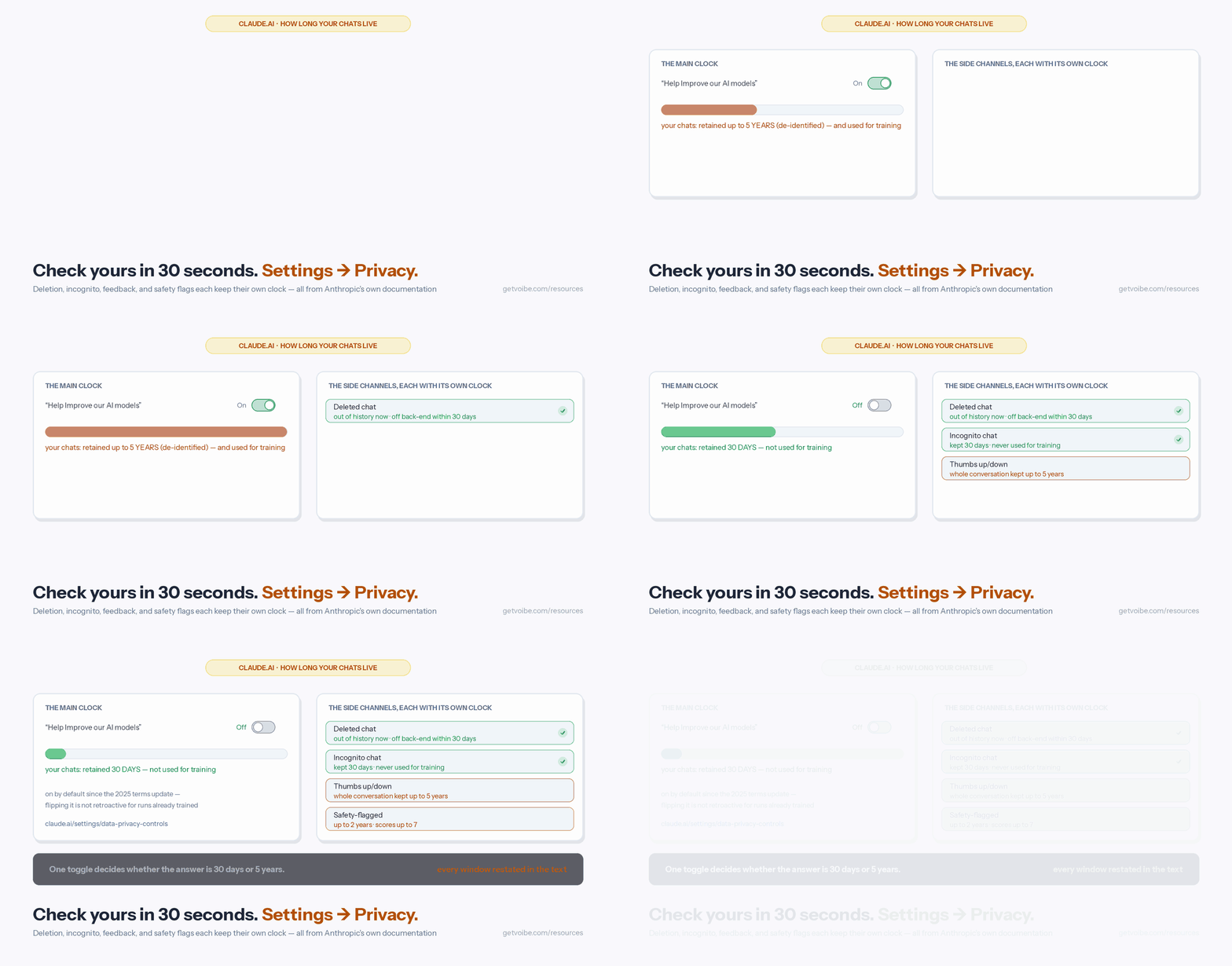
What Anthropic collects from claude.ai users is enumerable, and the current privacy policy (effective July 8, 2026) enumerates it: your identity and contact details, payment information, your inputs and Claude's outputs, feedback you submit, support communications, technical data (device, IP address, usage logs, cookies, error reports) — and, new in the 2026 policy, verification data such as age or identity checks, reflecting how much more Claude now connects to. The policy's own summary of the training question: “We may use your Inputs and Outputs to train and improve Anthropic AI models, unless you opt out through your account settings.”
How long it's kept comes down to a short list, all from Anthropic's retention documentation:
- Training on: chats retained de-identified for up to 5 years.
- Training off: 30-day retention.
- Deleted conversations: gone from history immediately, purged from back-end systems within 30 days — though content already used in completed training runs isn't clawed back.
- Incognito chats: up to 30 days, never used for training, never written to memory.
- The long-tail channels: thumbs up/down feedback stores the conversation up to 5 years; safety-flagged content up to 2 years, with classifier scores kept up to 7.
Anthropic documents all of this in plain articles rather than burying it — which is a real trust signal, and also exactly what makes the one bad default visible: none of those windows matter as much as which side of the training toggle you're on. The full consumer walkthrough — including memory management and the 2025/2026 policy-update history — is in our Claude Pro and Max privacy explainer.
Is Claude Safer Than ChatGPT?
Claude is marginally safer than ChatGPT on consumer data handling as of August 2026 — not because the policies read differently, but because of how each held up in practice. Read the two scorecards side by side first, because they're closer than either camp admits:
| Dimension | Claude (Free/Pro/Max) | ChatGPT (Free/Plus/Pro) |
|---|---|---|
| Trains on chats by default | Yes — “Help Improve our AI models,” one toggle off | Yes — “Improve the model for everyone,” one toggle off |
| Deleted chats | Off back-end within 30 days | Out of systems within 30 days, per OpenAI's help center |
| Private mode | Incognito chats — 30 days, never trained | Temporary Chats — deleted within 30 days |
| Published cap on kept-chat retention | Yes — up to 5 years, de-identified, when training is on | No equivalent published cap for kept chats |
| Deletion tested under litigation | No court-ordered suspension of consumer deletion | Court-ordered preservation May–Oct 2025, incl. deleted chats |
That last row is the story. In May 2025, a magistrate judge in the New York Times' copyright case ordered OpenAI to preserve all consumer output logs — including conversations users had deleted, overriding the 30-day promise. The order was terminated going forward on October 9, 2025, restoring normal deletion — with exceptions: logs preserved during the window stay held and accessible to the plaintiffs, and flagged accounts remain preserved. The dispute didn't end there; in July 2026 the publishers sought sanctions in a continuing fight over OpenAI's handling of chat logs. Anthropic has litigation of its own, but no court order has suspended claude.ai's consumer deletion pipeline.
The honest conclusion cuts both ways. Point for Claude: an uninterrupted deletion record, plus a published ceiling on training-data retention that OpenAI's consumer docs don't match. Point against over-reading it: the OpenAI episode proves any cloud vendor's deletion promise is a policy, suspendable by a subpoena neither you nor the vendor controls — and that structural fact applies to Anthropic too. If a conversation can't afford to exist on a server, the answer isn't picking the better chatbot; it's not putting the material on either one.
What's Reasonable to Paste Into claude.ai — and What Isn't
The pattern behind every “is it safe” question is really “is it safe for this” — so here is the working rule I apply, calibrated to the retention facts above: paste into consumer Claude only what you'd be comfortable seeing retained for 30 days on someone else's server. With the training toggle off, that's the documented posture you're accepting.
- Fine: drafts, notes, general writing, public information, research questions, brainstorming, learning, your own code that contains no secrets. This is the overwhelming majority of real usage, and consumer Claude handles it with a better-documented posture than most consumer software.
- Think first: personal financial or family details, unreleased work, internal documents. None of it is prohibited — but strip names and identifiers where you can, use an incognito chat (30 days, never trained, never in memory), and remember that deletion doesn't reach into completed training runs.
- Not on a consumer plan: client data under NDA or privilege, patient health information, passwords and API keys, anything a regulation or contract governs. This isn't because claude.ai is uniquely leaky — it's because the consumer terms simply don't carry the machinery that material requires: no zero-data-retention option, no BAA, no admin controls. Anthropic built the commercial surfaces — the API, Team, and Enterprise — for exactly that work, with a no-training default and contract-backed arrangements; the API retention guide maps them.
Credentials deserve the extra sentence: a pasted API key isn't just retained-for-30-days — it's a live secret sitting in a third-party system, and safety-flagged conversations can persist for up to 2 years. Rotate any key that lands in a chat, on any AI product, immediately.
Looking for Claude Code, the API, or Pro and Max?
This page covered claude.ai, the consumer product. The other three Claudes each have a dedicated page, because their answers differ in ways that matter:
- Is Claude Code safe? — the developer CLI, where the answer depends on whether you signed in with a consumer account or a commercial credential. The review covers the two-tier framework, the terms-update history, local transcript storage, and a deployment decision tree.
- Claude API data retention — the commercial side: the no-training default, the 30-day window, Zero Data Retention eligibility, the June 2026 Covered Models rule, HIPAA, and the Bedrock/Google/Foundry paths.
- The session transcript prompt — the terminal prompt asking whether Anthropic can look at your session transcript, what each of the three answers sends, and how to retire the question.
- Claude Code privacy settings — the configuration manual: every env var and toggle, copy-paste ready, plus session deletion.
- Claude Pro and Max privacy — the consumer plans in depth: the 5-year window, the update-notice history, incognito, deletion, and Claude Cowork.
- AI Tool Privacy Tracker — the continuously updated cross-tool comparison: Claude alongside ChatGPT, Gemini, Cursor, Copilot, and the dictation tools.
Using Claude Cowork? It is a paid-plan agent that works across your files, folders and connected tools, which makes the “what am I handing over” question much broader than a single chat message — you are pointing it at whole directories. See dictating in Claude Cowork for the two hops your words take and who controls each one.
Voibe: The Part of the Workflow That Doesn't Need a Policy
A pattern worth noticing in everything above: every safety property of a cloud AI product is a policy — a retention window, a toggle, a promise, occasionally a court order away from suspension. That's not a reason to avoid Claude; it's a reason to be deliberate about which parts of your workflow have to live on policies and which don't. Voice input is one that doesn't, and it's the part we build: Voibe is a dictation app whose privacy is architectural rather than contractual.
If you dictate into Claude — prompts, drafts, long messages, at roughly 5x typing speed — the dictation layer decides who hears your voice before any text reaches Anthropic. On Apple Silicon Macs, Voibe transcribes fully on-device with Whisper: the audio never leaves the Mac, so there's no retention window, no training toggle, and nothing a subpoena could collect from a server, because no server was involved. On Windows and Intel Macs, Voibe runs on its private zero-retention cloud with open-source models only — audio never stored, never sold, never used to train AI, as the default for every user. Smart Formatting cleans fillers locally without paraphrasing, and Developer Mode handles file names for the coding crowd. $7.50/month, $59/year, or $149 lifetime.
Clear boundary, as always: Voibe covers the audio; your text still lands in Claude under everything this page described — so set the toggle, use incognito when it fits, and keep the confidential material on the right surface. For the fuller privacy-first setup, see our voice data privacy guide and the case for offline dictation.
Info
Try Voibe for Free: download at getvoibe.com — no account, no credit card. On-device mode requires an Apple Silicon Mac (M1 or newer); Windows and Intel Macs run on the private zero-retention cloud.
Related Safety Reviews
This page is part of our is-it-safe series — privacy investigations built on primary sources, one product at a time:
- Is Claude Code Safe? — the hub for everything Claude, and the deepest of the four Claude pages.
- Is Wispr Flow Safe? — the cloud dictation tool whose screen-capture practices made it the series' cautionary tale.
- Is Superwhisper Safe? — the on-device dictation peer, and what its defaults store.
- Is DictaFlow Safe? — the case where the vendor's own privacy policy answered the question.
- AI Tool Privacy Tracker — every verdict in one continuously updated table.
- Zero Data Retention Explained — why ZDR is an enterprise contract term, and how consumer apps borrow the phrase.
Frequently Asked Questions
Is Claude safe to use?
Does Claude train on your conversations?
Is Claude safe for confidential information?
Is Claude safer than ChatGPT?
How long does Claude keep my data?
Can I delete my Claude data?
Does Anthropic sell my data or show ads in Claude?
Is Claude safe for work use?
Best AI Dictation and Meeting Notes for Confidential Work
Draft letters, notes and emails 5x faster. Get meeting notes without a bot joining your call. Nothing used to train AI.
- Mac + Windows
- No bot in your calls
- Nothing used to train AI
- 7-day free trial
Want to compare plans first? View pricing →
Related Articles
Claude Pro & Max Privacy: Retention, Training Opt-Out, Deletion
Do Claude Pro and Max train on your data? Retention periods, the training opt-out toggle, the 2025 privacy update explained, and how to delete your history.
Can Anthropic Look at Your Session Transcript? What Yes Uploads
Claude Code asks after the rating prompt. Yes uploads your transcript, subagent logs, and the raw session file, kept 6 months. What's redacted, what isn't.
Claude Code Privacy Settings: Every Opt-Out & Env Var (2026)
Every Claude Code privacy setting in one place: disable non-essential traffic, feedback survey, training opt-out, and how to delete sessions. Copy-paste ready.