
FluidVoice vs Handy: One Is Open Source. The Other Really Is.
FluidVoice vs Handy — both free, both local, both on GitHub. After three weeks in FluidVoice, only one of them is open source all the way down.

FluidVoice
Free GPLv3 macOS dictation app with on-device speech models and a closed, locally-run Fluid-1 enhancement model.
Free (GPLv3, no paid tiers)
Pros
- + Live word-by-word preview overlay as you speak
- + Fluid-1 enhancement cleans and formats transcripts locally, with no API key
- + Six local speech models including Nemotron Speech 3.5, Parakeet, and Cohere Transcribe
- + Completely free with no tiers, word limits, or account
- + Very fast release cadence — v1.6.9 shipped August 18, 2026
Cons
- - Fluid-1, the enhancement model, is closed source inside an otherwise open app
- - Anonymous analytics are enabled by default
- - Requires macOS 15 Sequoia or later; Intel Macs are limited to Whisper models
- - No Windows or Linux build ships today
- - Very small team with no formal support channel
Handy
Free MIT-licensed dictation app for macOS, Windows, and Linux with no cloud path of any kind and no AI rewriting layer.
Free (open source, MIT license)
Pros
- + MIT-licensed with no closed components anywhere in the stack
- + No cloud mode exists at all — nothing to misconfigure
- + Runs on macOS (Intel and Apple Silicon), Windows, and Linux
- + Roughly 30,500 GitHub stars and 2,700 forks
- + CLI flags and a Raycast extension for scripting and automation
Cons
- - No AI rewriting, tone matching, or formatting — output is near-verbatim
- - Minimal auto-punctuation compared to apps with an enhancement layer
- - Two to five seconds of processing delay after you stop speaking with Whisper models
- - Occasional first-word clipping reported by users
- - No mobile app on iOS or Android
Voibe
WinnerPaid on-device dictation for Mac and Windows with a zero-retention private cloud for Intel Macs and Windows.
$9.90/mo, $99/yr, or $199 lifetime
Pros
- + Runs on both Mac and Windows, including Intel Macs
- + Fully on-device Whisper mode on Apple Silicon
- + Zero-retention private cloud where audio is never stored, sold, or used to train AI
- + One-time lifetime licence option at $199
- + A team accountable for stability and support
Cons
- - Closed source — you go on the published policy rather than reading the code
- - Paid, where both FluidVoice and Handy are free
- - No Linux build
TL;DR: Both Say Open Source. Only One Means All of It.
I spent three weeks with FluidVoice as my daily dictation app. Handy is the one people keep naming as the alternative. Both are free, both live on GitHub, both keep your audio on your machine — and on the one thing they both claim, they don't actually match.
Handy goes all the way. MIT-licensed, around 30,500 stars, builds for macOS, Windows and Linux, and — this is the bit that counts — there's no cloud mode anywhere in it. Nothing to misconfigure. There's also no AI cleanup, because that would mean shipping a model you'd have to take on trust.
FluidVoice makes the practical call instead. GPLv3 app, on-device speech models, and a closed model called Fluid-1 that runs on your Mac and makes the output a lot nicer to read. The developers don't hide the arrangement: keeping Fluid Intelligence private is what pays for the free app.
So it isn't really a privacy question — both are local. It's whether you'd rather have cleaner text you can't check, or rougher text you can.
Key Takeaway
Handy is open all the way down and hands you near-verbatim text. FluidVoice is open right up to Fluid-1, the closed local model that formats your transcript. Both keep audio on your machine; only one lets you check every layer.
Key Takeaways: FluidVoice vs Handy at a Glance
| FluidVoice | Handy | |
|---|---|---|
| Licence | GPLv3 (since 2026-02-23) | MIT |
| Closed components | Fluid-1 enhancement model | None |
| GitHub stars / forks | 11,006 / 762 | ~30,500 / ~2,700 |
| Platforms | macOS 15+ (Windows in 0.0.9 pre-release) | macOS, Windows, Linux |
| Intel Mac support | Whisper models only | Full support |
| AI cleanup | Yes — Fluid-1, local, ~3.5 GB | None |
| Cloud path | Opt-in, your API key | None at all |
| Analytics | Anonymous, on by default | None |
| Price | Free | Free |
All figures retrieved from each project's repository and documentation on August 28, 2026.
The Trade in One Picture
Nobody here gives you everything. Handy gives up output quality so you can read the whole stack. FluidVoice gives up one closed component so your text arrives usable. Paid apps give up source access so you get more platforms and someone to email.
Worth asking which of those you'd miss. In practice people notice the thing they gave up, not the thing they got.
What Is FluidVoice?
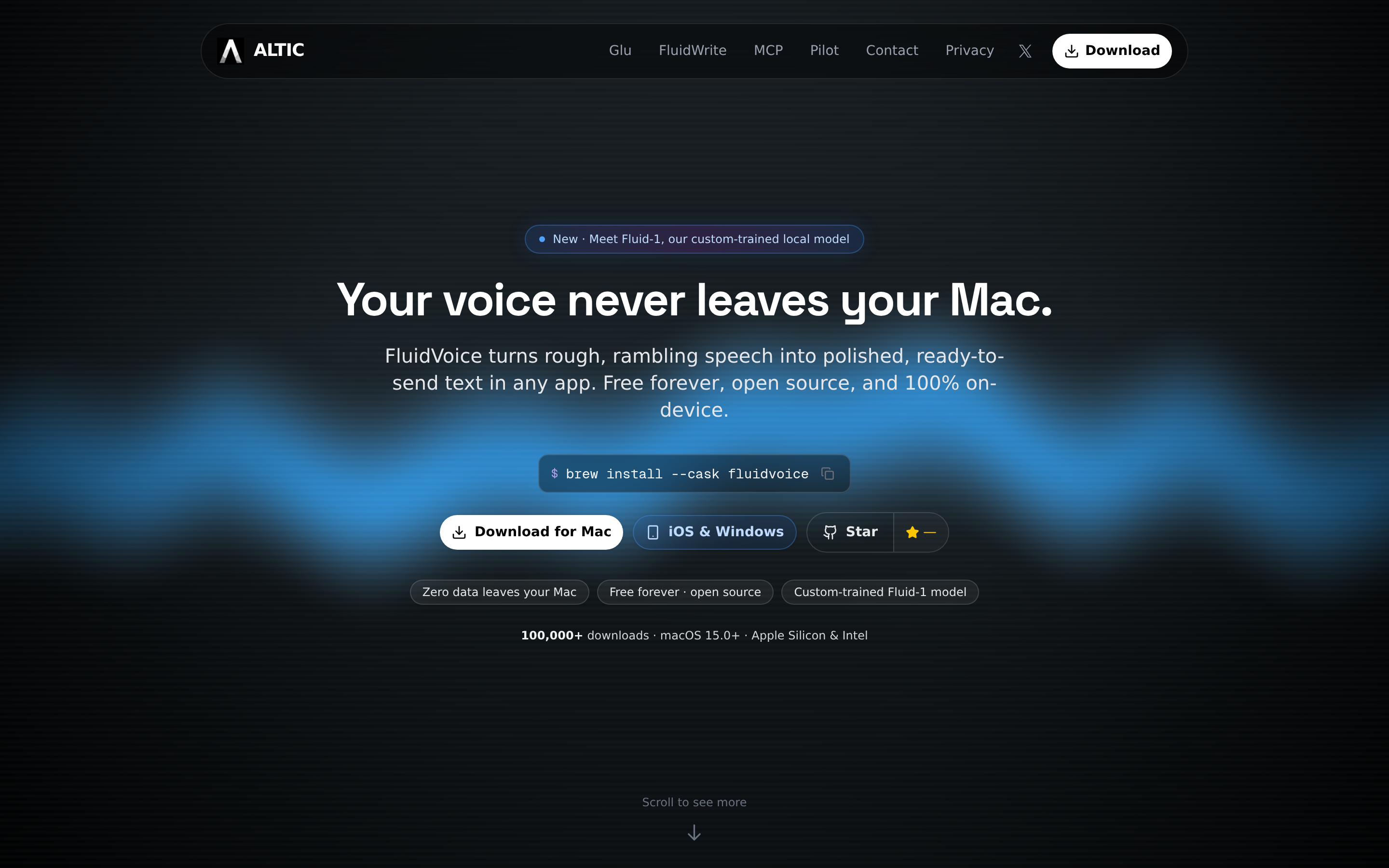
FluidVoice is a free macOS dictation app from Altic, public since September 2025 and moving fast — 11,006 GitHub stars, 762 forks, and v1.6.9 shipped on August 18, 2026. It is licensed GPLv3 as of February 23, 2026, having previously been Apache 2.0.
The speech layer is entirely local, with an unusually wide model lineup: Nemotron Speech 3.5, Parakeet Flash and TDT v2 and v3, Cohere Transcribe, Apple Speech, and Whisper. On top of that sits Fluid Intelligence, which runs the custom-trained Fluid-1 model — roughly a 3.5 GB optional download — to handle smart formatting, capitalisation, and tone. It needs no API key and works offline.
Fluid-1 is also the app's one closed component, which the README states outright: it is "a separate, privately maintained local AI runtime," kept private "so we can sustainably offer the core dictation experience for free." We unpack what that does and doesn't mean for privacy in is FluidVoice safe.
Key Takeaway
FluidVoice does more out of the box: local speech models, a live preview as you talk, and AI cleanup that runs on your Mac without an API key. One piece of it you can't look inside.
What Is Handy?
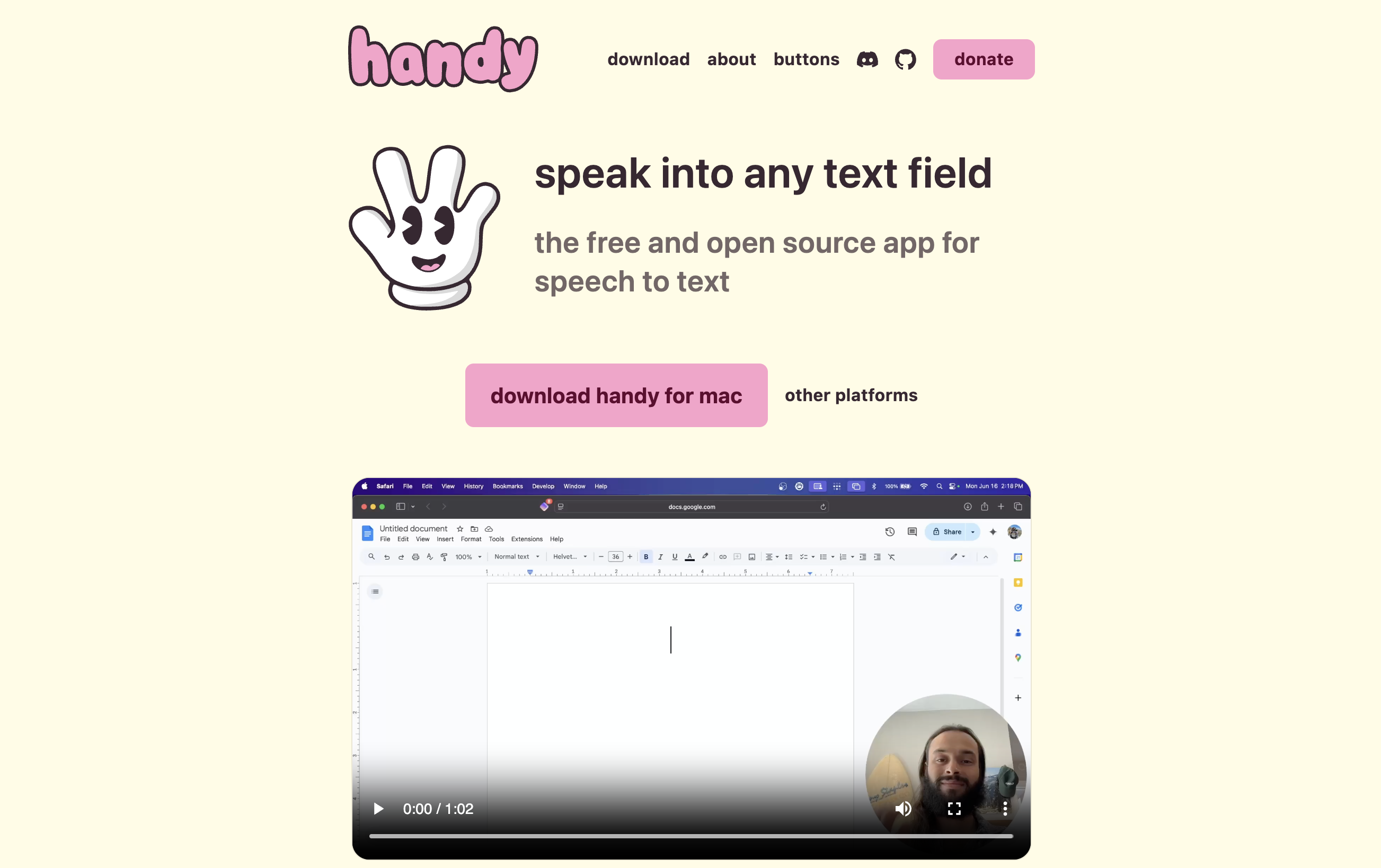
Handy is a free MIT-licensed dictation app built in Rust and Tauri, and it's the biggest open-source project in this category — around 30,500 stars and 2,700 forks as of August 28, 2026. It runs on macOS (Intel and Apple Silicon), Windows and Linux, the only app here that covers all three.
Most of what defines it is what it leaves out. No cloud mode, no account, no telemetry, no AI rewriting. Local models include Whisper in several sizes, Parakeet V2 and V3, Moonshine and Cohere Transcribe, with Silero voice activity detection to skip the silence. Developers get CLI flags and a Raycast extension.
What comes back is near-verbatim text with barely any auto-punctuation, usually two to five seconds after you stop talking on Whisper models. Some people hit occasional first-word clipping. Our full Handy review covers living with it, and is Handy safe covers how it's built.
Key Takeaway
Handy is the strictest option here: MIT-licensed, runs on all three desktop platforms, and has no way to send your audio anywhere even if you wanted it to. The cost is that it does nothing to clean your text up.
Feature by Feature: Where the Two Actually Diverge
Handy takes five of those six. The one it loses — output quality — is the one you notice on every single dictation, which is why FluidVoice keeps getting recommended anyway.
Two things settle it for most people. Platform: FluidVoice needs macOS 15 Sequoia or later, anything past Whisper needs Apple Silicon, and the Windows build is a 0.0.9 pre-release with an unsigned installer. Handy ships stable builds for Intel Macs, Windows and Linux. And the cleanup gap is bigger than it sounds — near-verbatim output means you're back to adding the punctuation and paragraph breaks yourself.
What Users and Reviewers Say
Neither app has a Product Hunt or App Store rating worth quoting, so GitHub adoption is the best signal available — and it isn't close. Handy sits at roughly 30,500 stars and 2,700 forks; FluidVoice at 11,006 and 762. Some of that is just age: Handy has been around longer, and FluidVoice's repository only opened in September 2025.
FluidVoice was also picked as the top macOS option in Adam Jones's independent test of 21 Wispr Flow alternatives, which is a genuine outside vote for the output quality.
Set against that, three weeks of using it daily turned up a run of problems: my microphone handling broke more than once, switching to AirPods froze dictation, and one update mid-test started clipping the first word of every sentence until I rolled back. The cleanup layer occasionally summarised instead of tidying. Handy's problems are duller — first-word clipping and the wait after you stop talking.
Roughly: FluidVoice tries more and breaks in more interesting ways. Handy does less and does it the same way every time.
Which Should You Choose?
Go with FluidVoice if you're on Apple Silicon running macOS 15 or later and you want your dictation to land already formatted without pasting an API key anywhere. Turn analytics off in the first minute. You're taking Fluid-1 on trust rather than reading it — that's the deal.
Go with Handy if you're on Windows, Linux, an Intel Mac or macOS 14 and earlier, where FluidVoice either won't run or is still a 0.0.9 pre-release. Same answer if one closed component rules an app out for you. You'll be punctuating your own text and waiting a few seconds for it.
Look at Voibe if neither of those works — you need Mac and Windows on one licence, you want the cleanup, and you want someone to chase when it breaks. It runs on Mac and Windows: the fully on-device Whisper mode is Mac-only (Apple Silicon), while Intel Macs and Windows use Voibe's zero-retention cloud — open-source models on zero-retention providers, where audio is never stored, sold, or used to train AI. $9.90/mo, $99/yr, or $199 lifetime — Voibe for Windows covers the native Windows app. It's closed source, and that's what you're giving up for the rest of it.
Final Verdict
Handy is the better open-source app. FluidVoice is the better dictation app. If "open source" is what you were after, Handy is what you meant — nothing closed inside it, and it runs on every desktop platform. If you're on a recent Apple Silicon Mac and you want your words to arrive punctuated, FluidVoice does that for free, and the part you're trusting never leaves your machine.
The one bad outcome is picking FluidVoice because it's open source without realising Fluid-1 isn't. Once you know that, either choice holds up.
Key Takeaway
Handy wins on what you can check, how many platforms it covers, and telemetry. FluidVoice wins on the thing you notice every day — text that arrives clean. Both are free, so getting it wrong costs you an evening.
Related Dictation Comparisons
- Is FluidVoice Safe? — the full breakdown of what's open, what's closed, and where each piece runs.
- FluidVoice Alternatives — what to run on Windows, Intel Macs, and macOS 14 or earlier.
- FluidVoice Review — three weeks of daily dictation, including what broke.
- Handy Review — the free MIT-licensed offline app in day-to-day use.
- OpenWhispr vs Handy — the same open-source question with a cloud tier attached.
- Best Open-Source Wispr Flow Alternatives — the wider field, ranked.
- All Dictation App Comparisons — the hub for every head-to-head on the site.
Frequently Asked Questions
Is FluidVoice or Handy more open source?
Which is more private, FluidVoice or Handy?
Does Handy have an AI cleanup feature like Fluid Intelligence?
Can I run FluidVoice on Windows or Linux?
Which one works on an Intel Mac?
Which has more community trust?
Should I use FluidVoice or Handy for confidential work?
Is there a paid app that solves both problems?
Do either of them cost anything?
Which should I try first?
Best AI Dictation and Meeting Notes for Confidential Work
Draft letters, notes and emails 5x faster. Get meeting notes without a bot joining your call. Nothing used to train AI.
- Mac + Windows
- No bot in your calls
- Nothing used to train AI
- 7-day free trial
Want to compare plans first? View pricing →
Related Articles
7 FluidVoice Alternatives I'd Switch To After 3 Weeks With It
I ran FluidVoice as my daily driver for three weeks, then hit its walls. Seven FluidVoice alternatives, sorted by whichever wall stopped you first.
FluidVoice Review: Free, Open Source, and My 7/10 Verdict
FluidVoice is a free, open-source Mac dictation app that runs on-device. My 7/10 after 3 weeks: where to get it, what broke, and whether Windows works yet.
Handy Review: Free Offline Dictation for Mac, With One Catch
Handy review: free, MIT-licensed speech-to-text that runs offline on Mac, Windows and Linux, with 32.9k GitHub stars. Our verdict: 7.5/10. The catch is polish.