
The 8-Second Sentence: 89,791 Dictations Say Nobody Dictates a Document
The median dictation is 15 words and 8 seconds, and half are followed by another within a minute. What a dictation tool should be built for, from Voibe's data.

The median dictation was 15 words and 8 seconds. Half of them were followed by another one within a minute.
Dictation software spent twenty-five years being built for the memo. Open the app, talk for ten minutes, fix the mistakes. Nobody does that. They hold a key, say a sentence, let go, read it, and hold the key again.
Those numbers come from 89,791 dictations through Voibe in one month, and they change what a dictation tool is for.
TL;DR: People don't dictate documents. They dictate sentences, a hundred times a day, mostly into AI assistants and code editors. A tool built for that needs a key you can press all day, text that lands before you look away, punctuation you never say, and mistakes that cost nothing. Those four things are the hundred-press test.
| Number | What it means |
|---|---|
| Median dictation: 15 words, 8 seconds | A dictation is a sentence, not a document |
| 50% followed by another within 60 seconds | People dictate in runs, the way they type |
| 3.4% of dictations carry 25% of the words | The paragraphs exist, and most go to an AI |
| 91 of 269 people ever said “comma” | Punctuation has to be automatic |
| 17% of dictations are 1–5 words | Short presses and mis-presses must be cheap |
Key Takeaway
The median dictation is 15 words and 8 seconds, and half of all dictations are followed by another within 60 seconds. A dictation tool should be built for a hundred short presses a day, not one long recording.
The Median Dictation Is 15 Words and 8 Seconds
Three numbers from 89,791 dictations:
- Median: 15 words, 8 seconds. Half of all dictations are shorter than this.
- Average: about 26 words, 16 seconds. The average is pulled up by a small number of long ones.
- 90th percentile: 61 words, 32 seconds. Nine in ten dictations are under half a minute.
Voibe caps a single press at five minutes. 79 dictations hit that cap in the whole month, out of 89,791. On a ruler that runs to five minutes, the median sits at the first tick.
That is what a dictation is now: a sentence. Sometimes two. Not a memo.
Half of All Dictations Are Followed by Another Within 60 Seconds
A short dictation on its own could mean people only use voice for quick notes. The gaps between dictations say otherwise.
- 50% of dictations are followed by another within 60 seconds.
- 28% are followed by another between one and five minutes later.
- 22% come after a longer break, or are the last one of the day.
So the typical session isn't one dictation. It's a run of them. Hold, speak a sentence, release, read what landed, hold again. It's exactly how people type: a sentence, a glance at the screen, the next sentence.
The thing that changed isn't the shape of writing. It's the input. The sentence still comes out one at a time. It just comes out at speaking speed now.
Key Takeaway
Half of all dictations are followed by another within 60 seconds and 78% within five minutes. People dictate in runs of sentences, not in single long recordings.
What the 8-Second Sentence Looks Like
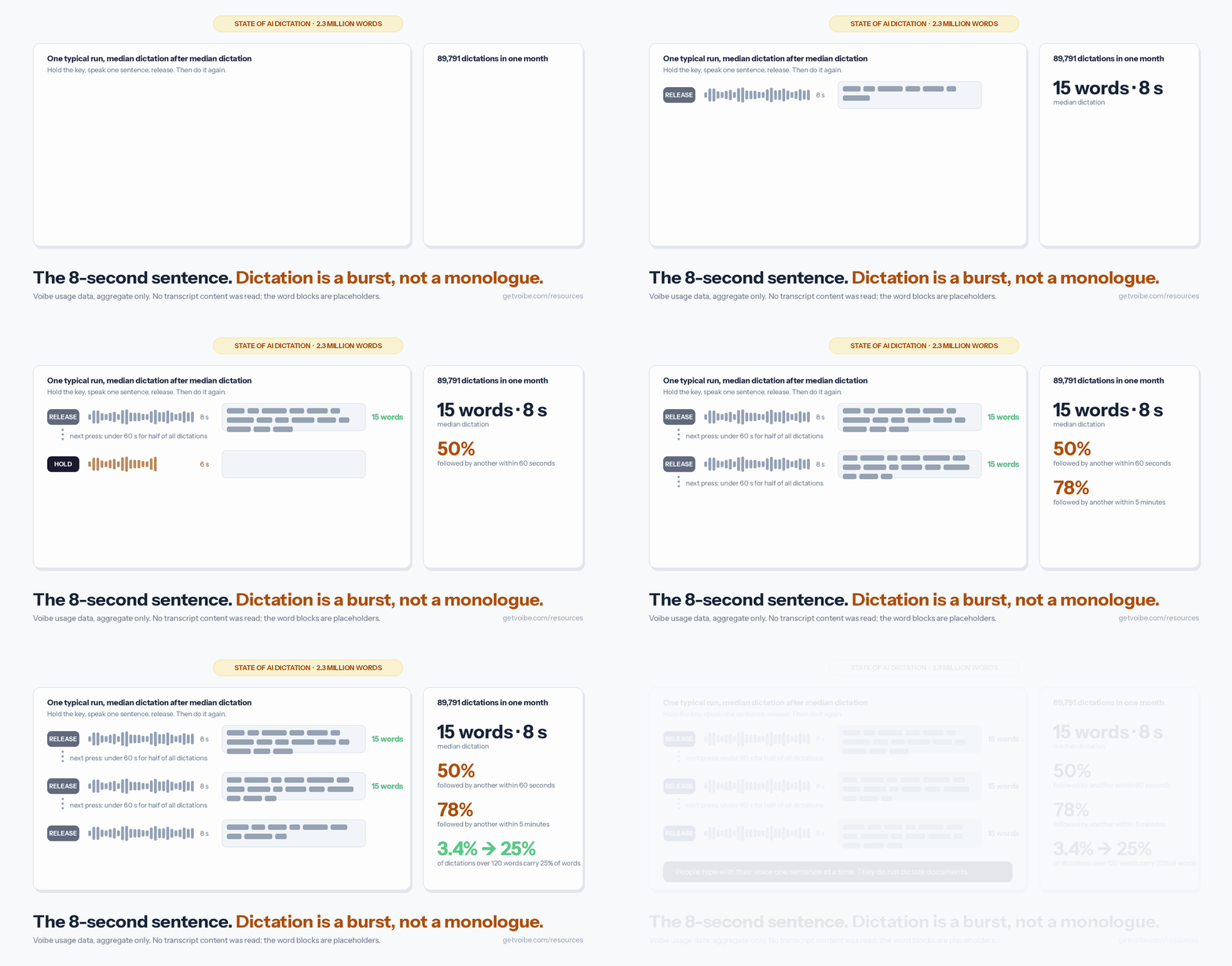
Press. Say one thought. Release. Read it. Press again.
Where the Paragraphs Go: 3.4% of Dictations Carry 25% of the Words
Long dictations exist. They're just rare, and they go somewhere specific.
| Dictation length | Share of dictations | Share of all words |
|---|---|---|
| 1–5 words | 17% | 2% |
| 6–15 words | 34% | 12% |
| 16–30 words | 24% | 19% |
| 31–60 words | 15% | 22% |
| 61–120 words | 7% | 20% |
| 121–300 words | 3% | 19% |
| Over 300 words | 0.4% | 6% |
The 3.4% of dictations over 120 words carried 25% of everything dictated. Those are the paragraphs.
Most of them are prompts. A dictation into an AI assistant app averaged 38.6 words. Into a code editor or terminal, 29.7. Into email, 17.1. Into a chat app, 18.3. The long dictation went to the thing that reads a whole paragraph and does something with it. The short one went to a person.
That's the split a tool has to serve: a hundred sentences a day, plus a handful of paragraphs, most of them spoken prompts.
Key Takeaway
Dictations over 120 words are 3.4% of all dictations and 25% of all words. Most of them are prompts to AI assistants, which average 38.6 words per dictation against 17.1 for email.
Dictation Software Was Built for the Memo
The classic desktop dictation product assumed a document. You opened the app. You dictated for minutes at a time. Then you went back and corrected it, often with more voice commands. The recording was the unit of work, and the correction screen was where the product lived.
That design made sense when the person dictating was a doctor or a lawyer with a letter to produce. It made sense when transcription was slow and expensive, so you batched.
None of those assumptions hold for the 8-second sentence:
- There is no document. There's a text field in Claude, a terminal, a Slack box.
- There is no correction pass. You read the sentence when it lands and fix it by hand, or say the next one.
- There is no batch. The next press is a minute away.
A tool that optimizes for the memo gets the sentence wrong in small ways that add up. A long-recording mode nobody uses. A results window that steals focus. A shortcut that's awkward to hold. Each is fine once. Over a hundred presses a day they're the whole experience.
The Hundred-Press Test: What an 8-Second Sentence Needs
If the median dictation is 8 seconds and people press the key a hundred times a day, five things matter more than anything else. Together they make the hundred-press test.
1. A Key You Can Press 100 Times a Day
The shortcut is the product. Not the settings screen, not the model picker. If the key is awkward to reach or fights another app's shortcut, you'll feel it a hundred times before lunch.
- Press-to-talk should work with a single key you can hold without contorting a hand. Our Mac dictation shortcut guide covers the conflicts that break it.
- If holding a key isn't comfortable, a hands-free mode has to exist. For anyone managing RSI, a hundred presses is a hundred small loads.
- The key has to work in every app, or you'll stop trusting it and go back to typing.
2. Text That Lands Before You Look Away
The loop is speak, release, read. If the text isn't there when your eyes get to the field, the loop breaks and you start waiting instead of working. Nobody waits a hundred times a day.
This is a feel thing more than a benchmark thing. The test is whether you ever find yourself staring at an empty field. If you do, the tool has failed the sentence, however well it handles the memo.
3. Punctuation You Never Have to Say
Of the 269 people on app builds that report it, 91 ever used a spoken punctuation command. Among those 91, the commands appeared in 4% of dictations.
Nobody says “comma” in a 15-word sentence. Punctuation has to be inferred from how you speak. A tool that needs it spoken is a tool built for the memo.
4. Works in Whatever Field the Cursor Is In
The sentence goes wherever you are. Across 89,791 dictations that meant Claude for 16% of dictations, code editors and terminals for 24%, browsers for 23%, email for 6%. Same person, same day, five different apps.
A dictation tool that lives in its own window and makes you paste is asking for an extra step on every one of those hundred presses. The text has to land at the cursor, and it has to know what kind of field it's landing in. A file name in a terminal and a sentence in an email need different handling. That's the case for features like Developer Mode in agent terminals.
5. A Cheap Mistake
17% of dictations are one to five words. Some are a one-word reply. Some are a press that caught nothing but a breath. Both should cost nothing: no error dialog, no stray text, no undo dance.
The same goes for cleanup. Smart Formatting fixes the ums and the false starts, but it has to stay bounded. If it rewrites your sentence, you'll read every result twice, and that doubles the loop. 208 people had Smart Formatting on and 45 had it off, which suggests most people trust it as long as it stays in its lane.
How to Run the Test Yourself
Don't test a dictation tool by reading a paragraph aloud. That's the memo test, and it flatters every tool.
Test it on the thing you'll actually do:
- Use it for one normal day. Messages, prompts, commit messages, replies.
- Count how many times you hesitated before pressing the key. That's the ergonomics score.
- Count how many times you waited on an empty field. That's the loop score.
- Count how many results you had to fix by hand. That's the formatting score.
By the end of the day you'll have pressed the key somewhere around a hundred times. If any of those counts is high, the tool failed the test, however good the demo looked. If you dictate in a language other than English, add a fifth count: how many results came back in the wrong language. Short clips give language detection very little audio to work with; our multilingual dictation report shows how to set your language so it never has to guess. The voice input workflow guide has the habits that make the sentence-at-a-time loop comfortable, and getting started with Voibe takes about ten minutes.
Tip
The best first test is a 15-word message to a colleague and a 40-word prompt to an AI. Those two cover most of what you'll dictate.
Frequently Asked Questions About the 8-Second Sentence
About the numbers
Where does the 8-second figure come from?
From 89,791 dictations made through Voibe over one month by a small group of users who opted in to share aggregate usage data. The median dictation was 15 words and 8 seconds. The full breakdown is in The State of AI Dictation report.
Isn't the median low because of accidental presses?
Some of the 17% of dictations under six words are mis-presses, and they pull the median down a little. But 6–15 words is the single largest band at 34% of dictations, and the 90th percentile is still only 61 words. Take out every dictation under six words and the typical dictation is still a sentence.
Does this apply outside Voibe?
The data is from a small opted-in group of Voibe users, so treat it as one tool's view. The shape, short presses in quick runs with a few long prompts, matches how people describe using other press-to-talk tools. It would not match a tool built around recording and transcribing whole meetings.
About using it
Should I dictate longer to get more out of it?
No. Dictate the way you'd type: a sentence, a look, the next sentence. Longer dictations make sense for prompts to an AI, where the whole paragraph is the unit. For messages to people, the sentence is the unit.
What if holding a key hurts?
Use a hands-free mode or a toggle instead of press-to-talk. Voibe has Hands-Free Mode, and the RSI dictation guide compares activation models across tools.
The Fine Print: Where This Data Comes From
A small subset of Voibe's users opted in, inside the app, to share usage data with us. This post is based on the data we collected from that group through the month of August 2026: 507 people who dictated at least once between 1 and 31 August 2026, 89,791 dictations. It is not our full user base and not a random sample of dictation users anywhere. The data reaches us only as totals across the whole group. There is no personal-level data in it and no per-person view for anyone at Voibe to open.
No transcript content was read for this post. In on-device mode on Apple Silicon Macs, audio and text never leave the machine. In zero data retention cloud mode, audio is deleted the moment transcription completes and is never stored, sold or used to train a model. Japanese, Chinese and Korean dictations are left out of the word-count figures because the word counter undercounts them.
Best AI Dictation and Meeting Notes for Confidential Work
Draft letters, notes and emails 5x faster. Get meeting notes without a bot joining your call. Nothing used to train AI.
- Mac + Windows
- No bot in your calls
- Nothing used to train AI
- 7-day free trial
Want to compare plans first? View pricing →
Related Articles
Claude Takes 16% of Every Dictation and 24% of Every Word: The State of AI Dictation Report
One app is now where people talk most. Claude gets 24% of every dictated word, AI assistants 31%, and people say twice as much to a machine as to a colleague.
The Best Wispr Flow Alternatives for Windows — From Someone Who Built One
Wispr Flow's Windows app is an Electron port users clock at ~800MB idle. I make a competitor — here are 7 alternatives ranked honestly, two of them free.
6 Best AI Dictation Apps for Windows — Ranked by Who Actually Built for Windows
Six AI dictation apps are actually great on Windows in 2026. We ranked them — including the one we built from the ground up for Windows — with verified pricing.