
The Granola Lawsuit, Explained: When "No Bot in the Call" Becomes a Wiretap Claim
A federal class action says Granola's invisible notetaker records everyone and trains AI on it by default. I read all 38 pages — here's what it means for you.

What the Granola Lawsuit Alleges: The Short Version
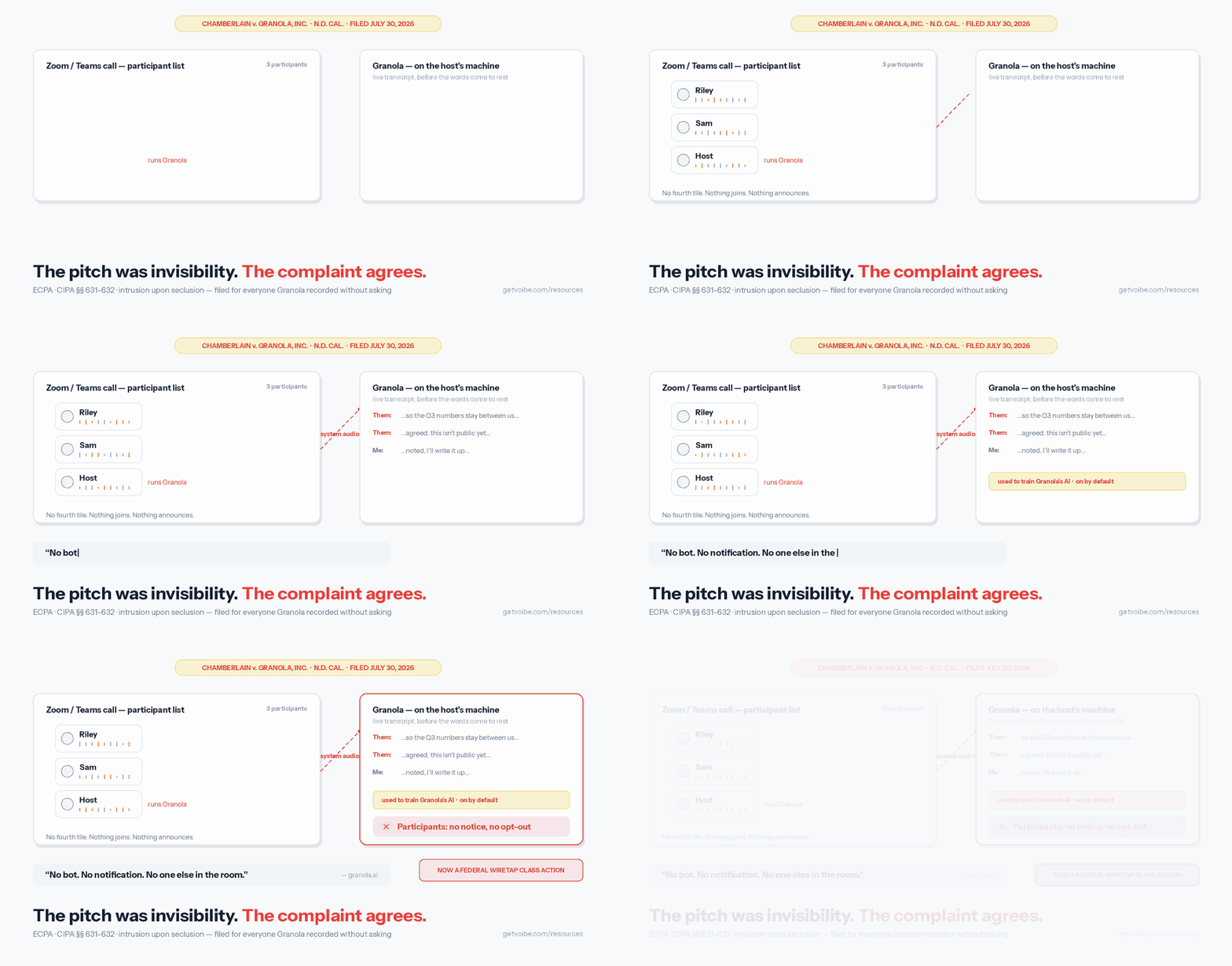
The first sentence of the complaint is: “This case concerns spyware.” The product it is describing is Granola — the fastest-growing AI notetaker of the past two years, and the one whose entire pitch is that nobody else in the meeting can tell it's running.
TL;DR: The Granola lawsuit — Chamberlain v. Granola, Inc., No. 3:26-cv-07926 (N.D. Cal., filed July 30, 2026) — is a putative class action alleging that Granola secretly intercepts, records, transcribes, and interprets the communications of every participant in virtual meetings without their knowledge or consent, and then, by default, uses those communications to train its AI models. It brings seven claims — federal Wiretap Act (ECPA), California Invasion of Privacy Act §§ 631 and 632, California's computer-fraud statute (CDAFA), intrusion upon seclusion, the Unfair Competition Law, and unjust enrichment — on behalf of a proposed nationwide class and a California subclass. The named defendants are Granola, Inc. (Delaware) and its UK affiliate Granola Labs Ltd.
I read all 38 pages of the complaint (the full PDF is on CourtListener) so you don't have to. What makes this case different from the earlier notetaker suits is that the plaintiff's core evidence is Granola's own marketing. The homepage still says it today: “No bot. No notification. No one else in the room.” The complaint's argument, compressed to one line: what Granola sells as its defining feature is what wiretap statutes were written to prohibit.
Granola has not yet responded in court. Everything in a complaint is an allegation until proven, and defendants win these fights often enough that nobody should treat filing day as a verdict. But whichever way it resolves, the case matters now — for anyone who runs Granola, anyone who sits in meetings where somebody might, and anyone deciding which of the four voice-tool categories their team should standardize on.
Key Takeaway
Chamberlain v. Granola targets the exact design Granola markets as its differentiator: meeting capture with no bot and no notification. If the theory holds, "invisible by design" becomes "wiretap by design" — and the entire bot-free notetaker pattern inherits the risk.
Key Takeaways: Chamberlain v. Granola at a Glance
Chamberlain v. Granola, Inc. was filed on July 30, 2026 in the U.S. District Court for the Northern District of California. Here is the case in one table:
| Item | Detail |
|---|---|
| Case | Chamberlain v. Granola, Inc., No. 3:26-cv-07926 (N.D. Cal.) |
| Filed | July 30, 2026 (docket on CourtListener) |
| Plaintiff | Tarra Chamberlain, Brevard County, Florida — a meeting participant, not a Granola user |
| Defendants | Granola, Inc. (Delaware corporation) and Granola Labs Ltd. (UK affiliate) |
| Plaintiff's firms | Schubert Jonckheer & Kolbe LLP (San Francisco); Lowey Dannenberg, P.C. (White Plains, NY) |
| Core allegation | Granola intercepts and records all meeting participants without knowledge or consent, and uses their communications to train AI models by default |
| Claims | ECPA (federal Wiretap Act); CIPA §§ 631, 632; CDAFA § 502; intrusion upon seclusion; UCL § 17200; unjust enrichment |
| Proposed classes | Nationwide: all persons in the US whose communications were recorded, intercepted, and/or used by Granola; plus a California subclass |
| Relief sought | Statutory, actual, and punitive damages; restitution and disgorgement; injunctive relief; attorneys' fees |
| Status | Just filed — no response from Granola yet; nothing proven |
The statutory stakes, stated plainly: ECPA provides damages of the greater of actual damages, $100 per day of violation, or $10,000; CIPA provides $5,000 per violation. The complaint alleges the classes “likely consist of millions of individuals.”
The Case: A Florida Resident, Two Meeting Apps, and a Notetaker Nobody Saw
The plaintiff, Tarra Chamberlain, is not a Granola customer. That is the point of the case. She is a Florida resident who joins Microsoft Teams and Zoom meetings as part of her personal and professional life. The complaint alleges that Granola's software was present in at least one of those meetings — run by some other participant — and that her side of the conversation was intercepted, transcribed in real time, and processed by Granola without her knowledge or consent. She alleges she learned this “only shortly before the filing of this action.”
That posture — a non-user suing over what a user's software did to her — is what separates wiretap claims from ordinary privacy-policy disputes. Granola's terms of service bind Granola's users. They cannot bind the other people in the room. Whatever consent the Granola account holder gave, the complaint argues, the people being transcribed gave none, because nothing in the product tells them it is running.
Two entities are named as defendants: Granola, Inc., a Delaware corporation, and Granola Labs Ltd., a UK company in St Albans, England, described as an affiliate that jointly provides the desktop and mobile apps. The complaint was signed by Schubert Jonckheer & Kolbe, a San Francisco class-action firm, with Lowey Dannenberg of White Plains, New York appearing pro hac vice — both are repeat players in data-privacy class actions.
Warning
A complaint is one side's story. Nothing in Chamberlain v. Granola has been proven, Granola has not yet filed a response, and early-stage privacy suits are dismissed with some regularity. This article explains what is alleged and what it would mean — not what a court has decided.
How Granola Captures Meetings — and Why That Design Is the Legal Crux
Granola captures meetings by reading the computer's own audio, not by joining the call. Per Granola's documentation (quoted throughout the complaint): when the Granola user speaks, the app captures the microphone input; when anyone else speaks, it captures the system-audio output. It “passes audio directly from your microphone and system audio” to a transcription vendor and generates a live transcript while the meeting is still happening. Granola is explicit that it “does not record or save audio or video at any point during the call” — the capture is real-time interception of the stream, not playback of a stored file.
That architectural detail carries the legal weight. Wiretap statutes — the federal ECPA and California's CIPA § 631 — prohibit intercepting communications in transit, as they happen. A tool that transcribes a recording after the fact raises different (often weaker) claims than one that acquires the words while they are “live,” before, as the complaint puts it, “the communications have come to rest.” Granola's own description of how transcription works is what the plaintiff uses to place it on the wiretap side of that line.
The complaint then walks through what happens to the intercepted audio: Granola's “speaker tags” feature labels who said what using each participant's display name, and even without tags it classifies the user's microphone as “Me” and everyone else's voices as “Them.” So the product doesn't merely capture the words of people who never consented — it identifies them, attributes statements to them, and preserves the attribution in the transcript.
Here is the part that makes this case unusual: none of this is hidden in a reverse-engineering report. It is Granola's pitch. The homepage advertises “No bot. No notification. No one else in the room” — live on granola.ai as of August 1, 2026 — and explains why: “People speak differently when a recorder is in the room – especially in client calls, interviews, or early-stage discussions.” The complaint quotes that marketing and reads it as an admission: candor from people who don't know they're being recorded is the product.
Granola does ship transparency features — a message posted to the meeting chat when transcription starts, and a “Granola Watermark” on the user's video. But both are optional, off unless the user or workspace admin enables “one or both,” and Granola states it “does not configure these settings on behalf of customers.” Its consent documentation tells customers to get consent and says they “remain responsible for determining what notice or consent is required for their use case and jurisdiction.” The complaint's response to that arrangement is a section heading of its own: Granola “cannot escape its legal obligations by attempting to pass them off to Granola users.” The existence of the features, it argues, proves Granola knows participants otherwise have no idea — and the default proves it chose invisibility anyway.
The Seven Claims, Translated From Legalese
The complaint brings seven claims for relief, all against both defendants, and all but the California-subclass angles on behalf of the proposed nationwide class. Here is each claim and what it actually argues:
| # | Claim | Statute | Plain-English theory |
|---|---|---|---|
| 1 | Intrusion upon seclusion | Common law | Secretly listening to private conversations is a highly offensive intrusion into a place (a private meeting) where people reasonably expect privacy |
| 2 | Federal Wiretap Act (ECPA) | 18 U.S.C. § 2510 et seq. | Granola intentionally intercepted the contents of electronic communications in transit, without consent from the people intercepted |
| 3 | CIPA wiretapping | Cal. Penal Code § 631 | Reading or learning the contents of a communication in transit without all parties' consent violates California's wiretap statute |
| 4 | CIPA eavesdropping | Cal. Penal Code § 632 | Recording a confidential communication requires consent from all parties; Granola obtained it from at most one |
| 5 | CDAFA | Cal. Penal Code § 502 | Granola knowingly accessed and used data from participants' communications without permission — California's computer-fraud angle |
| 6 | Unfair Competition Law | Cal. Bus. & Prof. Code § 17200 | The conduct above is an unlawful and unfair business practice; the plaintiff seeks restitution and injunctive relief |
| 7 | Unjust enrichment | Common law / equity | Granola profited from training its AI on communications it had no right to take, and should disgorge those gains |
The numbers that make defendants settle: ECPA statutory damages under 18 U.S.C. § 2520 are the greater of actual damages, $100 per day of violation, or $10,000. CIPA provides $5,000 per violation. The complaint alleges the classes “likely consist of millions of individuals,” and in per-violation statutes, every captured participant in every meeting is arithmetic. This is the same exposure math driving the Otter litigation — and it is why recording-consent suits get treated as existential by the companies on the receiving end.
One more structural note: the prayer for relief asks for certification, declaratory and injunctive relief, damages in every available flavor, restitution and disgorgement, interest, and fees. The injunction request matters as much as the money — an order restricting no-notice capture would force a product redesign, not just a payment.
The AI-Training Allegation: On by Default, Opt-Out for Users Only, Irreversible Once Done
The wiretap claims would exist even if Granola only transcribed meetings. The complaint goes further, alleging that Granola exploits the intercepted communications commercially — “a quintessential wiretap” compounded by what happens to the data afterward. Three quotes from Granola's own documentation, all cited in the complaint, carry this section:
- The default: “By default on Free and Business plans, anonymised data may be used for Granola's own model improvements.” A user must find and disable the settings toggle labeled “Use my data to improve models for everyone.” On Business plans, every user must opt out separately.
- The opt-out is prospective only: Granola “cannot guarantee that anonymised data wasn't used before you changed the setting.” Flipping the toggle stops future training; it does not undo past training.
- The irreversibility: Granola's privacy policy states that “once training is complete, it is not technically possible to isolate or extract any specific data from the resulting model,” and that data incorporated into models “will not be removed” because removal “may not be technically feasible without complete model retraining.”
Now apply that to the plaintiff. The training opt-out lives in the Granola user's account settings. Tarra Chamberlain — and everyone else in the proposed class — has no Granola account, no settings screen, and no toggle. The complaint states it directly: the individuals whose communications supply the training data “are not Granola users. Thus, they have no control over what Granola does with their data.” The people with the switch are not the people being recorded.
The complaint also attacks what happens after transcription: notes can be shared via an “Anyone with the link” setting Granola itself labels “public,” viewable by non-users in a browser; integrations push summaries into Slack, Notion, HubSpot, and email; and a summary posted to Slack “remains visible even if the user later changes the underlying Granola note to Private.” This mirrors what The Verge reported in April 2026 about Granola's default-sharing behavior — an episode already logged on our AI Tool Privacy Tracker, where Granola's track-record score dropped again when this suit was filed.
Granola is being sued over this structure; nobody is suing Wispr. But the structure itself is not unusual, which is the uncomfortable part. Wispr Flow's own security FAQ says model training is on by default for trial and standard accounts and off by default for Enterprise and HIPAA customers — and in August 2026 Wispr shipped its own speech model without saying what trained it. Same shape, no lawsuit: Whose Voice Trained Canto?
Otter, Then Fireflies, Now Granola: A Year of Notetaker Lawsuits
Chamberlain v. Granola is the third major US privacy suit against an AI notetaker in under a year, and each one attacks a different link in the same chain:
- August 2025 — Otter. Brewer v. Otter.ai and three related suits, consolidated that October as In re Otter.AI Privacy Litigation (N.D. Cal.), allege Otter recorded conversations and trained AI on them without all-participant consent. Otter's defense leans on its visible bot: OtterPilot appears in the participant list, which Otter treats as notice. Whether a visible bot equals consent is the live question — our full Otter investigation covers the case in detail. On August 13, 2026 the court denied Otter's motion to dismiss on the core Wiretap Act, CIPA, and Illinois BIPA claims, holding the plaintiffs plausibly allege Otter collects and uses recordings for its own purposes, including training; computer-intrusion and most intrusion-upon-seclusion claims were dismissed with leave to amend.
- December 2025 — Fireflies. Cruz v. Fireflies.AI, refiled in 2026 as two actions in the Northern District of Illinois, alleges the capture of meeting participants' voiceprints without the written consent Illinois' Biometric Information Privacy Act requires. Different statute, same underlying act: processing the voices of people who never agreed.
- July 2026 — Granola. The cleanest no-notice theory of the three. Otter at least has a bot to point to; Fireflies, the complaint notes, “by default, alerts participants they are being recorded.” Granola provides no bot, no notification, and — per its own marketing — sells that absence as the product's defining feature.
The complaint also cites where the rest of the industry has moved: competitor tl;dv now advertises “Your recordings and transcripts are yours (not ours). And we'll never, ever use them to train AI. Ever.” Consent screens, kick-out-the-bot controls, and no-training pledges are becoming the category's table stakes — which makes a no-notice, training-on-by-default design look less like an industry norm and more like an outlier a court can isolate.
All three cases, their dockets, and every vendor's current training default are tracked side by side on our continuously updated AI Tool Privacy Tracker.
What the Granola Lawsuit Means If You Use Granola
If you run Granola, the lawsuit does not make your usage illegal — but it puts a spotlight on obligations that were always yours. Granola's own documentation says customers “remain responsible for determining what notice or consent is required for their use case and jurisdiction.” The complaint disputes whether Granola can offload that duty, but until a court says otherwise, assume it sits with you. The practical checklist:
- Announce it, every call. One sentence at the start — “I'm using an AI notetaker that transcribes this call; is everyone okay with that?” — converts the lawsuit's core fact pattern (no notice) into documented consent. About a dozen US states, including California, Florida, Illinois, Maryland, Massachusetts, Pennsylvania, and Washington, require every participant's consent to record a private conversation; Justia maintains a 50-state survey. The plaintiff here is a Florida resident — a two-party-consent state.
- Turn on Granola's transparency features. The meeting-chat notice and the video watermark exist precisely for this; both are off unless you or your workspace admin enables them. Enable both, org-wide if you administer a workspace.
- Flip off AI training. Settings → disable “Use my data to improve models for everyone.” On Business plans this is per-user — every seat has to do it. Remember the limits Granola itself states: the opt-out is prospective only, and data already trained into a model cannot be extracted.
- Audit your sharing defaults. Check whether your notes are set to “Anyone with the link,” and remember that a summary pushed to Slack persists even if you later mark the note Private.
- Keep regulated content out entirely. Patient conversations, privileged legal calls, and NDA-bound discussions do not belong in any no-notice recorder, whatever this case decides — our dictation and HIPAA guide covers the compliance side.
Enterprise buyers have one more lever: Granola's Enterprise tier has training off by default, and contracts can restrict data handling further. If your org standardized on Granola before this suit, this is the week to re-read that contract.
Info
This section is general information about a pending case, not legal advice. If your organization records meetings at scale — especially across state or national borders — the consent script and tool configuration are questions for your counsel.
What It Means If You're Just In the Meetings
If you are a meeting participant rather than a Granola user, the uncomfortable takeaway from the complaint is that there was never a reliable way to know. No bot appears, no notification fires by default, and the AI-training opt-out belongs to someone else's account. The class definition covers exactly this position: “all persons in the United States or its Territories whose communications were recorded, intercepted, and/or used by Granola.” If that turns out to include you, there is nothing to file today — no class has been certified, and if the case reaches a settlement or judgment, class members receive notice with instructions then. The realistic clock is years, not months.
What you can do now is procedural, not technical:
- Ask at the start of calls whether anyone is running an AI notetaker — naming the category matters, since bot-free tools won't show themselves. Normalize the question the way “is this call being recorded?” became normal.
- Put it in the invite. A line in the calendar invite — “please disclose any AI recording or transcription tools at the start of this meeting” — creates a written expectation that undercuts any later implied-consent argument.
- Assume candor has a transcript. The complaint quotes Granola's own explanation that “people speak differently when a recorder is in the room.” Until notice becomes mandatory — by ruling, statute, or platform policy — the safe assumption in any external call is that a recorder may be present and invisible.
- Know your state's stake. If you are in California, CIPA gives individuals a private right of action at $5,000 per violation — the same statute this class action invokes. Two-party-consent states give participants real leverage, not just etiquette.
For the broader picture of what happens to your voice once any cloud tool captures it — retention, training, subpoenas, breaches — see our voice data privacy guide.
What Happens Next in Chamberlain v. Granola
What happens next follows a predictable procedural track. Granola must respond to the complaint — and for a case like this, the near-certain first move is a motion to dismiss rather than an answer. Expect the defense to argue some combination of: the Granola user was a party to the conversation and consented, the software acted as that user's tool rather than as an interceptor, and the participants had no reasonable expectation of privacy in a multi-person video call. The complaint visibly anticipates the first argument — an entire section is devoted to why Granola “cannot escape its legal obligations by attempting to pass them off to Granola users,” pointing to Granola's design choices and its marketing of invisibility as the product's core feature.
The calibration for timing is the Otter case, filed in August 2025 in the same district: consolidation took two months, and the motion-to-dismiss hearing did not happen until July 2026. On that clock, expect Granola's motion in fall 2026, a ruling sometime in 2027, and — only if claims survive — a class-certification fight after that. Wiretap class actions rarely reach trial; the historical endings are dismissal, settlement, or settlement-plus-product-changes.
That last category is why this case matters regardless of outcome. The market has already shown how it responds to recording-consent pressure: Zoom walked back its 2023 training-terms language after public outcry; Fireflies now alerts participants by default; tl;dv advertises never training on customer transcripts. If Chamberlain survives a motion to dismiss, the cheapest path for the entire bot-free notetaker category is to make notification non-optional — a chat announcement or watermark that cannot be turned off. Watch for Granola to move in that direction voluntarily; defendants often fix the design before a court orders it, because a fixed product caps forward-looking damages.
We track every development — filings, rulings, and any Granola policy changes — on the AI Tool Privacy Tracker, which is re-verified on a monthly cadence and updated immediately on major events. The docket itself is public on CourtListener.
Key Takeaway
Expect a motion to dismiss centered on user consent, a ruling on the Otter case's ~one-year clock, and — whatever the outcome — pressure on every bot-free notetaker to make participant notification non-optional.
The Bigger Question: Do You Actually Need to Record Other People?
The bigger question this lawsuit forces is one most teams never ask: is the thing you need a recording of other people, or just your own notes? Those are different product categories with different legal exposure — our breakdown of the four voice-tool categories maps the line in detail.
If what you actually need after a call is your own summary, action items, and follow-ups, you can get there without capturing anyone: dictate your notes right after the meeting with an on-device tool. Nobody else's voice is recorded, so there is no consent question, no wiretap surface, no training corpus, and no transcript for anyone to subpoena. That architecture is why we built Voibe — ours — the way we did: in on-device mode, dictation runs entirely on Apple Silicon and audio is discarded the moment it becomes text; nothing is stored, sold, or used to train any model, at $7.50/month or $149 lifetime. The case for offline dictation is the same case the Granola complaint makes in the negative.
If you genuinely need full transcripts of other people — depositions, research interviews, sales-call review — then the lesson of Otter, Fireflies, and now Granola is that consent is the feature to buy, not the checkbox to skip. Pick a tool with explicit notification defaults, announce every recording out loud, and check the vendor's training default and litigation history on our privacy tracker before you commit a whole org to it.
If you want meeting notes without a bot but don't want them sitting on a vendor's servers, that's the gap Voibe Work (ours, launched September 2026) is built for. It captures the call from your Mac, deletes the audio once processing completes, and saves the transcript and summary on your Mac, never used for training. It's still a no-bot tool, so the consent rule above applies to it too: Voibe reminds you to tell everyone when recording starts. Before you switch, it's worth knowing that getting your notes out of Granola got harder in 2026: the local cache that export tools read is now encrypted, and full API access needs a paid plan (Granola encrypted your meeting notes has the timeline and export steps). Our list of the best Granola alternatives compares nine options on where notes are stored, and our roundup of the best no-bot meeting note takers covers the whole category.
“No one else in the room will know” was always the product. As of July 30, 2026, it's also the complaint.
The consent question and the retention question are separate, and both matter. For the retention side — what a notetaker keeps, for how long, and what its terms permit — see zero data retention explained.
Granola Lawsuit FAQ
The questions people are actually asking about Chamberlain v. Granola, grouped by what you need to know.
About the case
Is Granola being sued? Yes. Chamberlain v. Granola, Inc., No. 3:26-cv-07926, was filed against Granola, Inc. and Granola Labs Ltd. in the U.S. District Court for the Northern District of California on July 30, 2026. It is a putative class action; no class has been certified yet and Granola has not yet responded.
What does the lawsuit accuse Granola of? Secretly intercepting and recording every participant in virtual meetings without knowledge or consent, and using those communications by default to train Granola's AI models — in violation of the federal Wiretap Act, California's Invasion of Privacy Act §§ 631–632, the CDAFA, the UCL, and common-law privacy rights.
Who can be part of the class? The proposed nationwide class is everyone in the US whose communications were recorded, intercepted, or used by Granola, with a California subclass. If certification is granted and the case resolves in the class's favor, members receive notice — there is nothing to file now.
If you use Granola
Do I have to stop using Granola? No court has ordered anything. But the consent obligation is yours: announce the notetaker on every call, enable Granola's chat-notice and watermark features (both off by default), disable “Use my data to improve models for everyone,” and keep regulated content out of it. In two-party-consent states, recording without every participant's consent is its own legal exposure, lawsuit or not.
Does opting out of training protect past meetings? No. Granola states the opt-out applies to future training only, that it “cannot guarantee that anonymised data wasn't used before you changed the setting,” and that data already trained into a model cannot be isolated or extracted.
If you're a meeting participant
Could Granola have recorded me without my knowledge? That is exactly what the complaint alleges happened to the plaintiff. Granola joins no participant list and fires no default notification; unless the user enabled optional transparency features or told you, there was no way to know. The only reliable countermeasure is asking, at the start of calls, whether anyone is running an AI notetaker.
Do I get money from the Granola lawsuit? Not now, and possibly never — the case was just filed. If it eventually settles or reaches judgment on behalf of a certified class, notice will explain who qualifies and how claims work. Treat any current website or message promising Granola settlement payouts as a scam.
The bigger picture
Are all AI notetakers being sued? The three biggest consent-model patterns are all now in court: Otter (visible bot — In re Otter.AI Privacy Litigation, N.D. Cal.), Fireflies (voiceprints — BIPA suits, N.D. Ill.), and Granola (invisible capture — this case). Vendors like tl;dv and Fathom advertise no-training pledges, and Fireflies alerts participants by default; the industry is converging on notice-and-consent as this litigation proceeds.
Where can I follow the case and the category? The docket is public on CourtListener, and our AI Tool Privacy Tracker logs every notetaker's training default, retention policy, and litigation status side by side, re-verified monthly. For the sibling investigation of the Otter case, see Is Otter Safe?.
Meeting notes without a bot in your call
Voibe Work takes notes from Zoom, Teams and Meet on your Mac, with dictation included. Nothing used to train AI.
- Mac + Windows
- No bot in your calls
- Nothing used to train AI
- 7-day free trial
Want to compare plans first? View pricing →
Related Articles
8 Best No-Bot Meeting Note Takers in 2026 (Compared & Reviewed)
Best no-bot meeting note takers in 2026, compared on privacy and price: 1. Granola 2. Voibe Work 3. Quill 4. Jamie 5. Krisp 6. Anarlog 7. Bluedot 8. Tactiq
9 Best Granola AI Alternatives in 2026 (Compared & Reviewed)
Best Granola AI alternatives in 2026, compared: 1. Fathom 2. Voibe Work 3. Quill 4. Jamie 5. Wispr Flow 6. Krisp 7. Anarlog 8. Circleback 9. Otter
Granola Encrypted Your Meeting Notes. Here's What Changed and How to Get Them Out
Granola moved from an open notes file to an encrypted cache, broke community tools and put its API on paid plans. The timeline, and how to export your notes.