
We Re-Read 58 AI Privacy Policies in October. 25 Changed.
Wispr Flow now trains by default, Google Meet takes notes on its own, and Zoom got sued. Every AI privacy change we found, Sept 10 to Oct 13, 2026.

October 2026 AI Privacy Changes: The Short Version
Wispr Flow's privacy policy says you opt in to training.
Its help center, updated this month, says training is on by default for Free and Pro.
Both can't be true. That one contradiction was the biggest move in this month's review of our AI Privacy Tracker, and it wasn't close to the only thing that changed.
TL;DR: between September 10 and October 13, 2026, we re-read the privacy policies, help centers, court dockets and security advisories for all 58 tools we track.
- 25 tools changed score. One new tool was added.
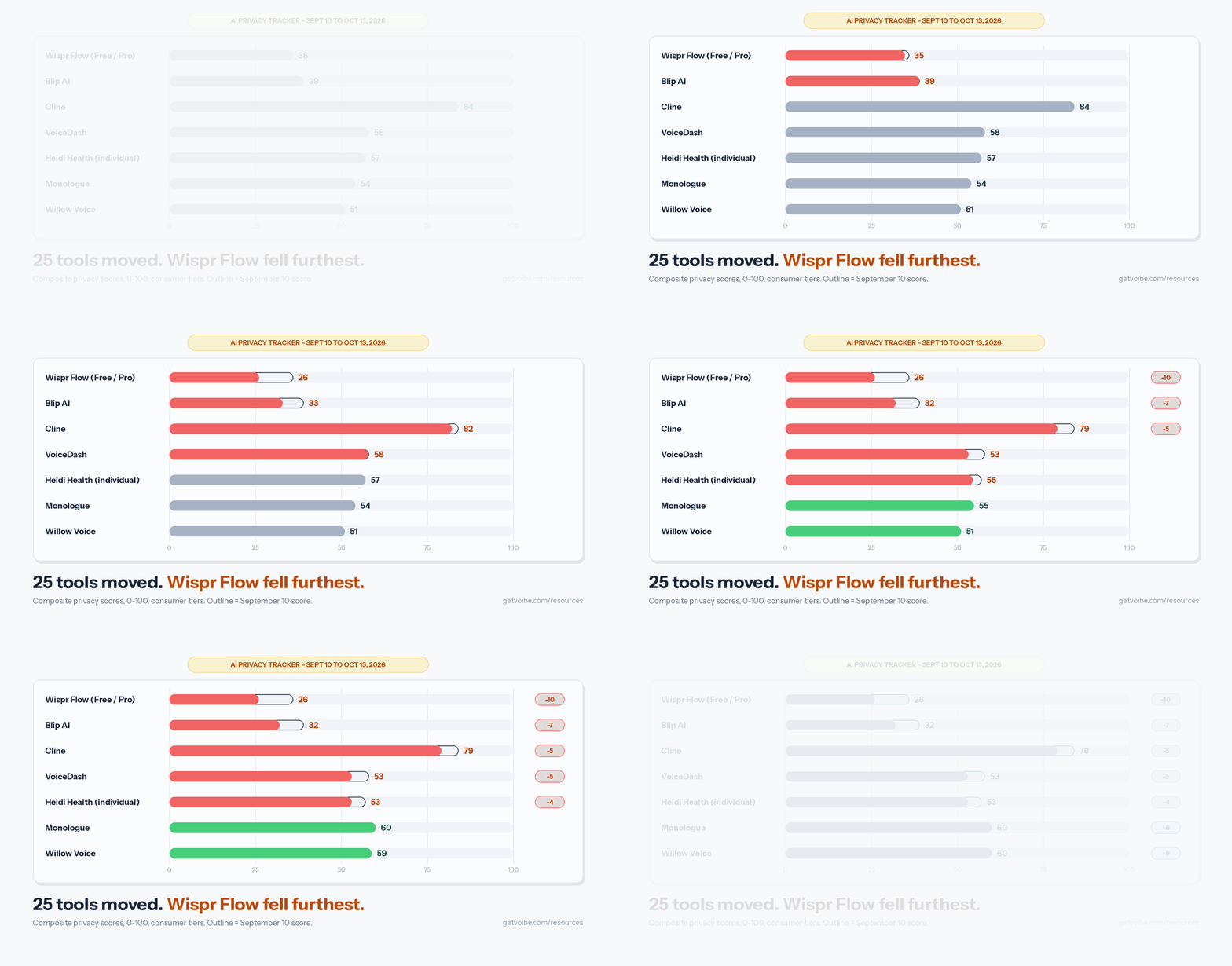
- Wispr Flow fell furthest, from 36 to 26 on Free and Pro.
- Willow Voice rose most, from 51 to 60.
- Google Meet now takes notes on its own in some Workspace meetings.
- Zoom was hit with a biometric-privacy class action.
- Heidi Health started training on free-plan data.
- Apple added an opt-in that lets it train its models on Siri requests.
- We took one of our own claims back, about Granola, because we couldn't source it.
Below is every change, what it did to the score, and the setting to check if you use the tool.
Key Takeaway
Do one thing today: if you're on Wispr Flow Free or Pro, open Settings and check whether “Improve the model for everyone” is on. Wispr's own help center says it is, by default.
Key Takeaways: October 2026 at a Glance
| What changed | Tool | Score | Why you should care |
|---|---|---|---|
| Training is on, not opt-in | Wispr Flow (Free / Pro) | 36 → 26 | Your dictation and Notetaker content can train Wispr's models until you turn it off |
| De-identified training, opt-out by email only | Blip AI | 39 → 32 | Our mistake. The live policy allows training we'd listed as unaddressed |
| Free-plan data now trains models | Heidi Health | 57 → 53 | The only way out is a paid plan |
| Notes on by default for 3+ guests | Google Meet (Workspace) | 57 → 56 | Your meetings get transcribed unless an admin or host turns it off |
| Offline mode and a tighter policy | Willow Voice | 51 → 60 | Biggest rise of the month |
| New row | Voibe Work | 72 | Meeting notes with no bot, scored apart from Voibe's dictation |
Every score is out of 100. It's four 0 to 25 scores added up: Training, Retention, On-device and Track record.
A drop means the vendor's own documents now describe a less private default, a longer retention window, or a new incident. A rise means the opposite.
How We Checked 58 AI Tools
We re-read every tool's primary sources between October 8 and October 13, 2026.
- Vendor documents: privacy policy, terms, help center and trust pages.
- Court dockets: CourtListener, for every lawsuit we track.
- Security advisories: NVD and GitHub advisories.
- Regulators: decisions and notices from data protection authorities.
Two sites blocked us. openai.com and x.ai both returned 403, so those rows keep their older “Last verified” date, and anything new in them is marked as coming from secondary reporting.
Each tier gets four scores we call the four-axis privacy score:
- Training: can the vendor, or its AI providers, train on your content by default?
- Retention: how long is your audio, text or code kept, and can you shorten it?
- On-device: does the work happen on your machine or on a server?
- Track record: lawsuits, breaches, security advisories and policy reversals.
Dictation apps moved the most this month: 11 of 21 changed.
- AI assistants: 5 of 9.
- AI coding tools: 3 of 9.
- Meeting notetakers: 3 of the 9 we already tracked.
- Local LLM runners: 2 of 3.
- Clinical scribes: 1 of 6.
Every change has a dated entry, with its source, in the tracker's Recent Changes timeline.
Dictation Apps: Wispr Flow Flipped, Willow Voice Went Offline
This is where most of the movement was. Eleven apps changed, and two of the changes were mistakes in our own rows.
Wispr Flow: Training Is On by Default (36 → 26)
Wispr Flow's Free and Pro plans train on your content unless you turn it off.
Wispr's help center article “Security and privacy overview” (updated October 2026) puts it plainly:
- “Improve the model for everyone is on by default for Free and Pro.”
- The setting “does apply to Notetaker as well as dictation.”
- Notetaker transcripts are stored in Wispr's US cloud with “no customer setting to opt out of that storage.”
- Uploaded meeting audio is kept for 7 days.
The problem: Wispr's privacy policy (August 19, 2026) still calls training something users “opt to share”.
When a vendor's own documents disagree, we score the less private one. So the Free / Pro Training score dropped from 20 to 10.
Growth and Enterprise keep training off and locked. The full picture is in our Is Wispr Flow safe? breakdown.
Blip AI: We Had This One Wrong (39 → 32)
This one's on us.
We finally got a clean read of Blip AI's live privacy policy and its Terms (updated February 9, 2026). Our row had said training wasn't addressed. It is.
- Blip AI may use “anonymized, de-identified transcription data” to train its models.
- The only opt-out is an email to privacy@blipai.app.
- The policy says “A small sample of voice recordings may be retained for quality assurance and AI improvement.”
- There's no HIPAA or BAA statement in the live policy.
Blip didn't change anything. We just read it properly this time.
Willow Voice and Monologue: The Two That Went Up
- Willow Voice (51 → 60). Willow's August 5, 2026 policy confirms zero data retention at its AI providers, and Willow now offers an on-device offline mode. Our row had been citing a 2025 policy.
- Monologue (54 → 60). Monologue's privacy policy at monologue.to/privacy says it will not “Train any artificial intelligence models using your PII, audio, or transcripts”. It names Groq, Fireworks and OpenRouter as its AI providers.
Neither app changed what it does. They wrote it down clearly, and that's what moved the score.
The Rest of the Dictation Apps
- Aqua Voice (26 → 28): on September 23 it said it's “GDPR and HIPAA compliant” and will “discuss BAA terms”. That's Aqua's claim, not ours. It also holds ISO/IEC 27001:2022 (July 14, 2026).
- VoiceDash (58 → 53): the October 5 policy weakened two promises. “Strictly excluded from our machine learning training sets” became not training “VoiceDash's own general-purpose AI models”. “Does not store” became “not intended to be retained permanently”.
- Paraspeech (cloud 42 → 39): the October 4 policy says it “does not make a zero-retention or no-training guarantee for Deepgram”.
- Spokenly: now lists 14 managed-cloud providers, up from 11.
- Handy: published its first privacy policy. No telemetry, and no audio sent to Handy's servers.
- OpenWhispr: now encrypts stored API keys with AES-256.
Voibe's own dictation rows didn't move. On-device mode on Apple Silicon Macs still scores 97, and the zero-retention cloud mode 71.
Meeting Notetakers: Google Meet Starts Taking Notes on Its Own
Two changes here affect people who never chose the tool: the other people in the meeting.
Google Meet: Notes On by Default for 3+ Guests
From September 21, 2026, Google Workspace Business Standard and Business Plus meetings “with 3 or more guests (including the host)” get Gemini notes automatically.
That's per Google's Workspace Admin Help, updated October 9, 2026.
- Admins can turn it off for the whole organisation.
- Hosts can override it in their own Meet settings.
- Google's page doesn't describe any new consent prompt.
If your company is on one of those plans, someone should look at that admin setting this week.
Zoom: A Voiceprint Class Action (47 → 45)
Sheldon v. Zoom Communications, Inc., No. 3:26-cv-10962 (N.D. Cal.), was filed on September 25, 2026.
It claims AI Companion and ZoomMate capture participants' voiceprints without written consent, under the Illinois Biometric Information Privacy Act (BIPA). Zoom hadn't responded as of October 13.
Otter, Fathom and Granola: Court Dates and a Sale
- Otter.ai: answered the consolidated class action on September 17. It admits it provides “Otter Notetaker” and denies the rest. The class-certification motion is due May 13, 2027. No score change.
- Fathom: acquired on September 14 by Superhuman, the company formerly named Grammarly. Fathom's privacy policy (August 16, 2026) predates the deal and hadn't changed by October 13. No score change.
- Granola: still hadn't answered Chamberlain v. Granola by its extended October 12 deadline. The parties agreed on October 6 to an amended complaint. No score change.
Voibe Work Joins the Table (72)
We added Voibe Work, our own meeting-notes plan, as a scored row. It gets 72 out of 100.
- No bot in the call. It captures the meeting from your Mac or Windows PC.
- Audio is deleted as soon as processing completes. Open-source models on zero-retention cloud providers do the processing.
- Notes stay on your computer. Transcripts and summaries aren't stored on Voibe's servers.
- Low on On-device (5 out of 25). Meeting notes need an internet connection. On-device mode is a dictation feature only.
Because there's no bot, nobody in the call sees one. Voibe reminds you to tell everyone you're taking notes when recording starts, and you're responsible for the consent rules where you are.
AI Assistants: Apple Adds a Training Opt-In, Google Gets Fined
Fewer big swings here, but Apple's change is the one most people will actually run into.
Apple: Siri Requests Can Now Train Apple's Models
Only if you opt in. Apple's September 14, 2026 privacy pages add a setting called “Improve Siri & Apple Intelligence”. If you turn it on:
- Apple “may store all of your interactions with Siri and Dictation”.
- “Siri audio data, transcripts, and related request data may be used to train Apple's foundation models, which power Apple Intelligence.”
- The data is tied to identifiers that now rotate “multiple times per hour”.
- It may be kept for up to two years.
Dictation you haven't opted in still isn't stored. Both Apple rows dropped a point or two. Our Apple Dictation privacy guide walks through the settings.
Google: A Logging Default and a €403 Million Fine
- Gemini business (61 → 57): Google's Gemini Enterprise Agent Platform zero-data-retention page (October 9) says prompts are logged for abuse monitoring unless Google grants an exception. The Interactions API stores data unless the request sets “store” to false. Grounding with Google Search logs are kept up to 3 days.
- The fine: Ireland's Data Protection Commission fined Google €403 million over location data it processed between 2018 and 2020.
Claude, ChatGPT, Meta AI, Perplexity and Grok
- Claude (no change): a proposed Illinois BIPA class action over Anthropic's ID and live-face-image check was filed September 29, as reported by The Epoch Times. No docket number or ruling yet.
- ChatGPT (no change): OpenAI's US privacy policy (September 10) now covers “ads history and interests” for Free and Go users, per a ConductAtlas comparison. openai.com blocks automated access, so this rests on secondary sources.
- Meta AI (17 → 18): a new setting keeps images and video from its AI glasses out of training. Voice isn't covered.
- Perplexity (21 → 22): the tracking lawsuit we'd noted was voluntarily dismissed on May 1.
- Grok (14 → 13): a June 11 finding by Canada's privacy commissioner over sexual deepfakes, which we'd missed.
AI Coding Tools and Local LLMs: Telemetry, CVEs and an End of Sale
If you write code with AI, Cline is the change to read first.
Cline: Telemetry Was On All Along (84 → 79)
Cline's telemetry is on by default. On Cline's own providers, it can include your prompts.
On October 7, Cline fixed its telemetry docs, which had called telemetry opt-in and anonymous. They now say:
- Telemetry is on in the VS Code and JetBrains extensions, Cline Desktop and the CLI.
- It carries a device identifier.
- On the Cline and ClinePass providers it “can include the prompt and the model's response”.
We also added Cline's February 17, 2026 npm compromise to the row. A stolen token was used to publish cline@2.3.0, and Cline reports no user data was accessed.
If you bring your own API key, the provider telemetry point doesn't apply to you.
Ollama and Jan: Update Your Local Models
- Ollama (98 → 95): CVE-2026-103663 (published October 8) is a path traversal in the /api/pull endpoint. In most Ollama Docker images it can lead to code execution as root. It's fixed in v0.35.0. An earlier agent-mode bypass, CVE-2026-102697, was fixed in v0.31.2.
- Jan (98 → 97): fixed a Host-header flaw in its Local API Server in v0.8.5 (October 8).
The default localhost setup isn't exposed to your network. If you run Ollama in Docker or on 0.0.0.0, update now.
Kiro, Gemini CLI, Tabnine and Codex
- Kiro (consumer 34 → 32): AWS now keeps all Claude Fable 5.1 traffic in Kiro for up to 30 days for abuse detection, with possible human review. Section 50.3 of the AWS Service Terms lets AWS use Free Tier and individual-subscriber content to improve the service.
- Gemini CLI (no change): Google stopped selling new Gemini Code Assist Standard and Enterprise subscriptions on October 9. The no-training commitment hasn't changed.
- Tabnine (no change): its site now redirects to Tricentis, which bought it. The no-train, no-retain policy is still in its documentation.
- OpenAI Codex: lost a point for CVE-2026-19591.
Claude Code's training and retention rows didn't change this month.
Clinical Scribes: Heidi Health's Free Plan Now Trains (57 → 53)
Heidi Health now trains on de-identified content from its free plan.
Heidi's Scribe Terms of Use, dated September 29, 2026 (§4.3), say free-plan users “agree that we may create De-identified Information from your Content ... and use it to develop, train, test and improve our models”.
- Paid individual plans and organisation customers are excluded. Their content isn't used to train any AI model.
- There's no opt-out short of upgrading.
- The free plan also shows labelled sponsored content in the US.
One court update: in Washington v. Sutter Health, No. 4:26-cv-03012 (N.D. Cal.), the suit over Sutter's use of Abridge's ambient scribe, the judge took Sutter's motions to dismiss under submission on October 6. Abridge isn't a defendant.
If you dictate clinical notes, our HIPAA dictation guide explains what a BAA does and doesn't cover.
The Month in Eight Dates
If you only want the dates, these are the eight changes most likely to affect your data:
- September 14: Apple adds the “Improve Siri & Apple Intelligence” training opt-in. Superhuman buys Fathom the same day.
- September 17: Otter files its answer in In re Otter.AI Privacy Litigation.
- September 21: Google Meet note-taking turns on by default for Business Standard and Business Plus meetings with 3+ guests.
- September 25: Sheldon v. Zoom is filed under Illinois BIPA.
- September 29: Heidi Health's new terms allow training on free-plan content.
- October 7: Cline's docs confirm telemetry is on by default.
- October 8: CVE-2026-103663 is published for Ollama (fixed in v0.35.0).
- October 10: Wispr Flow's help center says training is on by default for Free and Pro.
Every Score Change in the October 2026 Review
Every tool whose score changed, biggest fall first. “Consumer” and “business” are the two tiers we score for each tool.
| Tool | Consumer score | Business score | Why it moved |
|---|---|---|---|
| Wispr Flow | 36 → 26 | 61 → 58 | Help center: training on by default for Free and Pro; Notetaker transcripts stored with no opt-out |
| Blip AI | 39 → 32 | 39 → 32 | Correction: policy and Terms allow de-identified training, opt-out by email only |
| Cline | 84 → 79 | 84 → 81 | Telemetry on by default, can include prompts and responses on Cline's own providers; February npm compromise |
| VoiceDash | 58 → 53 | 58 → 53 | Training and storage promises narrowed in the October 5 policy |
| Heidi Health | 57 → 53 | 60 → 61 | Free-plan content now used for de-identified training; paid and organisation content is not |
| Ollama | 98 → 95 | 98 → 95 | Two CVEs, including an unauthenticated path traversal fixed in v0.35.0 |
| Paraspeech | 89 → 87 (local), 42 → 39 (cloud) | 61 → 60 | No zero-retention or no-training guarantee for Deepgram; cloud cleanup on by default |
| Gemini | 33 → 32 | 61 → 57 | Agent Platform logging defaults; Ireland's €403M location-data fine |
| Zoom AI Companion | 47 → 45 | 53 → 51 | Sheldon v. Zoom, a BIPA voiceprint class action |
| Apple Intelligence | 87 → 85 | 87 → 85 | New opt-in lets Apple train foundation models on Siri data |
| Kiro | 34 → 32 | 57 → 56 | 30-day retention on Claude Fable 5.1 traffic; two security bulletins |
| Apple Dictation | 69 → 68 | 69 → 68 | Same opt-in; identifiers now rotate several times an hour |
| OpenAI Codex | 44 → 43 | 72 → 71 | CVE-2026-19591 |
| Grok | 14 → 13 | unchanged | Canada privacy commissioner finding; Doe v. X.AI ruling (press reports) |
| Spokenly | 48 → 47 (Pro cloud) | unchanged | Managed-cloud providers grew from 11 to 14 |
| Google Meet notes | unchanged | 57 → 56 | Automatic note-taking on by default for 3+ guest meetings |
| Jan | 98 → 97 | 98 → 97 | Local API server Host-header flaw fixed in v0.8.5 |
| Willow Voice | 51 → 60 | 64 → 70 | August 5 policy (zero retention at providers) and a new offline mode |
| Monologue | 54 → 60 | 54 → 60 | Published privacy policy with an explicit no-training clause |
| Aqua Voice | 26 → 28 | 59 → 61 | ISO 27001 and a HIPAA statement with BAA terms on request |
| Handy | 96 → 97 | 96 → 97 | First privacy policy: no telemetry, no audio to Handy servers |
| OpenWhispr | 51 → 52 (BYOK) | unchanged | API keys now encrypted on the device |
| Granola | unchanged | 41 → 42 | Enterprise admin retention, transcript auto-deletion and Legal Holds |
| Perplexity | 21 → 22 | 56 → 57 | Tracker lawsuit voluntarily dismissed May 1, 2026 |
| Meta AI | 17 → 18 | n/a | New setting keeps glasses images and video out of training |
| Voibe Work (new row) | 72 | 72 | Added to the meeting-notes table |
Every row links to its sources on the AI Privacy Tracker.
The Claim We Took Back About Granola
We've removed our statement that Granola notes are shared by link by default.
Earlier versions of the tracker said Granola notes were “accessible to anyone with the share link by default”. We'd credited it to a Verge report, via a third-party summary.
- In October we couldn't find the Verge article.
- Granola's security FAQ says notes are “private by default”.
- Its sharing docs let you set default link sharing to “Anyone with the link”, “Only my company” or “Private”, but don't say which one you start with.
So the claim and its timeline entry are gone. The cell now says exactly what Granola's docs say.
What stays is what Granola does document:
- On Basic and Business, it trains on de-identified notes by default until you turn off “Use my data to improve models for everyone”.
- Notes are kept indefinitely unless you set a retention policy.
Our Is Granola safe? page covers both.
Info
Spotted a cell that's wrong? Email hi@getvoibe.com with the tool, the cell and a primary-source link. Corrections go into the next review and the timeline.
Five Settings to Check This Week
Most of this month's changes are defaults. That means the fix is usually a toggle.
- Wispr Flow (Free or Pro): in Settings, turn off “Improve the model for everyone”. Wispr says it covers Notetaker too.
- Granola (Basic or Business): Settings → Preferences → Data & sharing, then turn off “Use my data to improve models for everyone”. On Business, every user has to do this themselves.
- Siri on iPhone or Mac: leave “Improve Siri & Apple Intelligence” off unless you want your Siri requests used for training.
- Google Workspace admins on Business Standard or Plus: decide whether automatic note-taking should be off, on for all scheduled meetings, or on for 3+ guest meetings (the new default).
- Cline on the Cline or ClinePass provider: turn telemetry off, or switch to your own API key.
If you'd rather not rely on toggles, use tools that never send the data anywhere.
- Every local LLM runner we track still scores 93 or higher: Ollama 95, LM Studio 93, Jan 97.
- Voibe's on-device dictation on Apple Silicon Macs scores 97.
Our cloud vs local dictation explainer walks through the trade-off.
October 2026 AI Privacy Changes: FAQ
Quick answers, grouped by topic.
Basics
What is the AI Privacy Tracker?
The AI Privacy Tracker is Voibe's reference table of 58 AI tools in six categories: assistants, coding tools, dictation apps, meeting notetakers, clinical scribes and local LLM runners. Each consumer and business tier gets a score out of 100, built from Training, Retention, On-device and Track record, and every cell links to a primary source.
We review it monthly. The October 2026 review was finished on October 13, 2026.
How many tools changed in October 2026?
25 tools changed score in the October 2026 review, and we added one new tool, Voibe Work. The review covered changes between September 10 and October 13, 2026.
Specific tools
Does Wispr Flow train on my data by default?
On Free and Pro, yes, according to Wispr's help center: “Improve the model for everyone is on by default for Free and Pro,” and it covers Notetaker as well as dictation. Wispr's privacy policy (August 19, 2026) still describes training as opt-in, so Wispr's own documents disagree.
On Growth and Enterprise, training is off and locked.
Is Google Meet taking notes in my meetings automatically?
It might be. If your organisation is on Google Workspace Business Standard or Business Plus, automatic note-taking has been on by default since September 21, 2026 for meetings with 3 or more guests, host included.
Admins can turn it off in the Admin console, and hosts can override it in their Meet settings.
Does Heidi Health train on patient notes?
On the free plan, yes, on de-identified content. Heidi's September 29, 2026 terms let it create de-identified information from free-plan content and use it to train its models.
Content from paid individual plans and organisation customers isn't used to train any AI model.
Corrections and method
Why did you remove the Granola share-link claim?
We couldn't source it. We couldn't find the Verge article it was credited to, and Granola's own docs say notes are private by default without stating the starting link-sharing setting.
The tracker cell now says exactly that.
How is Voibe Work scored if Voibe runs the tracker?
The same way as every other tool: the same four scores, from the same kind of source, here getvoibe.com's own pages. It gets 72 out of 100.
It scores high on Training and Retention, because audio is deleted after processing and notes stay on your device. It scores low on On-device, because meeting notes are processed in the cloud.
What We're Watching in November
The next review is due November 10, 2026. These are the open threads:
- Wispr Flow: whether the privacy policy gets updated to match the help center.
- Fathom: whether Superhuman changes the privacy policy or subprocessors after the acquisition.
- Granola: the amended complaint in Chamberlain v. Granola, and Granola's response.
- Sutter Health: the written ruling on Sutter's motions to dismiss.
- Zoom: Zoom's response to Sheldon v. Zoom.
The full table and dated timeline live on the AI Privacy Tracker.
For background, our dictation privacy hub collects every is-it-safe investigation in one place. And why offline dictation matters makes the case for keeping your voice off servers entirely.
Best AI Dictation and Meeting Notes for Confidential Work
Draft letters, notes and emails 5x faster. Get meeting notes without a bot joining your call. Nothing used to train AI.
- Mac + Windows
- No bot in your calls
- Nothing used to train AI
- 7-day free trial
Want to compare plans first? View pricing →
Related Articles
AI Privacy Tracker
All 58 tools, scored on four axes, with a source link on every cell.
Is Wispr Flow Safe?
Training defaults, Notetaker storage and the SOC 2 scope question.
Is Granola Safe?
Training on by default, indefinite retention and the Chamberlain lawsuit.
Dictation Privacy Hub
Every is-it-safe investigation and privacy guide in one place.