
PowerScribe 360 Is Retiring: The Best Dictation Software for Radiologists in 2026
Microsoft ends PowerScribe 360 renewals August 31, 2026. The best dictation software for radiologists — reporting giants compared, plus a private $199 pick.

On August 31, 2026, Microsoft ends renewals and maintenance support for PowerScribe 360, the reporting software that at its peak sat behind roughly 75% of US radiology reporting. Groups that spent a decade building templates, macros, and muscle memory on an on-premises system they already own are being moved to a cloud subscription, and old pricing agreements lapse with the renewal date. So the best dictation software for radiologists stopped being a settled question this year.
The short answer: radiology dictation is really two purchases, and no single product wins both. For the reporting cockpit — the worklist, RIS integration, structured fields, critical results — the realistic 2026 options are PowerScribe One, Fluency for Imaging (Jacobian), and Rad AI Omni Reporting. For everything you write outside that cockpit — referrer emails, IR clinic notes, expert-witness reports, papers, teaching files — the best value in 2026 is Voibe: fast, private (fully on-device on Apple Silicon Macs), working in every app on Mac and Windows, with hands-free and live dictation modes — for $9.90/month, $99/year, or $199 once. That is a rounding error next to the estimated $5,000–$10,000 per radiologist per year the enterprise incumbents cost.
| Tool | Best for | Key strength | Price |
|---|---|---|---|
| Voibe | Everything outside the reporting system, on machines you control | On-device privacy (Mac), native Windows app, hands-free + live dictation | $9.90/mo, $99/yr, or $199 lifetime |
| PowerScribe One | Groups staying in the Nuance/Microsoft ecosystem | Deepest install base; direct migration path from 360 | Enterprise quote (est. $5,000–$10,000/radiologist/yr) |
| Fluency for Imaging (Jacobian) | Groups re-bidding the reporting contract | #1 Best in KLAS front-end imaging speech recognition, 2022–2026 | Enterprise quote |
| Rad AI Omni Reporting | High-volume groups cutting words dictated | Auto-drafted impressions in your own language patterns | Enterprise quote |
| Dragon Medical One | Medical vocabulary without a radiology platform | 400,000+ term medical vocabulary, system-wide on Windows | $79–$99/user/mo + $525 setup |
| Apple Dictation / Voice Access | The $0 baseline | Built in, on-device | Free |
Key Takeaway
Radiology dictation is two separate purchases: the enterprise reporting platform your group licenses ($5,000–$10,000 per radiologist per year, by third-party estimates), and the personal dictation layer for everything else — where Voibe costs $199 once and runs privately on Mac and Windows.
Why Radiologists Are Rethinking Dictation in 2026
Radiologists are rethinking dictation in 2026 because the incumbent is retiring, the replacements are expensive, and the daily experience still generates more corrections than it should. Five specific problems are driving the search:
1. The PowerScribe 360 sunset is forcing a decision. Microsoft sent end-of-life letters in February 2026. Renewals and maintenance end August 31, 2026; support ends entirely August 31, 2027. The Imaging Wire reports the move "alienated many radiology customers who had already paid to have an on-premises reporting solution" — groups that owned their software are being converted into subscribers, and prior pricing agreements are void after the renewal date. The community reaction, as RT Medical Systems summarized the Reddit thread on the sunset, was radiologists "voicing concerns about being forced to pay recurring fees for capabilities they already owned."
2. Enterprise pricing is opaque and heavy. Neither Nuance nor Microsoft publishes PowerScribe pricing. Third-party estimates put it at $5,000–$10,000 per radiologist per year — $50,000–$100,000 annually for a 10-radiologist group — and there is no individual seat you can buy with your own card.
3. Speech recognition errors survive into signed reports. The canonical study, Quint et al. in the Journal of the American College of Radiology (2008), found 22% of finalized speech-recognition reports contained errors, with per-radiologist error rates ranging from 0% to 100% — and, in the authors' words, "most radiologists believed that report error rates were much lower than they actually were."
4. The correction grind is real, and radiologists document it. Radiologist Ben White, MD describes PowerScribe inserting "3" when he said "2," adding brackets when a radiologist says "left" or "right," needing 7 different AutoCorrect entries to reliably produce "disc osteophyte complex," and settings that fail to follow you across workstations. His summary: many radiologists use it like "a stubbornly inaccurate transcriptionist."
5. Volumes keep rising while the workforce lags. Imaging volumes are growing roughly 3–4% per year against a shortage the American College of Radiology pegs at around 1,500 radiologists. Every extra correction, click, and re-dictation multiplies across a full worklist — which is why dictation friction, small per report, is a real productivity problem at scale.
Key Takeaway
The software behind most US radiology reports is retiring on a hard deadline, third-party estimates put replacement seats at $5,000–$10,000 per radiologist per year, and a JACR study found 22% of finalized speech-recognition reports contained errors. This is why dictation is a live purchasing question in radiology in 2026.
The Two-Layer Radiology Dictation Stack
The two-layer radiology dictation stack is the frame that makes this market make sense. Most "best dictation software for radiologists" lists mix hospital reporting platforms and personal dictation apps into one ranking, which produces nonsense comparisons — a $10,000-per-year reporting cockpit "versus" a $199 utility. They are different layers, bought by different people, for different work.
Layer 1 is the reporting cockpit. This is the platform your group or hospital licenses: it pulls the worklist from the RIS, injects patient demographics, manages structured fields and templates, routes critical results, and files the signed report back into the system of record. PowerScribe One, Fluency for Imaging (Jacobian), and Rad AI Omni Reporting live here. You do not choose this layer alone — your group, PACS admin, and IT department do, on an enterprise contract.
Layer 2 is the personal dictation layer. This is the tool that types wherever your cursor is, in any application, on machines you control — home workstation, personal laptop, private-practice office. Referrer emails, IR clinic notes, peer-review comments, tumor board prep, expert-witness reports, manuscripts, board-study notes: none of that happens inside the reporting cockpit, and all of it is still writing. Voibe, Dragon Medical One, and the free built-ins live here.
Each tool below is labeled with its layer, because that single distinction answers most of the "which should I buy?" confusion. If you also cover non-imaging clinical work, our guide to the best dictation software for doctors covers the broader clinical field, including ambient AI scribes.
Key Takeaway
Sort every radiology dictation product into one of two layers before comparing prices: the enterprise reporting cockpit (group purchase, PACS/RIS-integrated) and the personal dictation layer (your purchase, works in every app). Cross-layer price comparisons are meaningless; within-layer ones are decisive.
What Radiologists Should Look For in Dictation Software
Seven criteria separate dictation software that fits radiology from dictation software that merely exists. Use them to score any tool — enterprise or personal:
1. Where the audio goes. Radiology dictation is Protected Health Information the moment a patient identifier is in the room. On-device processing means audio never reaches a third party; cloud processing requires a signed BAA and trust in the vendor's retention policy. Know which model you are using before you dictate a single finding — our dictation and HIPAA guide breaks down the legal mechanics.
2. Latency and flow. You dictate while scrolling a stack, and text that lands seconds late breaks the read. Look for transcription fast enough that you never wait for it, and — ideally — a live view of the words as you speak so errors get caught with your eyes still on the images.
3. Hands-free operation. A radiologist's hands are on the mouse and navigation keys, not hovering over a push-to-talk key. A dictation tool needs a hands-free mode or hardware-mic workflow that keeps both hands on the images.
4. Vocabulary handling. "Pneumothorax" is not the hard part — modern speech models handle core radiology terms. The long tail is: referring physician names, outside facility names, hardware brands, subspecialty eponyms. A real custom dictionary (one that influences transcription, not a find-and-replace table) with bulk editing is what removes that correction tax.
5. Worklist and RIS integration — if you need it. Structured reporting, demographics injection, and critical-results routing are Layer 1 features. If your work requires them, only an enterprise platform will do; no personal app fakes this credibly.
6. Platform freedom. Hospital reading rooms run Windows; a lot of radiologists' personal machines are Macs. A tool that covers both — and works in any application rather than one reporting window — covers your whole writing day, not just the signed report.
7. Total cost per seat, over three years. Compare 3-year totals, not monthly stickers: $199 once (Voibe lifetime) vs $2,844–$3,564 plus a $525 onboarding fee (Dragon Medical One) vs an estimated $15,000–$30,000 (a PowerScribe-class enterprise seat). The deltas are not subtle.
Key Takeaway
Score radiology dictation tools on seven criteria: audio destination (PHI), latency, hands-free operation, custom vocabulary depth, worklist integration, platform coverage, and 3-year cost per seat. The first and last criteria eliminate the most candidates fastest.
Quick Comparison: Radiology Dictation Software at a Glance
Here is the full field side by side — with each tool's layer labeled, because that is the first thing to check:
| Tool | Layer | Where audio goes | Price | Individual seat? |
|---|---|---|---|---|
| Voibe | Personal dictation | On-device (Apple Silicon Macs); zero-retention private cloud (Windows, Intel Macs) | $9.90/mo, $99/yr, or $199 lifetime | Yes — buy it yourself |
| PowerScribe One | Reporting cockpit | Microsoft Azure cloud | Enterprise quote (est. $5,000–$10,000/radiologist/yr) | No — enterprise only |
| Fluency for Imaging (Jacobian) | Reporting cockpit | Cloud | Enterprise quote | No — enterprise only |
| Rad AI Omni Reporting | Reporting cockpit (AI-native) | Cloud | Enterprise quote | No — enterprise only |
| Dragon Medical One | Personal dictation (medical) | Microsoft Azure cloud (BAA available) | $79–$99/user/mo + $525 onboarding | Yes — subscription |
| Apple Dictation / Windows Voice Access | Personal dictation (basic) | On-device (Apple Silicon / Windows 11) | Free | Built in |
Ranked below: the personal layer first — because it is the decision an individual radiologist can actually act on this week — then the enterprise cockpit contenders in the order we would evaluate them.
How this list was put together
Tools are sorted by layer first — reporting cockpit versus personal dictation — because cross-layer rankings produce meaningless price comparisons. Within each layer: pricing was verified against official vendor pages and published terms in July 2026; ratings come from named third parties (KLAS client scores, Product Hunt) with links; and every user-complaint claim traces to a documented source — the JACR error study, radiologist writeups, and reported community reaction. The enterprise platforms cannot be bought or tested by an individual, so their coverage relies on vendor documentation, KLAS data, and published radiologist accounts rather than hands-on use.
1. Voibe — The Fast, Private Dictation Layer for Everything Outside the Reporting Cockpit
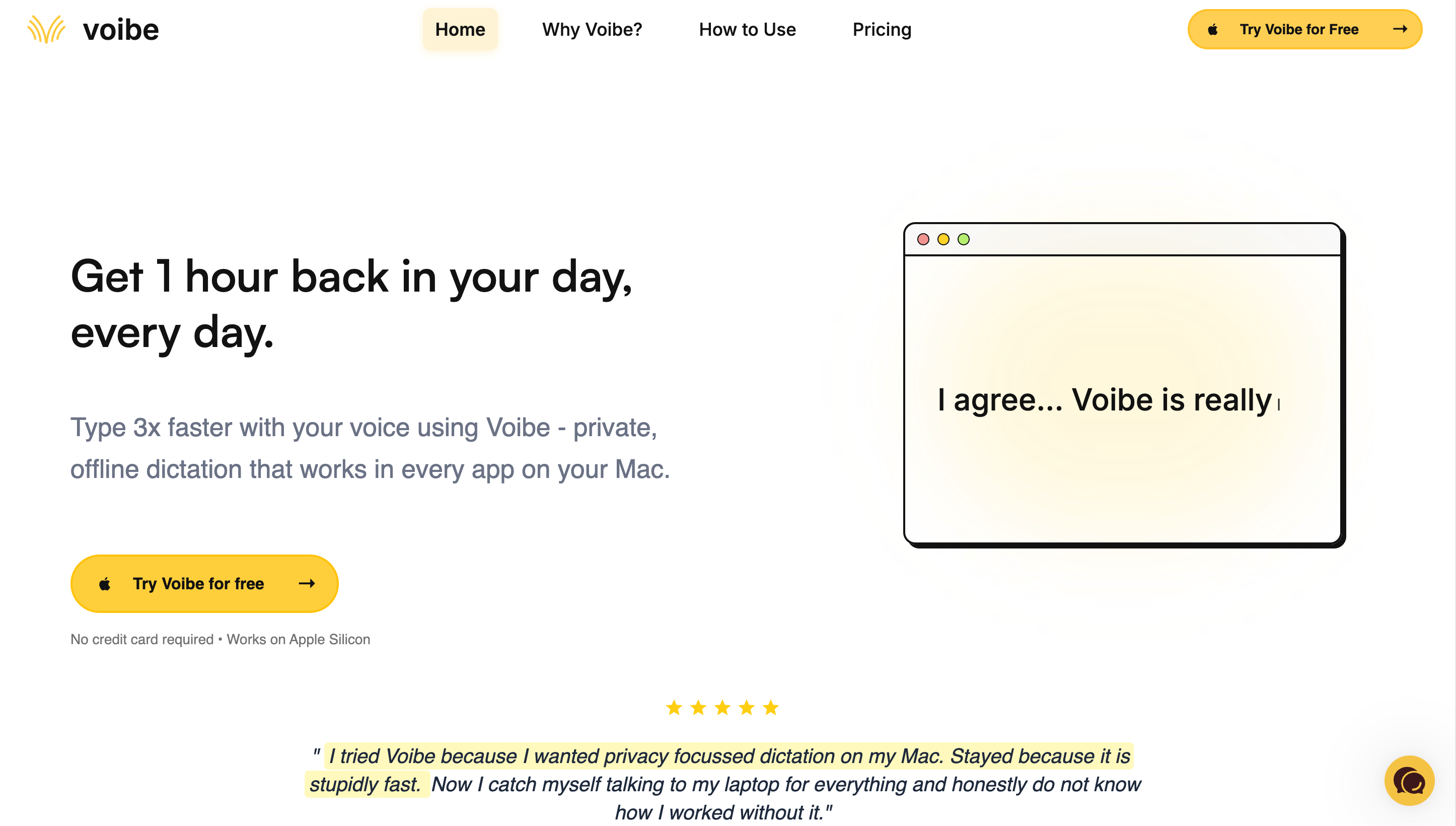
Voibe is a personal dictation tool for Mac and Windows that types wherever your cursor is — EHR text fields, Word, email, a browser RIS portal. Users rate it 4.8/5 on Product Hunt (6 reviews — early but consistent, with speed and privacy the recurring themes).
The privacy architecture is what matters most for radiology. On Apple Silicon Macs, Voibe runs fully on-device: audio is processed on your machine and never transmitted anywhere — no third-party server, nothing to breach, no BAA negotiation, because no business associate ever receives PHI. On Windows (a ground-up native app launched in 2026) and Intel Macs, it uses Voibe's zero-retention cloud, which runs open-source models on zero-retention providers: audio is never stored, sold, or used to train AI, a BAA is available on request, and local transcript history can be disabled entirely. Our dictation and HIPAA guide covers the legal mechanics.
Key Features for Radiologists
- Hands-Free Mode — press Fn+Space (or double-tap Fn) for continuous sessions up to 5 minutes. Both hands stay on the mouse and navigation keys: the same eyes-on-images posture you dictate in at the PACS workstation.
- Live Dictation — your words appear on screen as you speak, so a wrong word gets caught before it lands in the document. Every radiologist trained by speech-recognition errors to proofread will recognize why this matters.
- Dictionary — a real custom dictionary that influences transcription itself, not a find-and-replace table. Bulk editing lets you batch-import your whole long tail at once: referring physician names, outside imaging centers, hardware brands, subspecialty eponyms.
- Memory — saved text blocks triggered by a short spoken phrase. This doubles as a templates system for your standard report language (details below).
- Smart Formatting — an optional, bounded cleanup pass (off by default): it removes filler words and converts spoken numbers, dates, and units, and it never paraphrases or changes meaning — precisely the property you want near clinical text.
- Voice commands — "new paragraph," "bullet point," and spoken punctuation structure text as you go.
- Works in every app — no per-app integration needed; text lands wherever the cursor is, on both Mac and Windows.
Memory: A Templates Library for Your Standard Language
Radiologists live on saved language — the macro and normal-template habit from PowerScribe. Memory brings that habit to everything outside the reporting system: save a block once, speak its short trigger, and the full text types out wherever you are. Blocks to save on day one:
- Your standard follow-up recommendation sentences (the lines you dictate dozens of times a week)
- Referrer-letter openings and sign-off blocks
- Standard patient prep and post-procedure instructions
- Boilerplate paragraphs for research methods, teaching-file disclaimers, or peer-review comments
Combined with the Dictionary, this covers the two kinds of repetition in radiology writing: the phrases you always use (Memory) and the names the software never knew (Dictionary).
Pricing
The value combo: Wispr Flow and Granola in one plan. Voibe Dictation is $99 a year. For $50 more, Voibe Work ($19/month, $149/year, or $399 lifetime) adds AI meeting notes with no bot in the call. That one plan covers what Wispr Flow Pro ($144/year) and Granola Business ($168/year) charge $312 a year for separately, so it costs $163 (52.2%) less every year. Meeting notes are captured on your Mac or Windows PC, processed in Voibe's zero-retention cloud and saved on your computer, and Voibe reminds you to tell everyone you're taking notes.
- Fully on-device mode on Apple Silicon — PHI never transmitted
- Native Windows app (2026) — zero-retention private cloud, no Electron
- Hands-Free Mode and Live Dictation fit the reading-room posture
- Dictionary with bulk editing kills the referrer-name correction tax
- Memory doubles as a system-wide templates library
- $199 lifetime — 93–94% less than Dragon Medical One over 3 years
- No PACS/RIS worklist integration or structured reporting — not a Layer 1 platform
- General speech models, not a dedicated radiology lexicon — the long tail needs the Dictionary
- On-device mode requires Apple Silicon (M1+); Windows and Intel Macs use private cloud only
- No ambient/AI scribe features
Be clear about what Voibe is not: it has no PACS or RIS integration, no worklist, no structured reporting fields, no critical-results workflow. It is not a PowerScribe replacement inside a hospital reading room — and any personal dictation app that claims to replace an integrated reporting platform is selling you the wrong tool. Voibe is the layer for everything else, and for full report dictation in settings that never had an enterprise platform: small imaging clinics and international practices that type reports into a web RIS or Word. It is also the only tool in this list you can install on a personal machine in the next five minutes without talking to IT.
Key Takeaway
Voibe is the personal dictation layer for radiologists: on-device private on Apple Silicon Macs, native on Windows, hands-free with a live view of your words, a Dictionary for your referrer list, and Memory as a system-wide templates library — $199 once. It does not replace a PACS-integrated reporting platform; it covers everything the reporting platform doesn't, at 1–3% of the cost.
Tip
Set up Voibe for radiology in two batches: bulk-add your referring physicians and outside facilities to the Dictionary, then save your five most-repeated text blocks (follow-up sentences, sign-offs, patient instructions) in Memory. The correction tax and the retyping tax both disappear on day one.
2. PowerScribe One — The Incumbent Cockpit, Now Subscription-Only

PowerScribe One is Nuance/Microsoft's cloud-based successor to PowerScribe 360 — the default answer to "what does the reading room run?" for most of the last fifteen years. If your group is on 360 today, this is the path of least resistance: Microsoft's recommended migration, familiar behavior, and the largest install base in the specialty. Every locums and new hire already knows the muscle memory.
The catch is that the migration happens on Microsoft's schedule, not yours: renewals end August 31, 2026, old pricing protections lapse, and an owned on-premises license becomes a perpetual subscription.
Key Features
- Worklist-driven reporting — RIS/PACS integration, demographics injection, structured fields, critical-results routing
- In-workflow decision support — real-time guidance based on report context
- Template and macro ecosystem — the normals library and voice-macro habits your group already built on 360 carry into the same product family
- Microsoft Azure cloud — speech recognition and language processing hosted on Azure, with enterprise IT management
Pricing
Not published — quoted per organization. Third-party estimates run $5,000–$10,000 per radiologist per year ($50,000–$100,000 annually for a 10-radiologist group). There is no individual license: if you are one radiologist rather than a purchasing committee, this product is not for sale to you.
- Deepest install base in radiology — everyone already knows it
- Full Layer 1 integration: worklist, RIS/PACS, structured reporting, critical results
- Direct, vendor-supported migration path from the retiring 360
- Enterprise-only — no individual seats, opaque pricing (est. $5,000–$10,000/radiologist/yr)
- Forced subscription conversion as 360 sunsets; old pricing agreements void
- The correction-grind complaints radiologists document grew up in this product family
- Windows client; cloud-only
Key Takeaway
PowerScribe One is the continuity choice: the deepest install base in radiology and a direct migration path from the retiring 360 — at an estimated $5,000–$10,000 per radiologist per year, on a subscription you no longer control the terms of, with no individual seat available.
3. Fluency for Imaging (Jacobian) — The Best in KLAS Challenger for the Re-Bid
Fluency for Imaging is the other enterprise reporting cockpit — built by M*Modal, later 3M, then Solventum, and as of 2026 part of Jacobian, the company formed when Smart Reporting acquired Fluency for Imaging.
On product quality, its record is hard to argue with: #1 Best in KLAS for Speech Recognition: Front-End Imaging for the fifth consecutive year in 2026, scoring 88.3/100 — a ranking based on direct client feedback from working radiologists and imaging IT, not analysts. If your group is being pushed off PowerScribe 360 anyway, migration costs money in every direction — which is exactly why the sunset is the right moment to run a real head-to-head bid instead of auto-renewing into the incumbent.
Key Features
- Front-end speech recognition for imaging — the category KLAS has ranked it #1 in every year since 2022
- Integrated radiology reporting workflow — worklist, structured reporting, enterprise deployment
- Best-liked by its users — the KLAS streak (88.3/100 in 2026) reflects daily-user satisfaction, the metric that matters in a tool you use eight hours a day
Pricing
Enterprise quote only — same procurement reality as PowerScribe One, with no individual seat.
- #1 Best in KLAS, front-end imaging speech recognition, 2022–2026 (88.3/100)
- The credible head-to-head bid that keeps your PowerScribe One quote honest
- Full Layer 1 reporting integration
- Enterprise-only, custom quotes, IT-led deployment
- Three owners in roughly three years (3M → Solventum → Jacobian) — press roadmap and support continuity in the demo, and get it in the contract
Key Takeaway
Fluency for Imaging (now Jacobian) is the strongest reason not to auto-renew into PowerScribe One: #1 Best in KLAS for front-end imaging speech recognition five years running (88.3/100 in 2026), with the same enterprise procurement model and a three-owners-in-three-years history worth probing in the demo.
4. Rad AI Omni Reporting — The AI-Native Cockpit That Drafts Your Impressions
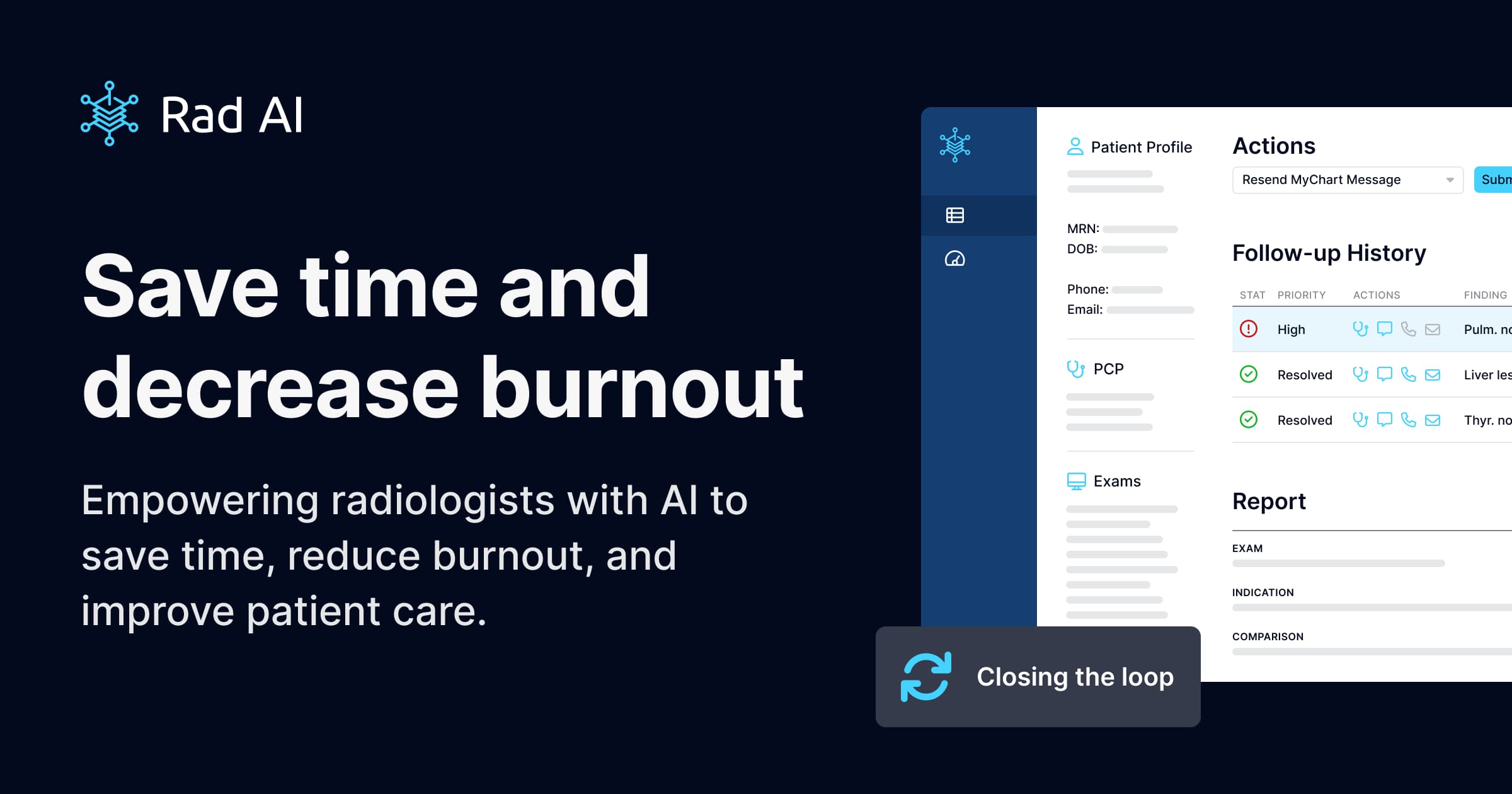
Rad AI Omni Reporting is the AI-native entrant in the cockpit layer, and its pitch is different in kind: instead of transcribing you faster, it makes you dictate less. This is where the reporting layer is clearly heading — Nuance and Jacobian are shipping their own generative features in response.
Key Features
- Auto-generated impressions — Rad AI Impressions drafts the impression section from your dictated findings and clinical indication, trained to match each radiologist's own historical language patterns
- Guideline insertion — consensus recommendations (Fleischner, TI-RADS, LI-RADS) added where they apply
- Works with the existing reporting stack — vendor-stated integration with PACS, RIS, and reporting systems via a lightweight client
- Vendor-reported time savings — a median of about 1 hour saved per shift and up to 35% fewer words dictated, per Rad AI's published case studies (vendor numbers; weigh accordingly)
Pricing
Enterprise quote only — a group-level purchase, not an individual one.
- Attacks dictation volume, not just speed — fewer words dictated per report
- Impressions in your own phrasing, with guideline language inserted automatically
- The most established of the AI-native reporting vendors
- Enterprise sales, cloud processing, group-level decision
- Time-savings numbers are vendor-reported, not independent
- AI-drafted clinical language still requires reading every word before you sign it
If your group evaluates ambient documentation more broadly, our AI medical scribe comparison covers the adjacent (non-radiology) tools.
Key Takeaway
Rad AI Omni Reporting attacks dictation volume instead of dictation speed: auto-drafted impressions in your own language patterns, with vendor-reported savings of about 1 hour per shift and up to 35% fewer words dictated. Enterprise-only, cloud-based, and you still read what you sign.
5. Dragon Medical One — Medical Vocabulary Without the Radiology Platform
Dragon Medical One is the in-between option: a personal-layer tool with an enterprise-grade medical brain, now being folded under Microsoft's Dragon Copilot brand. For a radiologist in a small practice with no Layer 1 platform — or a physician who dictates into the EHR all day — it is the most medically fluent dictation you can buy as an individual.
Key Features
- 400,000+ term medical vocabulary — deep pharmacological and procedural recognition out of the box
- System-wide on Windows — types into any Windows application, including EHR fields
- Cloud on Microsoft Azure with a BAA available — the compliance path hospitals already know; our Is Dragon Safe? investigation breaks down the BAA framework
- Browser access on Mac — no native Mac app; Mac users get a web session with real limits
Pricing
$99/user/month on a 1-year term, $89/month on a 2-year term, or $79/month on a 3-year term, plus a one-time $525 onboarding fee per user. That totals $3,369–$4,089 per seat over three years — 17–21 times Voibe's $199 lifetime — and it is subscription-only, so the meter never stops. Full breakdown in our Dragon Medical One cost guide (implementation fees, hidden costs, 3-year total); if you are shopping away from it, our Dragon Medical alternatives roundup compares seven options.
- Deepest stock medical lexicon available to an individual buyer
- BAA on Azure — a familiar compliance story for hospital IT
- System-wide dictation across Windows apps
- $3,369–$4,089 per seat over three years, subscription-only
- $525 onboarding fee before you dictate a word
- No native Mac app — browser session only
- No radiology worklist integration by itself
The radiology-specific verdict: choose Dragon Medical One if out-of-the-box recognition of deep drug and procedure vocabulary matters more than cost or platform freedom — and you live on Windows. Radiology's long tail is usually names and facilities rather than drug catalogs, which is exactly what a trainable dictionary handles for 1/20th the price.
Key Takeaway
Dragon Medical One is the most medically fluent personal dictation tool — 400,000+ terms, BAA on Azure, system-wide on Windows — at $79–$99/month plus a $525 onboarding fee ($3,369–$4,089 over three years, versus $199 once for Voibe). Worth it for deep medical vocabulary needs; expensive for radiology's names-and-facilities long tail.
6. Apple Dictation and Windows Voice Access — The Free Baseline, and Why It Fails a Working Radiologist
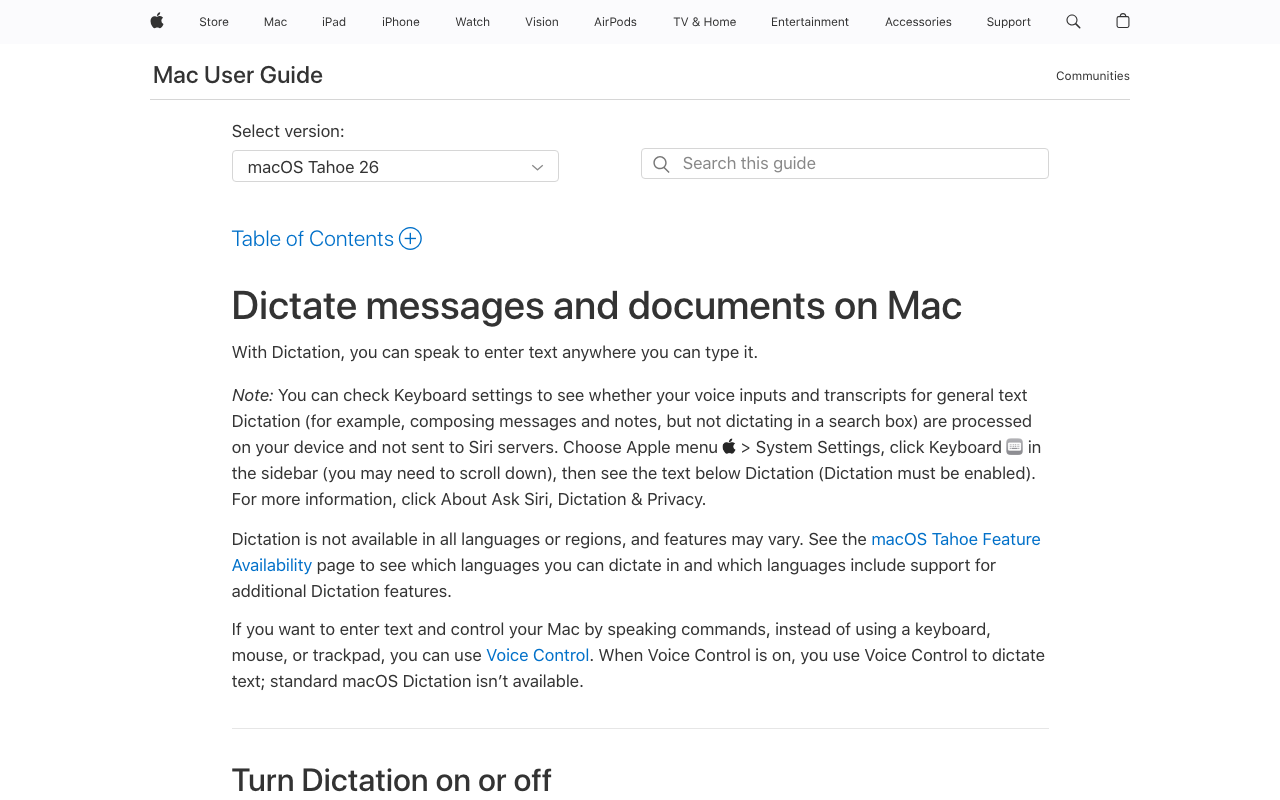
Apple Dictation (built into macOS, on-device on Apple Silicon) and Windows Voice Access (built into Windows 11, on-device) are the zero-cost baseline, and for a quick message they are genuinely fine. Both process locally on modern hardware, which makes them more private than several paid cloud tools.
Key Features
- Free and already installed — nothing to buy, nothing to deploy
- On-device processing — on Apple Silicon Macs and Windows 11 respectively
- System-wide basics — dictate into any text field
Where They Fail a Working Radiologist
- No custom vocabulary — no way to teach referrer names, outside facilities, or subspecialty terms; the same corrections recur forever
- Short-session design — Apple Dictation is built for bursts and times out on long sessions rather than sustained multi-paragraph dictation
- No medical tuning — punctuation and formatting quirks that are tolerable in a text message become an editing pass in a referral letter
Pricing
Free — included with macOS and Windows 11. Our full Apple Dictation review covers the details. Use them to answer a text; do not build a professional writing workflow on them when $99–$199 removes the ceiling.
Key Takeaway
The free built-ins (Apple Dictation, Windows Voice Access) are on-device and fine for short messages, but with no custom vocabulary, short-session design, and no medical tuning, they cannot carry a radiologist's daily writing volume.
The Rest of the Field: Augnito and the Post-PowerScribe Startup Wave
Two more names show up when radiologists shop this market.Augnito is a cloud medical speech-recognition product with specialty vocabularies (radiology included) sold on custom quotes rather than published pricing. It sits between Dragon Medical One and the enterprise cockpits, but it has very little independent review presence — its Capterra listing currently shows zero reviews — so demo it against your own case mix before committing.
Second, the PowerScribe 360 sunset has produced a visible wave of AI-native reporting startups pitching radiology groups on skipping PowerScribe One entirely. Rad AI (covered above) is the most established; the rest are early. The evaluation rule for all of them is the same: demand a live demo on your worklist, your templates, and your subspecialty mix — a reporting platform is a ten-year marriage, and slideware accuracy numbers are not evidence.
How to Choose: Four Questions That Settle It
Four questions sort every radiologist reading this into the right tool:
1. Does it need to live inside your PACS/RIS worklist, with structured fields and critical-results routing?
- Yes → You are shopping Layer 1: get PowerScribe One and Fluency for Imaging (Jacobian) quotes side by side — the 360 sunset already voided your old pricing, so bid it properly — and have Rad AI Omni demo against your case mix.
- No → You are shopping the personal layer. Continue.
2. Will you dictate PHI, and on whose machine?
- Hospital-managed workstation → Use whatever your group licenses there; you cannot (and should not) install personal software on it anyway.
- Your own machine, PHI involved → Prioritize audio that never reaches a third party: Voibe's on-device mode on an Apple Silicon Mac, or its zero-retention cloud on Windows (BAA available on request). Other cloud tools with a BAA (Dragon Medical One) also work if your compliance posture accepts a business associate.
- Your own machine, no PHI (papers, teaching, admin) → Any personal tool qualifies; decide on speed, vocabulary, and price.
3. Do you need a deep medical lexicon out of the box, or is a trainable dictionary enough?
- Deep lexicon, Windows, budget available → Dragon Medical One ($79–$99/mo + $525 setup) recognizes the pharmacological deep end unprompted.
- Strong general accuracy + your specific long tail → Voibe with Custom Vocabulary bulk-added once. Radiology's long tail is mostly names and facilities, which no stock lexicon ships anyway.
4. Do you want to pay monthly forever, or once?
- Once → Voibe lifetime, $199. Three years of Dragon Medical One costs 17–21 times more.
- Monthly is fine → Voibe at $9.90/mo is still 90% less than Dragon Medical One's $99/mo entry price.
- Zero budget → The built-ins, with the ceilings described above.
Key Takeaway
Worklist integration puts you in the enterprise bid (PowerScribe One vs Fluency vs Rad AI). Everything else comes down to PHI handling and cost: on-device Voibe at $199 lifetime for private everyday dictation, Dragon Medical One at $3,369+ per 3 years when only a stock 400,000-term lexicon will do.
Best Tool for Your Situation: A Radiology Use-Case Cheat Sheet
Eleven situations radiologists are actually in, mapped to the right tool:
| Your situation | Best choice | Why |
|---|---|---|
| Hospital or academic group reading from the main worklist | PowerScribe One or Fluency (group contract) | Worklist, RIS integration, and critical results are Layer 1 features — use what your group licenses |
| Group facing the August 2026 PowerScribe 360 deadline | Run a real bid: PowerScribe One vs Fluency (Jacobian) vs Rad AI | Your old pricing is void anyway; the KLAS leader and the AI-native challenger deserve the demo |
| High-volume practice trying to cut words dictated per report | Rad AI Omni Reporting (on top of the cockpit) | Auto-drafted impressions in your own phrasing; vendor-reported ~1 hr/shift saved |
| Teleradiologist on your own home setup | Voibe | The group provides the reporting client; referrer emails, case notes, invoices, and everything else on your machine is yours to speed up — privately |
| Medicolegal / expert-witness reports in Word | Voibe (on-device mode) | Long-form dictation where nothing should leave your machine; hands-free 5-minute sessions |
| IR attending: clinic notes, procedure logs, patient instructions | Voibe (or Dragon Medical One if the department pays) | Types into any EHR text field on machines you control; custom vocabulary for device names |
| Small imaging clinic typing reports into a web RIS or Word | Voibe | No enterprise platform to integrate with — you need fast, private dictation into a browser, today, at clinic prices |
| Academic radiologist writing papers, grants, and reviews | Voibe | No PHI, high volume, every app — the $199 lifetime pays for itself against any subscription |
| Resident or fellow: board notes, flashcards, case write-ups | Voibe (free plan) → $99/yr | 7-day free trial, then a free plan with limited words; $99/yr when you outgrow it |
| Solo physician dictating deep medical vocabulary into an EHR on Windows | Dragon Medical One | The 400,000+ term lexicon earns its $79–$99/mo when drug and procedure names dominate |
| Occasional dictation, zero budget | Apple Dictation / Windows Voice Access | Free and on-device — fine until custom vocabulary and session length start to matter |
Key Takeaway
Match the tool to the situation, not the brand to the specialty: enterprise cockpits for worklist reporting, Rad AI for impression volume, Voibe for everything you write on machines you control, Dragon Medical One for stock medical-lexicon depth on Windows.
FAQ: The PowerScribe 360 Sunset
What exactly happens to PowerScribe 360, and when?
Microsoft ends annual renewals and maintenance support for PowerScribe 360 on August 31, 2026, and ends support entirely on August 31, 2027. End-of-life letters went out in February 2026, and existing pricing agreements are no longer valid after the renewal date. Microsoft's recommended path is PowerScribe One, a cloud subscription.
Do we have to move to PowerScribe One?
No. The sunset is a genuine shopping window, not a single-vendor funnel. Fluency for Imaging (Jacobian) — #1 Best in KLAS for front-end imaging speech recognition five years running, at 88.3/100 in 2026 — and AI-native platforms like Rad AI Omni Reporting compete for exactly these seats, and every vendor knows your old pricing just lapsed. Migration costs money in any direction, which is the strongest argument for running a real bid rather than auto-renewing.
What should our group evaluate before the deadline?
Three things: the PowerScribe One quote in writing against Fluency and Rad AI bids; the true migration cost of your template, macro, and AutoCorrect libraries in each direction; and what none of these contracts cover — the writing your radiologists do outside the reporting window, which is a separate and far cheaper purchase.
FAQ: Privacy and HIPAA for Radiology Dictation
Can radiologists use general dictation software with PHI?
Yes, if you know where the audio goes. Cloud dictation makes the vendor a business associate under HIPAA, which requires a signed BAA and vendor-side safeguards. On-device dictation transmits nothing, so there is no business associate in the loop at all. Voibe's on-device mode on Apple Silicon Macs processes audio entirely on the machine, and its zero-retention cloud mode has a BAA available on request; Dragon Medical One processes on Azure with a BAA available. Our dictation and HIPAA guide and our explainer on why offline dictation matters cover the mechanics in depth.
Does Voibe store dictation audio or transcripts?
Voibe discards audio immediately after transcription. On-device mode never transmits it; private cloud mode (Windows, Intel Macs) is zero-retention — audio is never stored, sold, or used to train AI. Local transcript history can be disabled entirely, leaving nothing behind after the text is inserted.
Is dictating on a hospital workstation different from a personal machine?
Yes, practically and legally. Hospital-managed workstations run what IT installs — you use the licensed enterprise tool there. Personal machines are where you choose your own dictation layer, and where on-device processing matters most, because your home office does not have a hospital's network controls around it.
FAQ: What Radiology Dictation Software Costs
How much does PowerScribe cost per radiologist?
There is no published price; Nuance/Microsoft quote per organization. Third-party estimates put PowerScribe at $5,000–$10,000 per radiologist per year — $50,000–$100,000 annually for a 10-radiologist group — with no individual or self-serve option.
How much does Dragon Medical One cost in 2026?
$99/user/month on a 1-year term, $89/month on a 2-year term, or $79/month on a 3-year term, plus a one-time $525 onboarding fee per user — $3,369–$4,089 per seat over three years. Full breakdown in our Dragon pricing guide.
What is the cheapest serious setup for an individual radiologist?
Voibe: $9.90/month, $99/year, or $199 lifetime, with a 7-day free trial and 30-day money-back guarantee. Over three years the lifetime license is 93–94% cheaper than Dragon Medical One — a saving of $2,645–$3,365 before Dragon's onboarding fee. The free built-ins cost nothing but hit their ceilings (no custom vocabulary, short sessions) quickly at professional volume. For tier-by-tier pricing across every major dictation tool, see our dictation app pricing guide.
FAQ: Workflow and Fit
Can Voibe replace PowerScribe for signing radiology reports?
No. Voibe has no PACS/RIS integration, no worklist, no structured fields, and no critical-results routing — it is not a reporting platform, and this article's ranking does not pretend otherwise. Voibe covers everything else a radiologist writes, and full report dictation only in settings without an enterprise platform (clinics typing into a web RIS or Word).
Does Whisper-based dictation handle radiology terminology?
Core terms, yes — "pneumothorax," "spondylolisthesis," "contrast-enhanced" transcribe reliably on modern Whisper models. The misses cluster in the long tail: referrer names, outside facilities, hardware brands. That tail is exactly what Voibe's Custom Vocabulary with bulk editing exists for — batch-add it once. Dragon Medical One's 400,000+ term stock lexicon is deeper out of the box, at 17–21x the three-year cost.
Can Voibe store my standard report language as templates?
Yes — that is what Memory is for. Save a reusable block once (a follow-up recommendation sentence, a referrer-letter sign-off, patient instructions), and a short spoken trigger types out the full text wherever your cursor is. It is the PowerScribe macro habit, working system-wide in email, Word, and EHR fields, and it pairs with the Dictionary, which teaches transcription your referrer and facility names.
Can I dictate hands-free while scrolling a stack?
With Voibe, yes: Hands-Free Mode (Fn+Space, or double-tap Fn) runs continuous sessions up to 5 minutes with both hands on the mouse and keyboard, and Live Dictation shows the words as you speak so errors get caught before insertion — the posture radiologists already dictate in.
Do dictation microphones like the PowerMic work with these tools?
The microphone carries over; the buttons mostly do not. Hardware dictation mics (Nuance PowerMic, Philips SpeechMike) present to the operating system as USB microphones, and Voibe’s built-in microphone picker can select any input device your Mac or PC recognizes — dictation mics, USB desk mics, headsets — without changing the system-wide input. The programmable buttons are the exception: Voibe’s activation is keyboard-driven (hold Fn, or Fn+Space for Hands-Free Mode), not dictaphone-button-driven. Enterprise platforms like PowerScribe One are built around the PowerMic’s buttons; for everything in the personal layer, a basic USB microphone is enough.
Does Voibe work the same on Mac and Windows?
The workflow is the same — dictate into any app — but the processing differs: Apple Silicon Macs run fully on-device (audio never leaves the machine), while Windows and Intel Macs use Voibe's zero-retention private cloud. Voibe for Windows is a ground-up native app launched in 2026, not an Electron port.
The Bottom Line for Radiologists
The bottom line: treat radiology dictation as two purchases, and make each one deliberately. If you own the enterprise decision, do not let the PowerScribe 360 deadline auto-renew you into anything — bid PowerScribe One against Fluency for Imaging (Jacobian) and Rad AI Omni while your leverage is at its peak, because it lapses with your old contract on August 31, 2026.
And whichever cockpit your group lands in, the other half of your writing day is yours to fix this week. Voibe gives you fast, private dictation in every app on Mac and Windows — on-device on Apple Silicon, zero-retention everywhere else, hands-free sessions, a live view of your words, and a custom dictionary for your referrer list — for $9.90/month, $99/year, or $199 once. Try it free (7-day full trial, then a free plan with limited words; 30-day money-back on paid plans) at getvoibe.com.
Related reading: our dictation guide for doctors (the broader clinical field, including AI scribes), the dictation and HIPAA guide, our Dragon Medical alternatives roundup, and the full alternatives hub for every dictation tool we have compared.
If your PACS or reporting client runs inside Citrix or VMware Horizon, the deciding question is not accuracy but whether text can reach the field at all. DictaFlow is the one tool in this category that types character by character instead of pasting, so it works where clipboard redirection is switched off. Its Medical Pro build at $39/user/month is roughly half of Dragon Medical One, and the full data path names every subprocessor that touches a dictated report.
Reporting platforms are a category of their own, but the underlying decisions are the same everywhere in medicine. Our guide to medical dictation AI covers the architecture question, the best practices, and the dos and don’ts that apply across specialties.
Key Takeaway
Bid the enterprise contract while the August 31, 2026 deadline gives you leverage — and fix the personal half of your dictation today: Voibe is fast, private, works in every app on Mac and Windows, and costs $199 once instead of thousands per year.
Best AI Dictation and Meeting Notes for Confidential Work
Draft letters, notes and emails 5x faster. Get meeting notes without a bot joining your call. Nothing used to train AI.
- Mac + Windows
- No bot in your calls
- Nothing used to train AI
- 7-day free trial
Want to compare plans first? View pricing →
Related Articles
Best Wispr Flow Alternatives for Lawyers and Small Law Firms (2026)
8 Wispr Flow alternatives for lawyers (2026): on-device dictation, HIPAA-aligned cloud, and legal-vocabulary tools compared on privilege exposure, post-Delve compliance, and 3-year TCO.
Dragon Medical One Alternatives: 7 Tools From $0 to $750 a Month
Dragon Medical One runs $79 to $99 a seat per month plus setup. Here are 7 alternatives for Mac and Windows clinics, what each costs, and where your audio goes.
I Tested 9 Bluedot Alternatives. Granola Wins, With a Catch
I tested 9 Bluedot alternatives and ranked them: 1. Granola 2. Voibe Work 3. Circleback 4. Fathom 5. Jamie 6. Quill 7. Otter 8. Fireflies 9. Krisp.