

Is It Legal to Use an AI Notetaker? The Short Answer
The bots are leaving the call. Granola, Fireflies' Take Notes, Otter's desktop app and Voibe Work all capture a meeting from your own computer, so nobody sees a notetaker join. The recording consent laws that made people nervous about bots didn't leave with them.
Yes, it's legal to use an AI notetaker in every US state, as long as you get the consent that the strictest state on the call requires. Federal law and 36 states plus DC need only one party's consent, and that party can be you. Nine states need everyone's consent, two more need it on phone calls, two are unsettled, and Oregon requires telling everyone in an in-person conversation.
- All-party states: California, Florida, Illinois, Maryland, Massachusetts, Montana, New Hampshire, Pennsylvania and Washington.
- All-party on phone calls only: Connecticut and Nevada.
- Unsettled, so treat as all-party: Delaware and Michigan.
- No bot doesn't change any of this. A bot in the participant list is a notice. It was never consent, and a bot-free notetaker hands the whole job of telling people to you.
I went through the Reporters Committee for Freedom of the Press recording guide for all 50 states and DC, checked the statutes it cites, and read what Granola, Otter, Fireflies, Fathom, Read AI and Notion each do to tell the people on your call. This is general information, not legal advice. If a recording could end up in a dispute, ask a lawyer licensed in the states involved.
Key Takeaway
AI notetakers are legal everywhere in the US, but in 9 all-party states (plus Connecticut and Nevada on phone calls) every participant has to agree first. Bot-free notetakers don't change the law; they make announcing the recording your job.
Key Takeaways: AI Notetaker Recording Consent in 2026
| Question | Short answer | What to do |
|---|---|---|
| Is one-party consent enough? | Under federal law and in 36 states plus DC, yes. You count as the one party. | Tell people anyway. It takes five seconds and heads off the awkward question later. |
| Which states need everyone's consent? | CA, FL, IL, MD, MA, MT, NH, PA, WA; CT and NV on phone calls; DE and MI unsettled. | If anyone on the call is in one of them, get a yes from everyone. |
| Does a no-bot notetaker change the rules? | No. It removes the only visible sign that a recording is running. | Announce it out loud at the start of every call. |
| What about late joiners and phone dial-ins? | They missed your announcement, and a phone caller can't see a chat notice or watermark. | Re-announce when anyone joins. |
| In-person meetings? | The same statutes apply. Oregon requires telling everyone, even though it's one-party for calls. | Say it before you start and keep the laptop in view. |
| Can a notetaker prove consent? | Mostly no. Chat messages, watermarks and emails are notices. Otter's Microsoft Teams acknowledgment page is the exception. | Ask for the yes after the recording starts, so it's in the transcript. |
One-Party vs All-Party Consent: Whose Yes Do You Need?
One-party consent means a conversation can be recorded if one person in it agrees, and the person recording counts. All-party consent (often called two-party consent) means every person in the conversation has to agree before the recording starts.
Federal wiretap law sets the floor at one party. 18 U.S.C. §2511(2)(d) makes a recording lawful where the person recording is a party to the conversation or "one of the parties to the communication has given prior consent", unless it's made to commit a crime or a tort. States can be stricter, and 14 of them are in some way.
Two words do most of the work in these laws:
- Consent is an agreement to be recorded. Some states accept implied consent, where someone hears a clear announcement and stays on the call. Others read it as an affirmative yes.
- Notice is telling people a recording is happening. A bot in the participant list, a chat message or a watermark is notice. Notice can lead to implied consent, but it isn't consent on its own.
The Strictest-Person Test
Here's the four-step test I use before any recorded call:
- List where every person is, not where their company is based. Include anyone dialing in by phone.
- Find the strictest rule among them. If anyone is in an all-party state, or in Connecticut or Nevada on a call, the whole call is all-party. If you don't know where someone is, assume the strictest rule.
- Meet that rule before you record. For all-party calls that means an announcement and a yes from each person.
- Run the test again when someone joins. A new arrival hasn't agreed to anything yet.
Recording Consent Laws by State: All 50 States and DC
Thirty-seven jurisdictions (36 states and DC) are one-party, 9 states are all-party, Connecticut and Nevada are all-party for phone calls, Delaware and Michigan are unsettled, and Oregon requires notice for in-person conversations. The table below follows the RCFP Reporter’s Recording Guide state pages, checked on October 30, 2026, with the Oregon row updated for the 2025 Ninth Circuit ruling.
"Calls" covers phone, Zoom, Teams, Meet and other electronic communications. Most all-party laws only protect conversations where someone expected privacy, which covers nearly every business meeting and almost no public speech. Bold rows are the states where one-party consent may not be enough.
| State | Phone and video calls | In-person meetings | Main statute | Note |
|---|---|---|---|---|
| Alabama | One party | One party | Ala. Code §13A-11-30 | — |
| Alaska | One party | One party | Alaska Stat. §42.20.310 | — |
| Arizona | One party | One party | Ariz. Rev. Stat. §13-3005 | — |
| Arkansas | One party | One party | Ark. Code §5-60-120 | — |
| California | All parties | All parties | Cal. Penal Code §632 | Covers confidential conversations; cellphone and cordless calls need everyone's consent regardless (§632.7). $5,000 per violation in civil suits (§637.2). |
| Colorado | One party | One party | Colo. Rev. Stat. §18-9-304 | — |
| Connecticut | All parties (civil liability) | One party | Conn. Gen. Stat. §52-570d | Criminal law is one-party; recording a phone call without everyone's consent invites a civil suit. |
| Delaware | Unsettled: follow all-party | Unsettled: follow all-party | Del. Code tit. 11, §§1335, 2402 | The wiretap law is one-party, a later privacy law says all parties. RCFP advises following the stricter one. |
| District of Columbia | One party | One party | D.C. Code §23-542 | — |
| Florida | All parties | All parties | Fla. Stat. §934.03 | — |
| Georgia | One party | One party | Ga. Code §16-11-62 | — |
| Hawaii | One party | One party (see note) | Haw. Rev. Stat. §803-42 | A separate privacy law (§711-1111) needs everyone's consent to place a recording device in a "private place". |
| Idaho | One party | One party | Idaho Code §18-6702 | — |
| Illinois | All parties | All parties | 720 ILCS 5/14-2 | Applies when someone reasonably expected the conversation to be private, which covers most meetings. |
| Indiana | One party | Not addressed | Ind. Code §35-33.5-5-5 | The interception law covers calls and electronic communications; it doesn't address in-person talk. |
| Iowa | One party | One party | Iowa Code §808B.2 | — |
| Kansas | One party | One party | Kan. Stat. §21-6101 | — |
| Kentucky | One party | One party | Ky. Rev. Stat. §526.020 | — |
| Louisiana | One party | One party | La. Rev. Stat. §15:1303 | — |
| Maine | One party | One party | Me. Rev. Stat. tit. 15, §§709–710 | — |
| Maryland | All parties | All parties | Md. Code, Cts. & Jud. Proc. §10-402 | — |
| Massachusetts | All parties | All parties | Mass. Gen. Laws ch. 272, §99 | The law targets secret recording; telling everyone up front is the fix. |
| Michigan | Unsettled: follow all-party | Unsettled: follow all-party | Mich. Comp. Laws §750.539c | An appeals court said a participant may record; the Michigan Supreme Court hasn't ruled. |
| Minnesota | One party | One party | Minn. Stat. §626A.02 | — |
| Mississippi | One party | One party | Miss. Code §41-29-531 | — |
| Missouri | One party | One party (see note) | Mo. Rev. Stat. §542.402 | RCFP calls the in-person rule unclear and suggests getting everyone's consent for private conversations. |
| Montana | All parties (knowledge) | All parties (knowledge) | Mont. Code §45-8-213 | Everyone must know; a warning that the conversation is recorded satisfies the law. |
| Nebraska | One party | One party | Neb. Rev. Stat. §86-290 | — |
| Nevada | All parties | One party | Nev. Rev. Stat. §§200.620, 200.650 | — |
| New Hampshire | All parties | All parties | N.H. Rev. Stat. §570-A:2 | — |
| New Jersey | One party | One party | N.J. Stat. §2A:156A-4 | — |
| New Mexico | One party | No consent rule | N.M. Stat. §30-12-1 | The statute covers phone lines; RCFP says it doesn't reach in-person conversations. |
| New York | One party | One party | N.Y. Penal Law §250.00 | — |
| North Carolina | One party | One party | N.C. Gen. Stat. §15A-287 | — |
| North Dakota | One party | One party | N.D. Cent. Code §12.1-15-02 | — |
| Ohio | One party | One party | Ohio Rev. Code §2933.52 | — |
| Oklahoma | One party | One party | Okla. Stat. tit. 13, §176.4 | — |
| Oregon | One party | Tell everyone (notice) | Or. Rev. Stat. §165.540 | In person, every participant must be "specifically informed". The full Ninth Circuit upheld that rule in 2025. |
| Pennsylvania | All parties | All parties | 18 Pa. C.S. §5703 | — |
| Rhode Island | One party | One party | R.I. Gen. Laws §11-35-21 | — |
| South Carolina | One party | One party | S.C. Code §17-30-30 | — |
| South Dakota | One party | One party | S.D. Codified Laws §23A-35A-20 | — |
| Tennessee | One party | One party | Tenn. Code §39-13-601 | — |
| Texas | One party | One party | Tex. Penal Code §16.02 | — |
| Utah | One party | One party | Utah Code §77-23a-4 | — |
| Vermont | One party (federal rule) | One party (federal rule) | No state statute; 18 U.S.C. §2511 | — |
| Virginia | One party | One party | Va. Code §19.2-62 | — |
| Washington | All parties | All parties | Wash. Rev. Code §9.73.030 | A recorded announcement that the call is being recorded counts as consent. |
| West Virginia | One party | One party | W. Va. Code §62-1D-3 | — |
| Wisconsin | One party | One party | Wis. Stat. §968.31 | — |
| Wyoming | One party | One party | Wyo. Stat. §7-3-702 | — |
The per-state RCFP pages were last updated between 2019 and 2025, so treat the table as a starting point and check the statute for any state you rely on.
The 'It Depends' States: Connecticut, Nevada, Oregon, Michigan, Delaware, Montana, Illinois and Washington
Eight states have a rule that changes with the channel, the setting or a court split. These are the ones older guides most often get wrong.
- Connecticut: one-party in person and under the criminal law, but recording a phone call without everyone's consent exposes you to a civil suit (Conn. Gen. Stat. §52-570d).
- Nevada: one-party in person, all-party for phone calls (Nev. Rev. Stat. §200.620).
- Oregon: one-party for calls. In person, ORS 165.540(1)(c) requires that every participant be "specifically informed" that they're being recorded. That's notice, not consent. A Ninth Circuit panel struck the rule in 2023, but the full court reheard the case and upheld it 10–2 on January 7, 2025, in Project Veritas v. Schmidt, 125 F.4th 929 (ABA Journal). The Supreme Court denied review on October 6, 2025. RCFP's Oregon page still describes the 2023 panel decision.
- Michigan: the statute bars recording without everyone's consent, and a 1982 appeals decision (Sullivan v. Gray) says a participant may record their own conversation. The Michigan Supreme Court hasn't settled it, so get consent.
- Delaware: the wiretap law is one-party; a later privacy law says all parties. RCFP's advice is to follow the stricter law.
- Montana: a "knowledge" state. Everyone must know about the recording, and a warning counts.
- Illinois: all-party for any conversation a participant reasonably expected to be private. Illinois also has a biometric privacy law, covered below.
- Washington: generally all-party, and a recorded announcement that the conversation is being recorded counts as consent.
Two one-party states carry footnotes. RCFP calls Missouri's in-person rule unclear and suggests getting everyone's consent for private in-person conversations. Hawaii is one-party, but a separate law requires everyone's consent to place a recording device in a private place.
Calls Across State Lines, Late Joiners and Phone Dial-Ins
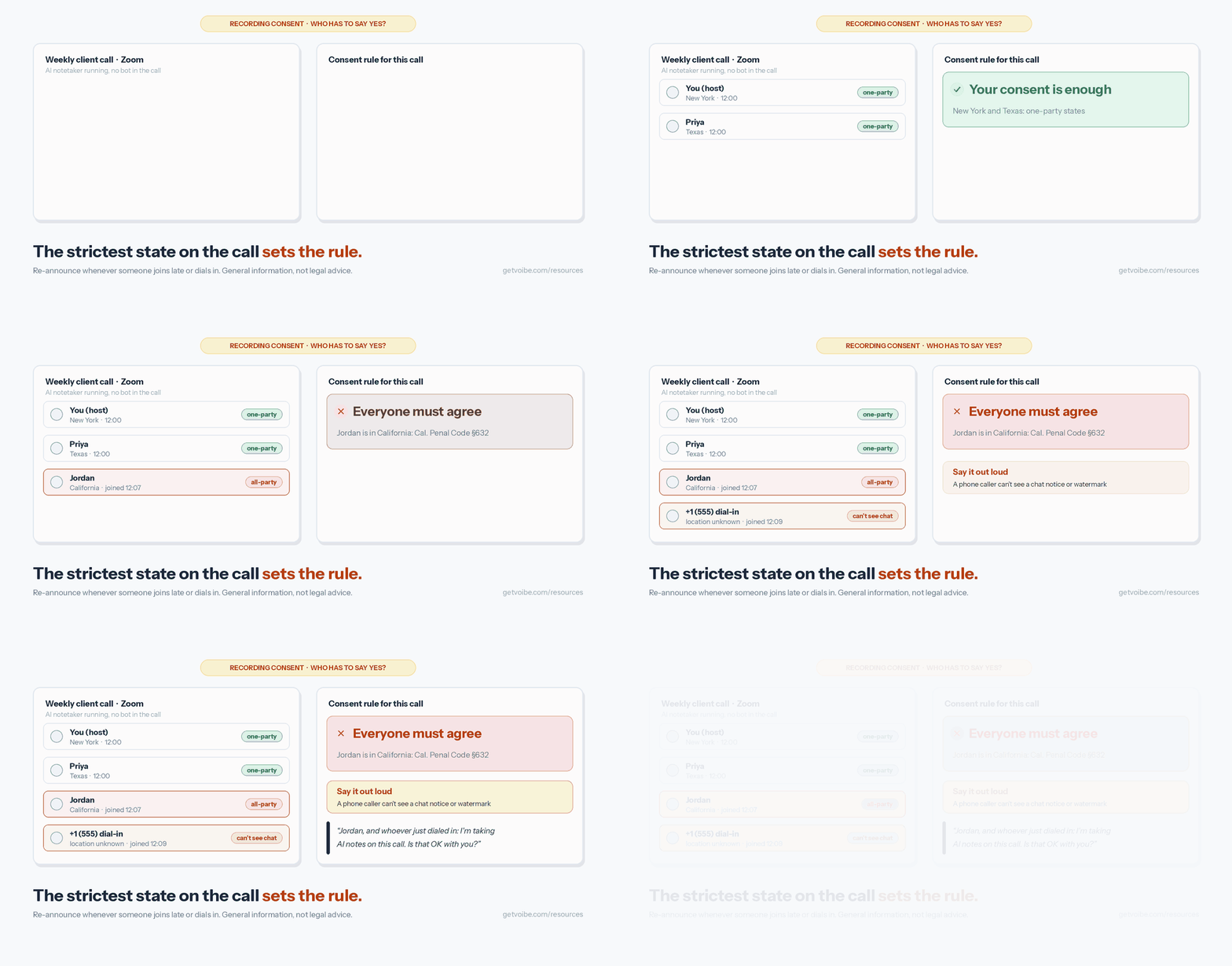
When people on a call are in different states, plan for the strictest state's rule. No federal statute settles which state's law governs an interstate call, so the safe assumption is that a court in the strictest state could apply its own.
California has done exactly that. In Kearney v. Salomon Smith Barney, 39 Cal.4th 95 (2006), the California Supreme Court applied California's all-party law to brokers in Georgia, a one-party state, who recorded calls with clients in California. The court also noted that a business that "adequately advises all parties to a telephone call, at the outset of the conversation" that it's being recorded wouldn't violate the law. That sentence is the whole fix.
People who join late
Someone who joins after your announcement hasn't heard it, so they haven't agreed to anything. If they're in an all-party state, the call just became an all-party call. Re-announce when anyone joins. Granola's chat message is the only notice I found that repeats itself: its help center says "If someone joins a few minutes late, Granola sends a reminder in the chat."
People who dial in by phone
A phone caller can't see a chat message, a watermark or a bot tile. You also often don't know where they are, so assume the strictest rule. California's law adds a twist: calls involving a cellphone or cordless phone need everyone's consent whether or not the conversation is confidential (Cal. Penal Code §632.7). Say the announcement out loud, and say it again when the caller connects.
A no-bot notetaker doesn't create a new consent problem in all-party states. It removes the visible reminder that covered some of these gaps, which leaves the late joiner and the phone caller entirely to you.
Recording In-Person Meetings With an AI Notetaker
The same consent laws apply to a meeting in a room as to a call, because almost every state statute covers "oral" conversations as well as phone calls. A recording app on a laptop in a conference room is subject to the in-person column of the table above.
- The all-party states stay all-party in person. California, Florida, Illinois, Maryland, Massachusetts, Montana, New Hampshire, Pennsylvania and Washington all cover in-person conversations where people expect privacy.
- Connecticut and Nevada relax in person. Both are one-party for a face-to-face conversation.
- Oregon tightens in person. It's one-party on the phone, but everyone at the table must be told.
- Massachusetts targets secret recording. An announced, visible recording is the safe version.
In-person recording is now a normal notetaker feature. Voibe Work records a meeting in the room through your Mac or PC's mic, Fireflies' desktop Take Notes works for in-person conversations, and Granola's phone app is built for in-person meetings. None of them can post a chat message to people sitting across a table, so the announcement is spoken or it doesn't happen.
Make the device visible, say what it does before anyone starts talking, and ask for a yes. If someone arrives after you start, tell them too.
Bot-Free Is Not Consent-Free: What a Missing Bot Changes
A visible bot is a notice mechanism, not consent. Removing it changes who gives notice, not whether notice and consent are needed. With a bot, the vendor shows everyone something. Without one, you're the only notice the other people get.
The 2025–26 lawsuits show that neither design settles the question:
- Otter (bot). In re Otter.AI Privacy Litigation (5:25-cv-06911, N.D. Cal.) challenges whether a bot in the participant list plus continued participation amounts to consent. On August 13, 2026 the court let the federal wiretap, California CIPA and Illinois BIPA claims go forward while dismissing others with leave to amend. Details in our Otter safety review.
- Fireflies (bot and voiceprints). Fricker v. Fireflies.AI (1:26-cv-02675, N.D. Ill.) is a BIPA voiceprint class action; Fireflies' motion to dismiss was fully briefed in August 2026 with no ruling on the docket as of October 30. See is Fireflies safe.
- Granola (no bot). Chamberlain v. Granola (3:26-cv-07926, N.D. Cal.) was filed on July 30, 2026 by a meeting participant, not a Granola user, who says she never knew Granola was running. The case was reassigned to Judge Edward M. Chen, and the docket shows an amended complaint filed on October 19, 2026. Our Granola lawsuit explainer covers the claims.
All three are allegations, not rulings on the merits. The pattern is still useful: plaintiffs are suing over invisible capture and over visible bots that nobody agreed to. The defence that holds up under both theories is a spoken announcement and a yes from each person.
What Each AI Notetaker Does to Tell People, and Whether Admins Can Enforce It
Every notetaker I checked puts consent on the user, and their notice tools range from on-by-default announcements to a simple reminder. Here's what each one does, from its own help center on October 30, 2026.
| Notetaker | Bot joins? | What participants see or hear | Pre-call email | Can admins enforce it? |
|---|---|---|---|---|
| Granola | No | Chat message when transcription starts, a reminder for late joiners, optional video watermark. Opt-in on Free and Business. | Not offered | Enterprise only |
| Otter | Yes (desktop app records without one) | Notetaker shown as a named participant, chat message with a live-transcript link; desktop app can post a custom message in Teams. | Yes, to all calendar guests | Workspace admins can make pre-recording emails the default |
| Fireflies | Yes (Take Notes records without one) | Take Notes: spoken notice about 10 seconds in, "AI Taking Notes" watermark, chat message on Mac only, all on by default. | Yes, one hour before, with a decline link | Email notice can be set team-wide |
| Fathom | Yes (Mac desktop mode records without one) | Visible bot and a recording notice. | Yes, 24 hours before (not for same-day meetings) | Yes: "Enabled for all" |
| Read AI | Yes (desktop app records without one) | Announces itself, needs host approval; anyone can type "opt out" to delete the meeting. | Not documented | Not documented |
| Notion AI Meeting Notes | No | Reminder to get consent; chat text or a voice message. | Not offered | Yes, workspace owners (Business and Enterprise) |
| Voibe Work | No | Reminds you to tell everyone when recording starts; you make the announcement. | No | No |
Can Granola admins enforce the consent message and watermark for everyone?
Yes, but only on Granola's Enterprise plan. Granola's admin guide is "for Enterprise plan admins who want to enforce transparency features for everyone in their workspace"; Free and Business users turn the features on for themselves under Settings, Preferences, Transparency. The chat message now reads "Granola is transcribing this call" with a link to who is transcribing, and the watermark can only be enforced after at least one chat-message option is on. More in our Granola safety review.
Which notetakers help get consent when no bot joins?
Among bot-free modes, Fireflies Take Notes does the most by default: a spoken notice, a watermark and (on Mac) a chat message, all switched on. Notion lets workspace owners require its consent message. Granola's chat message and watermark help once someone turns them on. Voibe Work, the notetaker we build, only reminds you; it posts nothing to the call. If you want a tool to do the telling for you, Fireflies, Notion or Granola Enterprise do more than Voibe Work.
For bot-based tools: Otter recommends combining pre-recording emails with the bot's chat announcement, Fireflies emails participants an hour ahead with a link to decline, Fathom says "It is the recording owner's responsibility to make sure all participants have given consent to be recorded", and Read AI lets any participant type "opt out".
Can an AI Notetaker Prove Everyone Consented?
Mostly no. A chat message, a watermark or an email shows that notice was given, not that each person agreed. If your firm has to prove consent, you have to capture the yes yourself.
- The one exception I found: Otter for Outlook can route Microsoft Teams guests through a recording-permissions page where they "must actively acknowledge and agree to being recorded" before joining. Otter calls it "affirmative, individual permission — not just notification". It needs a Microsoft Enterprise licence and Otter's account team to switch on (Otter help center).
- The method that works with any tool: start the recording, make the announcement, and ask each person to say yes. The yes then sits in the transcript with a speaker label and a time.
- For scheduled meetings: put the notice in the calendar invite too, so people can object before the call.
Voibe Work doesn't capture, record or prove consent. It reminds you to ask, and the transcript it saves on your computer will contain the yes if you ask for it on the recording.
Disclosure Scripts for Every Meeting Type (Copy and Paste)
A good disclosure takes under ten seconds: what's recording, why, and a question that invites a no. Follow these four steps on every call:
- Put it in the invite for scheduled meetings: "I use an AI notetaker on calls. Tell me if you'd rather I didn't."
- Start the notetaker, then say the script, so the announcement and the answers are in the transcript.
- Wait for a yes from each person in all-party situations. Silence is weaker evidence than a yes.
- Repeat it for anyone who joins late, and stop the recording if anyone says no.
Client call
"Before we start: I'm using an AI notetaker so I can focus on you rather than my notes. It doesn't join as a bot, and I only use the notes for our work together. Are you comfortable with that?"
Sales or prospect call
"Quick heads-up, I take AI notes on calls so I don't miss what matters to you. Is that OK with everyone?"
Internal team meeting
"I'm taking AI notes today and I'll share the summary after. Shout if you'd rather I didn't."
Internal meetings still count. Colleagues in all-party states have the same rights as clients, so ask for the yes when anyone on the call is in one.
Job interview or recruiting call
"I'd like to use an AI notetaker so I can listen properly instead of typing. It's only for our hiring notes. Is that all right with you? It's completely fine to say no."
In-person meeting
"This laptop is taking AI notes of the meeting, nothing else. Is everyone OK with that before we start?"
Phone dial-in or late joiner
"Hi, just so you know, I'm taking AI notes on this call. Is that OK with you?"
If someone says no, turn the notetaker off and take notes by hand, or dictate your own summary after the call.
Lawyers, Clinicians and Illinois: Rules on Top of Recording Law
Recording law is the floor. Professional rules, health privacy law and biometric law can require more, even in one-party states.
- Lawyers. ABA Formal Opinion 512 (July 29, 2024) requires informed client consent before client information goes into a generative AI tool that learns from inputs, and says boilerplate in an engagement letter isn't enough. NYC Bar Formal Opinion 2025-6 (December 22, 2025) says to notify clients and get consent before AI-recording a client call, even though New York is one-party. NYC Bar Formal Opinion 2026-2 (August 5, 2026) covers non-client calls: no surreptitious recording, permission from all participants, and a default of not recording. See our guide to AI notetakers for lawyers.
- Clinicians and HIPAA. A business associate agreement is a contract that lets a vendor handle protected health information (45 CFR §164.502(e)). It says nothing about whether the patient agreed to be recorded. State recording law still applies to the visit, so a BAA never replaces the patient's consent.
- Illinois biometrics. Illinois' Biometric Information Privacy Act (740 ILCS 14/15(b)) requires written consent before collecting a voiceprint. Notetakers that identify speakers by voice are the target of the Fireflies and Otter BIPA claims, which is why an Illinois participant is a two-law problem.
- EU and UK. GDPR has no one-party rule. Recording a meeting processes personal data, so you need a lawful basis (Article 6, where consent is one of six) and you must tell people at the time you collect the data (Article 13). The UK's ICO applies the same right to be informed. Some countries add criminal recording laws, so check locally before recording European participants.
Where Voibe Work Fits: No Bot, a Reminder, and Your Responsibility
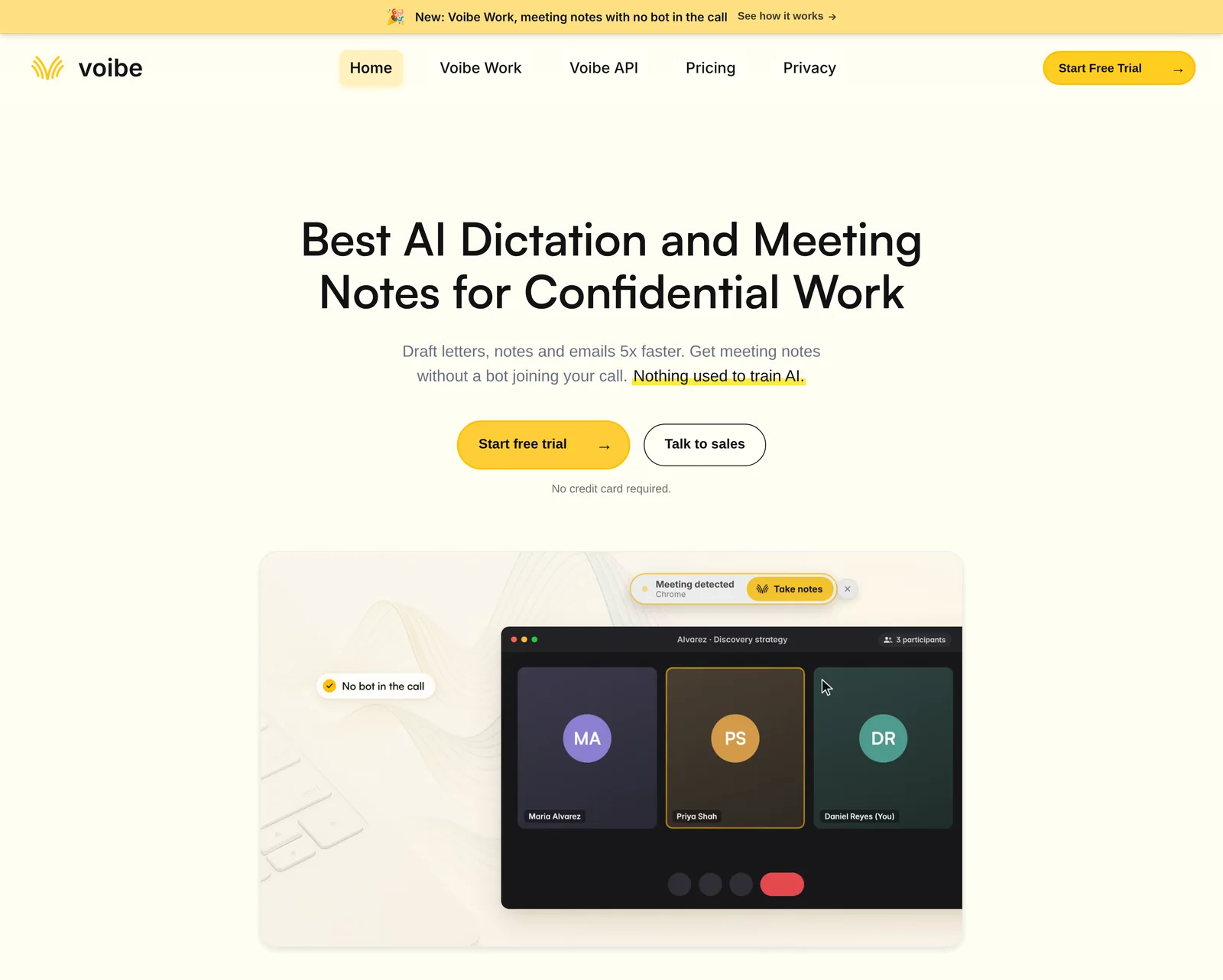
Voibe Work is the meeting-notes plan of Voibe, the app we build: it captures Zoom, Microsoft Teams, Google Meet, Webex, Slack huddles or any other meeting app from your Mac or Windows PC, with no bot in the call. It also records in-person meetings through your Mac or PC's mic.
On consent, here's exactly what it does and doesn't do:
- It reminds you. When recording starts, Voibe reminds you to tell everyone you're taking notes. Following the consent rules for your meeting and your location is your responsibility.
- It doesn't post anything to the call. No chat message, no watermark, no pre-meeting email, and no admin setting that forces a notice. Fireflies, Notion and Granola Enterprise do more here.
- It doesn't capture or prove consent. Ask for the yes after recording starts and it will be in your transcript, with speaker labels and a time on every line.
What it adds is a smaller footprint once people have agreed. Meeting audio is processed by open-source models on zero-retention cloud providers and deleted as soon as processing completes. The transcript and summary are saved on your computer, not on Voibe's servers, and never used to train AI. Meeting notes need an internet connection, and one meeting can run up to 4 hours.
Voibe Work costs $19 a month, $149 a year or $399 lifetime per seat, includes all of Voibe Dictation, and a BAA is available on request. Every new account gets a 7-day trial of every Voibe Work feature with no credit card. The Voibe Work launch post and our no-bot note taker comparison cover the rest.
Trusted by 4,000+ professionals, including people at Netflix, NVIDIA, Amazon, Twilio, and Intercom





See Voibe Work in action
Take meeting notes with no bot in the call
Start free on Mac or Windows. 7 days of every Voibe Work feature, no credit card required. Voibe reminds you to tell everyone you're taking notes.
AI Notetaker Recording Consent FAQ
The basics
Is it legal to use an AI notetaker? Yes, in every US state, if you get the consent the law requires. Federal law and 36 states plus DC need one party's consent, which can be you. California, Florida, Illinois, Maryland, Massachusetts, Montana, New Hampshire, Pennsylvania and Washington need everyone's consent; Connecticut and Nevada need it on phone calls; Delaware and Michigan are unsettled.
What are the all-party consent states in 2026? California, Florida, Illinois, Maryland, Massachusetts, Montana, New Hampshire, Pennsylvania and Washington require every participant's consent. Connecticut and Nevada require it for phone calls, Delaware and Michigan are unsettled, and Oregon requires telling everyone in an in-person conversation. Source: the RCFP Reporter's Recording Guide and the state statutes.
Is Oregon a two-party consent state? Not exactly. Oregon is one-party for phone calls. For in-person conversations, ORS 165.540(1)(c) requires that every participant be told they're being recorded, which is notice rather than consent. The full Ninth Circuit upheld that rule in Project Veritas v. Schmidt (2025), and the Supreme Court declined to review it on October 6, 2025.
Granola and other tools
Can Granola admins enforce consent notifications and the recording watermark for everyone in the workspace? Yes, on Granola's Enterprise plan only. Granola's admin guide is for Enterprise admins who want to enforce the automated chat message and the Granola Watermark for everyone; on Free and Business each user turns them on for themselves under Settings, Preferences, Transparency. The watermark can only be enforced after a chat-message option is on.
Does Granola require the other person to consent to recording? Granola itself doesn't require it, but the law may. Granola adds no bot and says customers remain responsible for determining what notice or consent is required. In an all-party state, or with anyone on the call located in one, every participant has to agree.
Is Granola illegal? No. Granola is legal software, and using it is lawful when you get the consent your participants' states require. Chamberlain v. Granola (N.D. Cal., filed July 30, 2026) alleges that Granola's invisible capture and default AI training violate wiretap laws; those are allegations, not a ruling.
How do Granola and Fathom compare on handling consent for a 120-person company? Fathom gives admins more control on its team plans: its bot is visible, it emails external participants 24 hours before scheduled meetings, and admins can set Auto Request Recording Consent to Enabled for all. Granola adds no bot, and its chat message and watermark can only be enforced company-wide on Enterprise.
What's the best AI notetaker with automatic recording consent disclosures? For bot-free capture, Fireflies Take Notes does the most by default: a spoken notice, an AI Taking Notes watermark and a chat message on Mac, all on. Notion lets workspace owners require a consent message, Otter sends pre-recording emails, and Granola enforces its notices on Enterprise. Voibe Work only reminds you to tell people.
Calls, late joiners and in-person meetings
Does a notetaker that doesn't join as a bot create consent problems in all-party states when someone joins late or dials in by phone? It doesn't change the law, but it removes the visible reminder. A late joiner missed your announcement and a phone caller can't see a chat message or watermark, so neither has agreed to anything. Re-announce whenever someone joins, and assume the strictest state when you don't know where a caller is.
Which state's law applies when callers are in different states? Plan for the strictest one. In Kearney v. Salomon Smith Barney (2006), the California Supreme Court applied California's all-party law to Georgia brokers recording calls with California clients. Telling everyone at the start of the call satisfies the stricter rule.
Do consent laws apply to recording in-person meetings? Yes. Most state recording laws cover in-person conversations where people expect privacy. Connecticut and Nevada are one-party in person, Oregon requires telling everyone, and the nine all-party states still need everyone's consent. Make the device visible and announce it before the meeting starts.
Proof and professional rules
Can an AI notetaker prove that participants consented? Mostly no. Chat messages, watermarks and emails prove notice, not agreement. Otter for Outlook's Microsoft Teams permissions page, which asks each guest to agree before joining, is the exception. With any tool, ask for each person's yes after recording starts so it's in the transcript.
Does a BAA mean I don't need patient consent to record? No. A business associate agreement is a contract that lets a vendor handle protected health information under HIPAA. It doesn't address whether the patient agreed to be recorded, and state recording law still applies to the visit.
Do lawyers need client consent even in one-party states? Under current ethics guidance, effectively yes. NYC Bar Formal Opinion 2025-6 says to notify clients and get consent before AI-recording a client call even in one-party New York, and ABA Formal Opinion 512 requires informed client consent before client information goes into a self-learning AI tool.
The Bottom Line on AI Notetaker Consent Laws
Using an AI notetaker is legal in every state when you meet the strictest rule on the call. Treat anyone in an all-party state, or anyone you can't place, as a reason to get everyone's yes, and re-announce for late joiners and phone callers.
No bot means no visible reminder, so the announcement is the whole compliance plan. Pick a tool whose notice features fit how your team works, put the notice in the invite, and ask for the yes on the recording. If a meeting is sensitive enough that you'd rather nobody recorded it, dictate your own notes afterwards instead.
For the safety record of specific tools, read is Granola safe, is Otter safe and is Fireflies safe. This page is general information, not legal advice.