
9 Best OpenAI Whisper Alternatives for Speech-to-Text (2026)
Compare the best OpenAI Whisper alternatives for developers, led by Voibe's zero-retention speech-to-text API, plus Gladia, Deepgram, AssemblyAI, and top open-source tools.

TL;DR: For most developers replacing Whisper today, the strongest starting point is the Voibe speech-to-text API — batch transcription on a zero-retention private cloud, diarization and a prompt-steerable summary included at no extra charge, billed per second and only on a finished job ($0.25-$0.30/hour, 15 free minutes, no SDK required). If your workload is real-time streaming specifically, Deepgram Nova-3 ($0.0043/min) is the fastest option. For audio intelligence bundled into the same call, AssemblyAI ($0.0025/min) is cheapest. For self-hosting, faster-whisper (free, open-source) runs Whisper 4x faster with lower memory.
OpenAI's Whisper model changed speech-to-text when it launched in 2022 as a free, open-source model. The demand for speech-to-text solutions continues to grow: the global voice-to-text market is valued at $9.66 billion and is projected to grow at 15–20% CAGR through 2030, driven by enterprise adoption, accessibility requirements, and AI assistant integration. But building a production speech pipeline around Whisper means managing GPU infrastructure, handling scaling, fighting hallucinations, and accepting that Whisper has no native streaming support — and it says nothing about what happens to the audio you send it. This guide covers eight alternatives — a managed zero-retention API, other managed APIs, and optimized open-source implementations — for developers who want to stop maintaining their own Whisper pipeline. For background on how Whisper works, see our technical Whisper explainer.
Key Takeaways: Whisper Alternatives at a Glance
| Tool | Best For | Price per Minute | Key Strength |
|---|---|---|---|
| Voibe API | Zero-retention batch + agents | $0.0042-$0.005 | Diarization + steerable summary included, MCP server, audio deleted on transcript |
| Gladia (Solaria-3) | European-language, noisy business audio | $0.0102 (Starter, async) | #1 on Earnings22 and Switchboard per Gladia; diarization/translation/sentiment bundled |
| Deepgram Nova-3 | Real-time streaming | $0.0043 (pre-recorded) | Fastest streaming STT, self-hosted option |
| AssemblyAI | Audio intelligence | $0.0025 (Universal-2) | Summarization, sentiment, entity detection |
| Google Cloud STT | Multilingual at scale | $0.016 (Chirp 3) | 100+ languages, GCP integration |
| Amazon Transcribe | AWS ecosystem | $0.024 (standard) | AWS integration, medical transcription |
| Azure Speech | Microsoft ecosystem | $0.016 (real-time) | Whisper models hosted, custom models |
| faster-whisper | Self-hosted Whisper | Free (+ GPU cost) | 4x faster than stock Whisper, open-source |
| whisper.cpp | Edge/mobile deployment | Free (+ hardware) | C++ port, runs on CPU, mobile support |
Key Takeaway
The Voibe API is the strongest default for batch transcription and agent workloads: zero-retention by design, diarization and a summary in one response, $0.25-$0.30/hour. Gladia's new Solaria-3 model claims the top spot on the Earnings22 and Switchboard benchmarks for European-language, real-world audio. Deepgram Nova-3 is the best managed API for real-time streaming at $0.0043/min. AssemblyAI offers the cheapest per-minute rate at $0.0025/min with audio intelligence features. faster-whisper is the best self-hosted option for teams already using Whisper.
Why Developers Look for Whisper Alternatives
Whisper is a powerful open-source model, but building production speech-to-text around it comes with real challenges:
- No native real-time streaming. Whisper processes audio in batch — it transcribes complete audio files, not live streams. Building real-time transcription on top of Whisper requires chunking audio, managing buffers, and handling partial results. Managed APIs like Deepgram and AssemblyAI offer streaming natively.
- GPU infrastructure costs and complexity. Running Whisper's large-v3 model requires 10GB+ VRAM. Self-hosting on cloud GPUs costs $1.00–$1.60/hour per instance. Scaling, monitoring, and maintaining GPU infrastructure adds DevOps overhead that managed APIs eliminate.
- Hallucination problems. Whisper can generate text that was never spoken — especially on silent or low-quality audio segments. This is a well-documented issue that requires post-processing workarounds in production systems.
- No speaker diarization. Whisper does not identify different speakers. Multi-speaker transcription requires pairing Whisper with a separate diarization model (e.g., pyannote.audio), adding complexity.
- Unreliable language detection. Whisper's language detection can misidentify short audio segments, leading to incorrect transcription language selection. This is problematic for multilingual applications.
- OpenAI has moved beyond Whisper. In March 2025, OpenAI released gpt-4o-transcribe and gpt-4o-mini-transcribe with lower error rates than Whisper. OpenAI now recommends gpt-4o-mini-transcribe over Whisper for new API users.
What to Look For in a Whisper Alternative
1. What Happens to the Audio After Transcription
Whisper's license says nothing about this because Whisper is a model, not a service — the retention policy is whichever vendor you wrap it with. Some providers run opt-out training programs on submitted audio or default to 12-month retention; zero retention is sometimes a custom policy you have to request. Check this before volume, not after: Voibe's API deletes the recording the moment the transcript exists, on every tier, with no setting to configure.
2. Managed API vs Self-Hosted
Managed APIs (Voibe, Deepgram, AssemblyAI, Google, AWS, Azure) handle infrastructure, scaling, and maintenance. Self-hosted options (faster-whisper, whisper.cpp) give you full control but require GPU management. Choose based on your team's DevOps capacity and cost sensitivity at scale.
3. Real-Time Streaming Support
If your application needs live transcription (voice assistants, live captions, call centers), you need native streaming support. Whisper does not offer this. Deepgram and AssemblyAI provide WebSocket-based streaming APIs.
4. Pricing Model
APIs charge per minute of audio. Self-hosting charges per GPU-hour. Calculate your breakeven: at what volume does self-hosting become cheaper? For most teams processing under 5,000 hours/month, managed APIs are cheaper when you include DevOps costs. Also check whether failed or retried jobs are billed — the Voibe API charges only on a job that reaches DONE, so retries in an agent loop cost nothing.
5. Audio Intelligence Features
Some APIs go beyond transcription: speaker diarization, sentiment analysis, entity detection, summarization, and topic detection. AssemblyAI bundles most of these into the same API call, at extra cost for some add-ons. Voibe includes diarization and a prompt-steerable summary in every response at no extra charge. With Whisper alone, you need separate models for each.
6. Accuracy for Your Domain
General accuracy benchmarks do not always predict your specific use case. Test candidates against your actual audio (accent, noise level, domain vocabulary). Deepgram Nova-3 Medical is purpose-built for clinical audio. Google Chirp 3 excels at multilingual content.
7. Latency Requirements
For real-time applications, latency matters more than raw accuracy. Deepgram leads on streaming latency. Self-hosted faster-whisper can achieve low latency but requires optimization. Batch transcription — the Voibe API included — is latency-insensitive, since the job runs after the recording already exists.
1. Voibe Speech-to-Text API — Best for Zero-Retention Batch Transcription and Agents
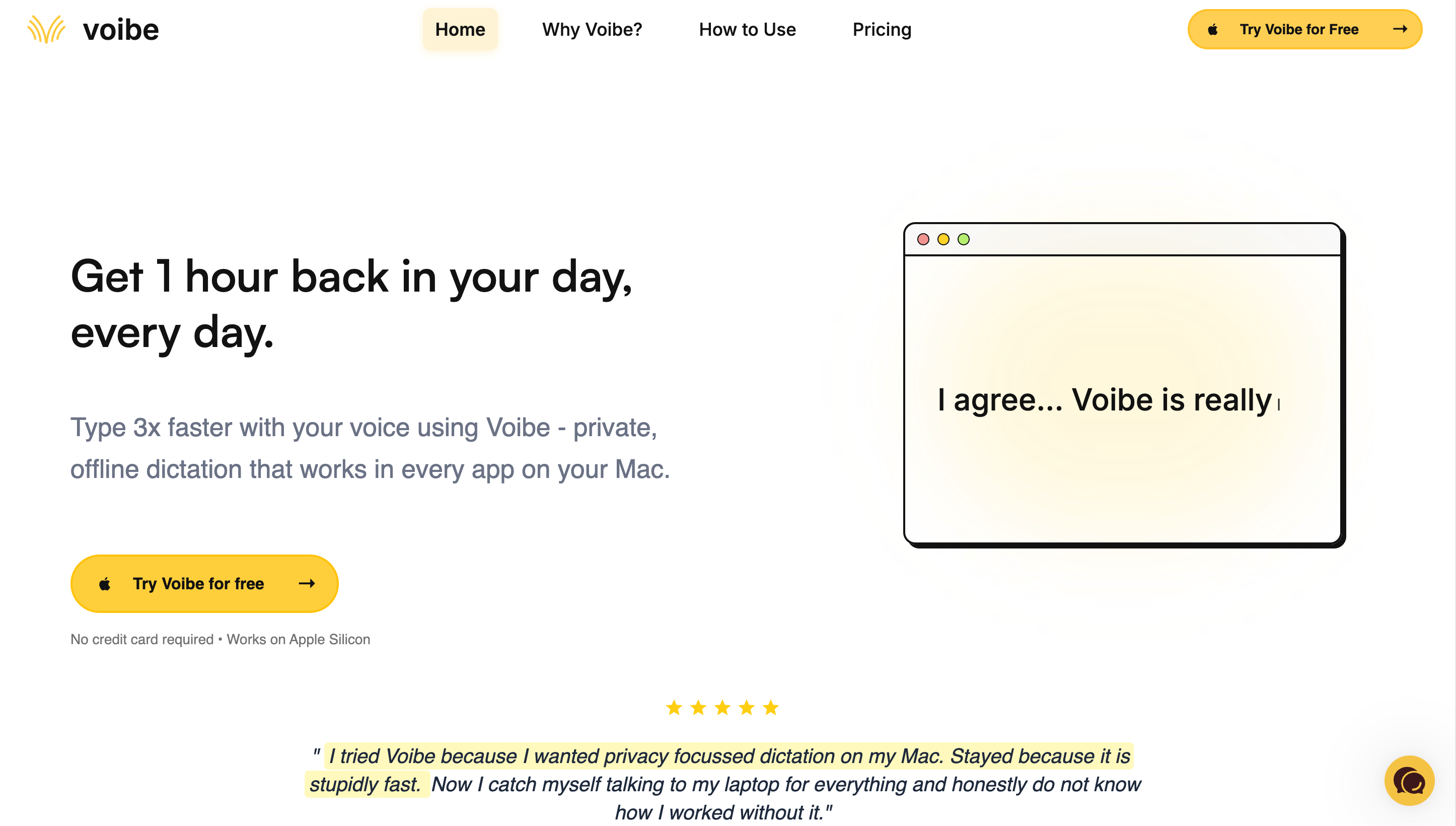
Voibe's speech-to-text API is a batch transcription API launched August 2026 that runs on Voibe's zero-retention cloud — open-source models on zero-retention providers, with no third-party AI lab anywhere in the audio path. It's built for exactly the workload this page is about: replacing a self-managed Whisper pipeline with something you don't have to operate, while keeping a privacy story a Big Tech API can't offer.
Key Features
- Diarized transcript with per-segment speaker labels and timestamps, included by default
- Prompt-steerable summary (up to 2,000 characters) returned in the same response as the transcript
- Audio deleted the moment the transcript exists — never archived, never used to train models, on every tier
- Three REST endpoints and a bearer token — no SDK to install or maintain
- Hosted MCP server at api.getvoibe.com/mcp for Claude Code, Claude Cowork, Cursor, and other MCP clients
- Per-second billing, charged only on jobs that reach DONE
Pros
- Zero retention is the default on every tier, not an enterprise add-on or a custom policy to request
- Diarization and summarization ship in the base price — most competitors charge add-ons or require a separate LLM call for these
- No SDK dependency to track or update; any HTTP client or MCP-capable agent can use it immediately
- Failed and retried jobs cost nothing, which matters most in agent loops that retry on error
- Minutes never expire once purchased
Cons
- Batch only — no real-time streaming, so it isn't a fit for live captioning or voice assistants
- No published data-residency or region option, unlike some competitors here
- New to the market (August 2026), so it lacks the years of production track record Deepgram and AssemblyAI have
- No dedicated medical or legal model variant the way Deepgram and Amazon offer
Pricing
Prepaid minute packs: $10 for 2,000 minutes ($0.30/hour), $25 for 5,250 minutes ($0.29/hour), $50 for 11,000 minutes ($0.27/hour), $100 for 24,000 minutes ($0.25/hour). Billing is per second of audio and only on jobs that reach DONE — queued, processing, and failed jobs cost nothing. New accounts get 15 free minutes with no card required.
Best For
Developers and AI agents transcribing recordings that already exist — meeting recordings, coaching or interview calls, support tickets, voicemail — where the priority is not sending that audio to a third-party AI lab, and where diarization plus a summary saves a second API call. See our full eight-API roundup for agent workloads for where Voibe is and isn't the pick.
2. Gladia (Solaria-3) — Best for European-Language Accuracy on Noisy Business Audio
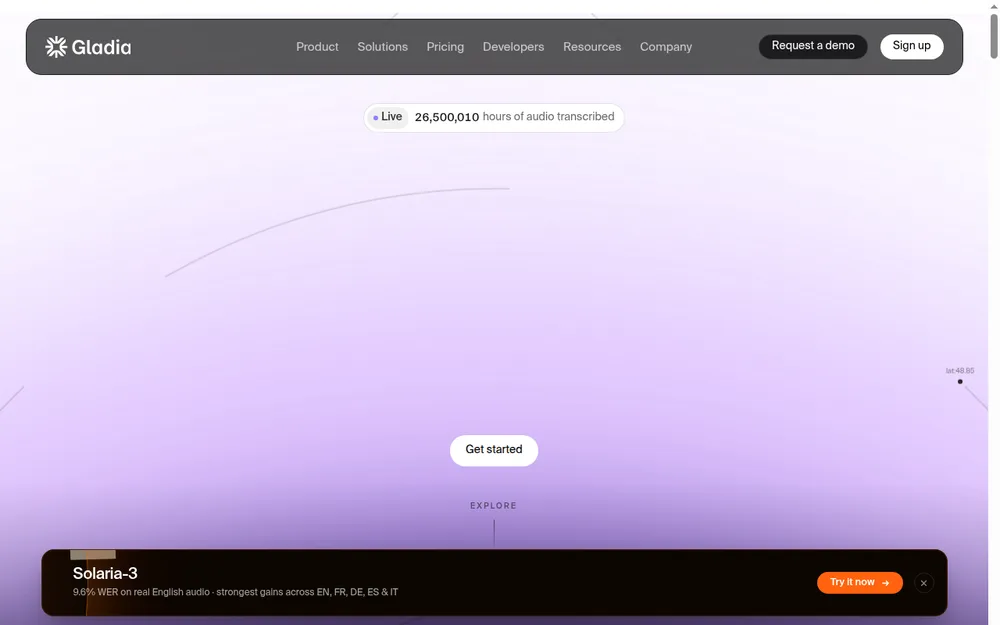
Gladia released Solaria-3 on June 10, 2026 — a speech model built specifically for noisy, accented, multi-speaker business audio in European languages, the exact conditions where Whisper's accuracy tends to fall apart. Gladia's own benchmarks put it #1 on two widely-used public speech-to-text tests, and the model is live now through Gladia's async and real-time APIs.
Key Features
- Solaria-3: 9.6% WER on Gladia's internal production-audio benchmark (English) — a 26% improvement over Solaria-1's 12.9%, per Gladia
- #1 on the Earnings22 financial-call benchmark at 6.4% WER, and #1 on the Switchboard conversational-telephone benchmark at 33.9% WER, per Gladia's published results
- Optimized for five European languages — English, French, German, Spanish, Italian — with 100+ languages supported overall
- Diarization, automatic language detection, translation, sentiment and entity detection bundled into every paid plan, not sold as add-ons
- Both real-time and async (batch) APIs, each with its own free trial
Pros
- Strongest published accuracy on financial/business calls (Earnings22) and difficult conversational telephone audio (Switchboard) among the models Gladia benchmarked
- No add-on pricing for diarization, translation, sentiment, or entity detection — bundled into the base rate
- Growth-tier pricing drops to $0.20/hour async ($0.25/hour real-time), competitive with the cheapest options in this roundup
- States GDPR, HIPAA, and SOC 2 Type 2 compliance
Cons
- The Earnings22/Switchboard results are Gladia's own benchmarks, not an independent third party's — a useful data point, not a verified neutral ranking
- Solaria-3 is tuned for five European languages; Gladia's own posts note Solaria-1 remains stronger for clean read-speech and broader multilingual coverage
- Starter (pay-as-you-go) pricing is among the pricier per-hour rates here: $0.61/hour async, $0.75/hour real-time, before any volume commitment
- Zero data retention is an Enterprise-tier feature, not the default on Starter or Growth
Pricing
Starter (pay-as-you-go): $0.61/hour async, $0.75/hour real-time, with €50 in free credits (roughly 80+ hours of async transcription). Growth: as low as $0.20/hour async, $0.25/hour real-time, with a volume commitment. Enterprise: custom pricing, unlimited concurrent requests, zero data retention.
Best For
Teams transcribing European-language business calls, contact-center audio, or other noisy real-world recordings — where Gladia's benchmarks show the largest gap over competitors — and anyone who wants diarization, translation, and sentiment analysis bundled into the base price instead of billed as add-ons.
3. Deepgram Nova-3 — Best Managed API for Real-Time Streaming
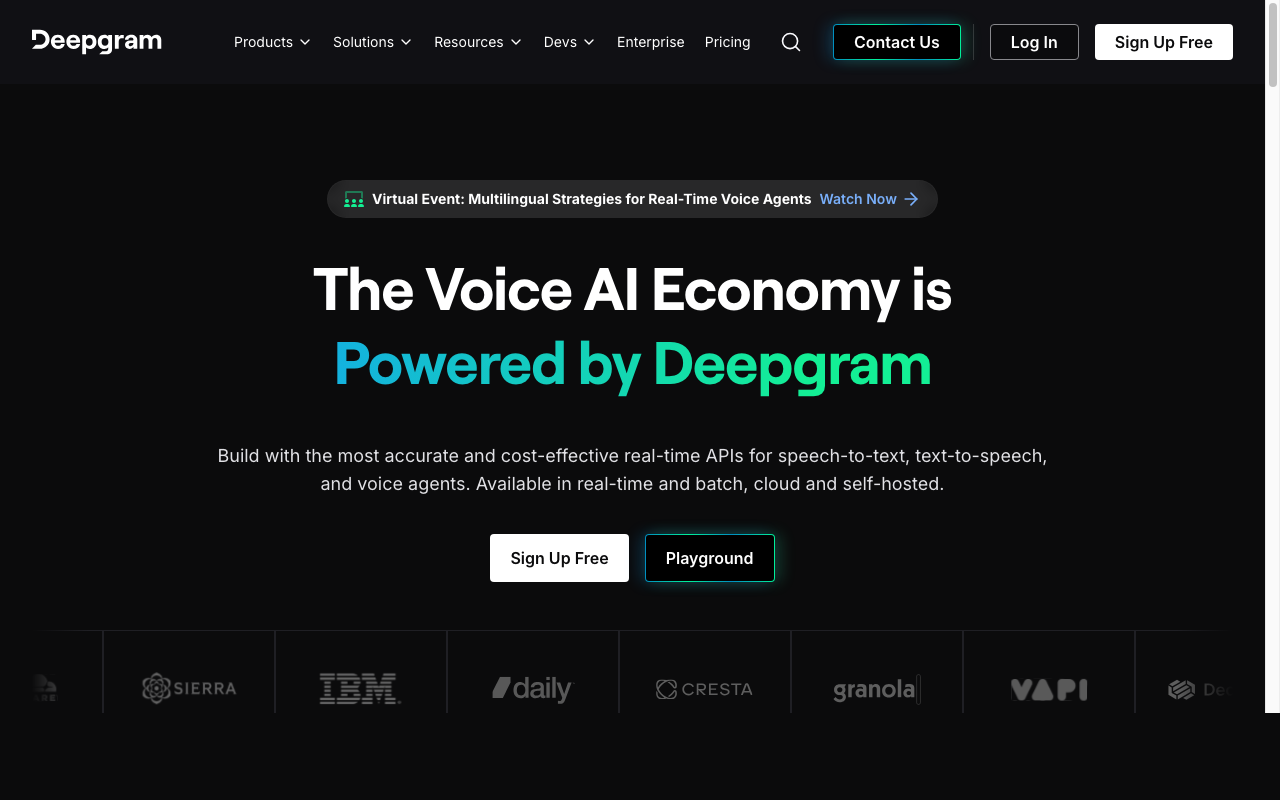
Deepgram Nova-3 is the leading speech-to-text API for production applications that need real-time streaming. Deepgram's proprietary model is purpose-built for low-latency streaming — the feature Whisper fundamentally lacks. Nova-3 also offers a self-hosted deployment option for on-premises requirements.
Key Features
- Real-time WebSocket streaming with low latency
- Speaker diarization (add-on)
- Nova-3 Medical model for clinical audio
- Self-hosted deployment option
- 30+ language support
- Topic detection and summarization
Pros
- Fastest streaming speech-to-text API available
- 28% cheaper than Whisper API for pre-recorded English ($0.0043 vs $0.006/min)
- Self-hosted option for on-premises requirements
- Nova-3 Medical model for healthcare applications
Cons
- Proprietary model — no self-hosting the model itself (only the inference platform)
- Speaker diarization is a paid add-on, not included in base price
- More expensive than AssemblyAI at most volume tiers
- Multilingual pricing higher ($0.0052/min pre-recorded)
Pricing
Pay-as-you-go: $0.0043/min (English pre-recorded), $0.0077/min (English streaming). Growth plan: $0.0036/min (pre-recorded), $0.0065/min (streaming). Free tier: $200 credit. 1,000 hours/month cost: approximately $258 (pre-recorded) or $462 (streaming).
User Reviews
Deepgram is listed on G2 with strong developer sentiment for streaming performance.
Best For
Applications requiring real-time streaming transcription: voice assistants, live captions, call center analytics, and real-time meeting notes.
4. AssemblyAI — Best for Audio Intelligence Features
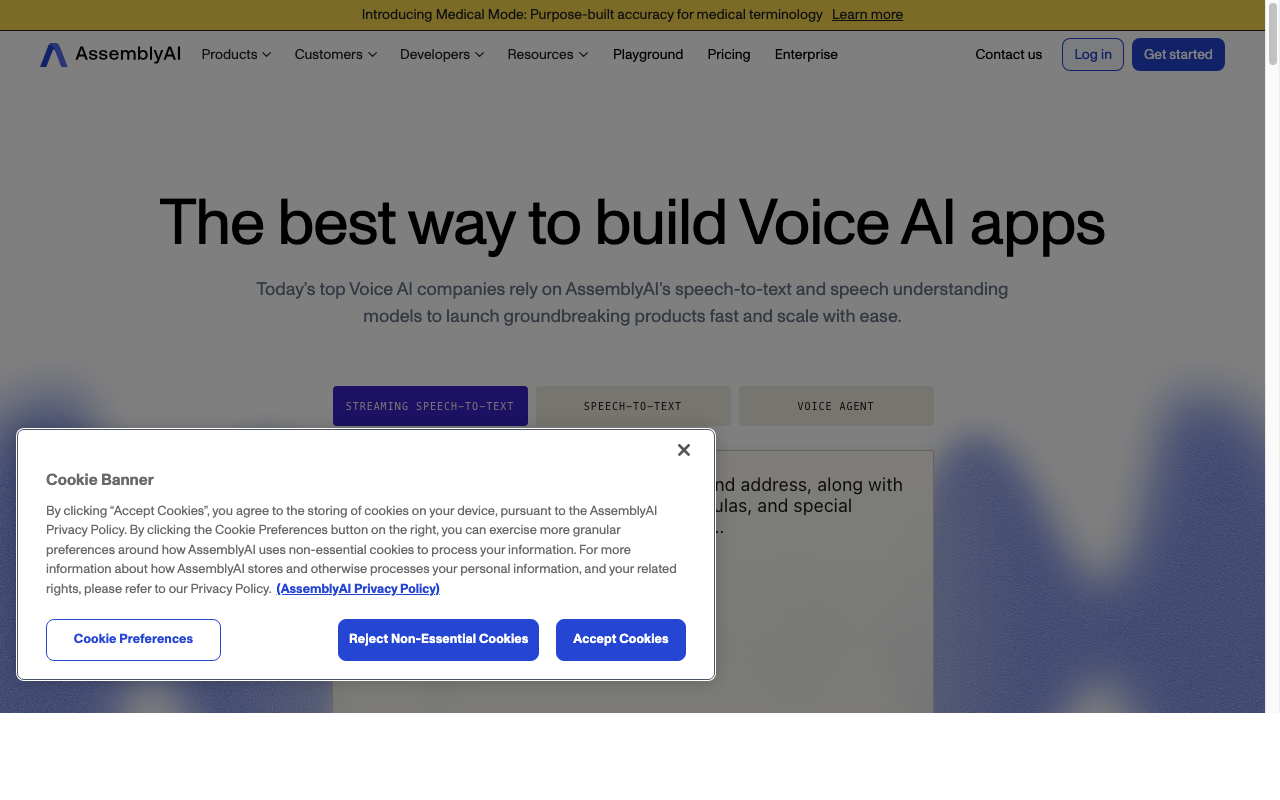
AssemblyAI combines transcription with audio intelligence — summarization, sentiment analysis, entity detection, and topic detection — in a single API call. For developers who need more than raw transcription, AssemblyAI avoids the need to build a separate LLM pipeline for post-processing.
Key Features
- Universal-2 model with 99-language support
- Audio intelligence: summarization, sentiment, entity detection, topic detection
- Speaker diarization (add-on at $0.02/hr)
- Real-time streaming via WebSocket
- $50 free credits (~185 hours of transcription)
Pros
- Cheapest base rate among major APIs at $0.0025/min ($0.15/hr)
- Audio intelligence features built into the same API call
- 99-language support with Universal-2
- Generous free tier ($50 credits)
Cons
- Charges based on session duration, not audio length — real-world costs can be ~65% higher for short audio segments
- Add-on features (diarization, sentiment, summarization) increase total cost
- No self-hosted deployment option
- Streaming latency higher than Deepgram for real-time applications
Pricing
Universal-2: $0.0025/min ($0.15/hr). Add-ons: diarization +$0.02/hr, summarization +$0.03/hr, entity detection +$0.08/hr. Free tier: $50 credits.
User Reviews
AssemblyAI is listed on G2 with positive reviews for developer experience and documentation.
Best For
Developers who need transcription plus audio intelligence (summarization, sentiment, entities) without building a separate processing pipeline.
5. Google Cloud Speech-to-Text (Chirp 3) — Best for Multilingual at Scale
Google Cloud Speech-to-Text with the Chirp 3 model offers the broadest language support (100+ languages) among commercial APIs. For teams already on Google Cloud Platform, STT integrates natively with other GCP services.
Key Features
- Chirp 3 model with 100+ language support (GA in 2025)
- Real-time streaming and batch transcription
- Speaker diarization
- Dynamic batch option (75% cheaper, up to 24hr delivery)
- Deep GCP integration (BigQuery, Cloud Storage, Pub/Sub)
Pros
- Broadest multilingual coverage among APIs
- Dynamic batch pricing is extremely cost-effective ($0.004/min)
- Native GCP ecosystem integration
- Free tier: 60 minutes/month
Cons
- Standard pricing is expensive at $0.016/min (4x Deepgram, 6x AssemblyAI)
- GCP billing complexity for non-Google shops
- Chirp 3 available only through V2 API
Pricing
Standard: $0.016/min. Dynamic batch: $0.004/min (up to 24hr delivery). Volume discounts available. Free tier: 60 min/month.
Best For
Teams on GCP needing multilingual transcription across 100+ languages, or batch workloads where 24-hour delivery is acceptable.
6. Amazon Transcribe — Best for AWS Ecosystem
Amazon Transcribe is AWS's managed speech-to-text service. Amazon Transcribe Medical is purpose-built for healthcare applications with HIPAA eligibility. For teams on AWS, Transcribe integrates natively with S3, Lambda, and other AWS services.
Key Features
- Amazon Transcribe Medical for HIPAA-eligible clinical transcription
- Real-time streaming and batch modes
- Custom vocabulary and custom language models
- Speaker diarization
- Deep AWS integration
Pros
- HIPAA-eligible medical transcription model
- Custom vocabulary support — closest to building domain-specific models
- Native AWS ecosystem integration
- Free tier: 60 minutes/month for 12 months
Cons
- Most expensive major API at $0.024/min (standard)
- AWS billing complexity
- Fewer audio intelligence features than AssemblyAI
Pricing
Standard: $0.024/min. Medical: $0.0375/min. Free tier: 60 min/month for 12 months.
Best For
Teams on AWS needing deep service integration, or healthcare applications requiring HIPAA-eligible transcription.
7. Azure Speech Services — Best for Microsoft Ecosystem
Azure Speech Services hosts Whisper models alongside Microsoft's own speech models, giving you a choice. For teams already on Azure, Speech Services integrates with the broader Azure AI ecosystem. Azure is the only major cloud that lets you run Whisper as a managed service without self-hosting.
Key Features
- Hosted Whisper models (no self-hosting required)
- Microsoft's proprietary speech models as an alternative
- Custom Speech for building domain-specific models
- Real-time streaming
- Azure ecosystem integration
Pros
- Run Whisper without managing GPU infrastructure
- Custom Speech allows domain-specific fine-tuning
- Can use either Whisper or Microsoft's own models
- Free tier: 5 hours/month (real-time), 1 hour/month (batch)
Cons
- Pricing at $0.016/min is above Deepgram and AssemblyAI
- Azure billing and service management complexity
- Fewer audio intelligence features than AssemblyAI
Pricing
Real-time: $0.016/min. Batch: $0.0108/min. Free tier: 5 hours/month (real-time).
Best For
Teams on Azure who want managed Whisper without self-hosting, or those needing custom speech model training.
8. faster-whisper — Best Open-Source Self-Hosted Option
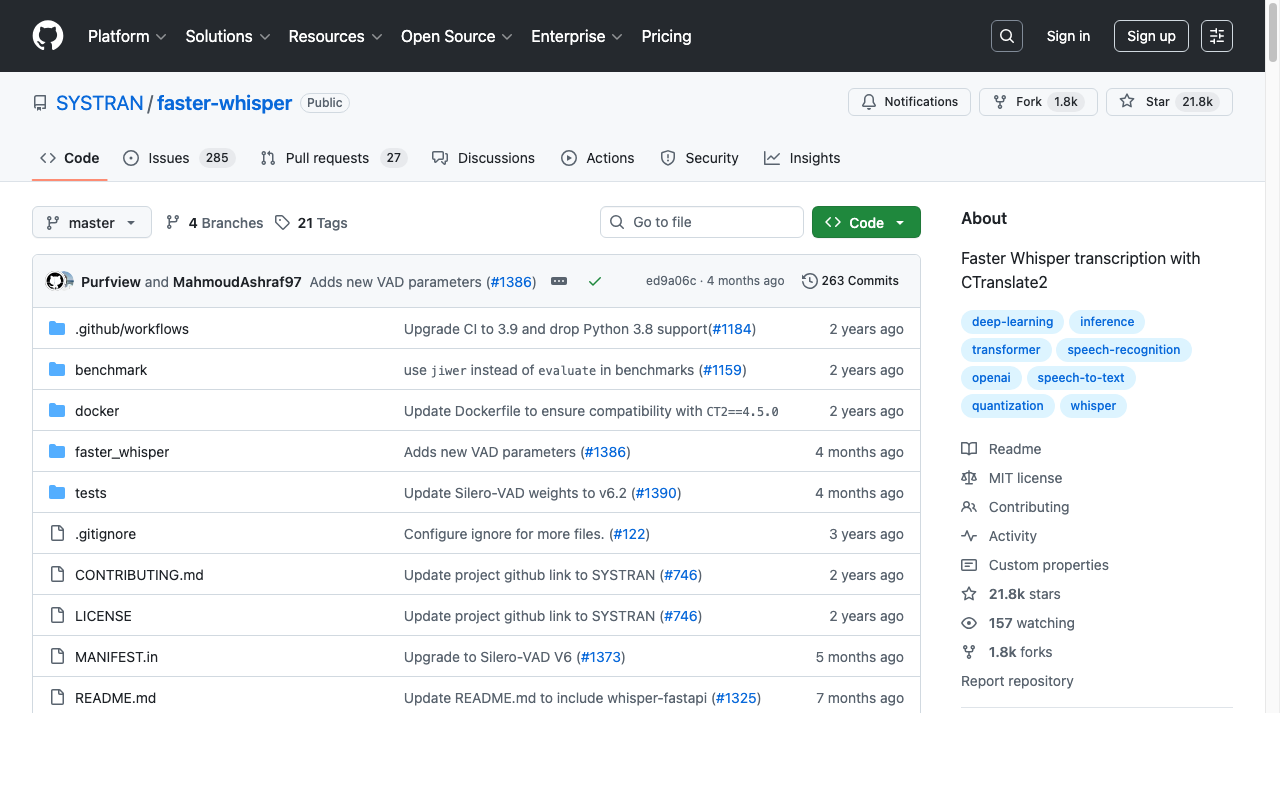
faster-whisper replaces Whisper's PyTorch runtime with CTranslate2, a C++ inference engine that runs Whisper models up to 4x faster with the same accuracy and lower memory usage. For teams committed to self-hosting, faster-whisper is the best way to reduce GPU costs without changing models.
Key Features
- 4x faster inference than stock OpenAI Whisper
- 8-bit quantization support (CPU and GPU) for further speedups
- Same Whisper model weights — identical accuracy
- Python API (drop-in replacement for openai-whisper)
- 14,000+ GitHub stars, active community
Pros
- 4x faster = 4x lower GPU cost per minute of audio
- Same accuracy as stock Whisper — just faster
- 8-bit quantization reduces memory requirements
- Open-source and free
Cons
- Still requires GPU infrastructure management
- No streaming support built-in (same Whisper limitation)
- No speaker diarization, summarization, or audio intelligence
- You own the scaling, monitoring, and maintenance burden
Pricing
Free (open-source). GPU costs: approximately $0.005–$0.013/min depending on instance type and utilization. At typical rates, self-hosting faster-whisper costs $30–$80/month for a single GPU instance.
Best For
Teams already self-hosting Whisper who want to cut GPU costs by 4x without changing their model or pipeline architecture.
9. whisper.cpp — Best for Edge and Mobile Deployment
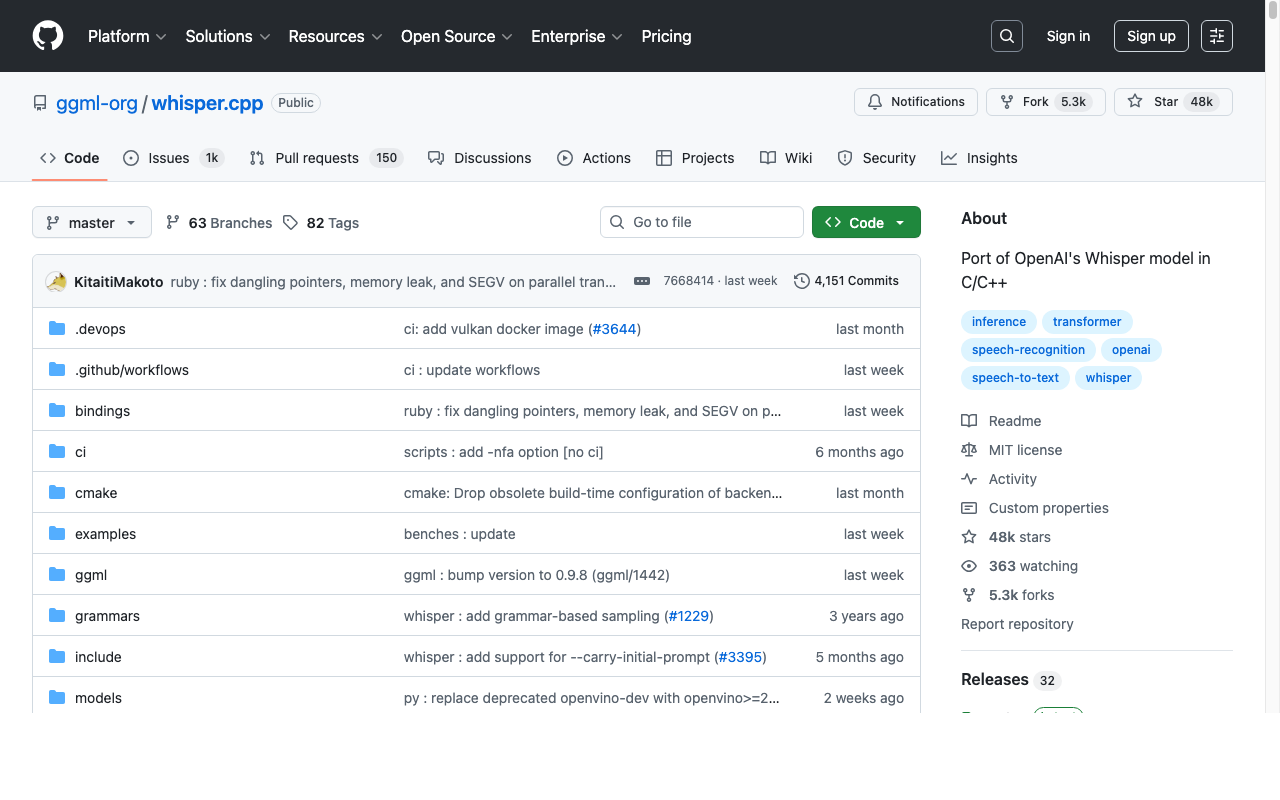
whisper.cpp is a C/C++ port of Whisper by Georgi Gerganov that runs efficiently on CPU, Apple Neural Engine, and mobile devices. whisper.cpp is the foundation for many consumer Whisper apps — including Mac dictation tools like Voibe that run Whisper entirely on-device. With 38,000+ GitHub stars, whisper.cpp is the most popular Whisper implementation for edge deployment.
Key Features
- C/C++ implementation — runs on CPU without GPU
- Apple Silicon optimization (ARM NEON, Metal, Core ML)
- iOS, Android, and WebAssembly support
- Quantized models for reduced size (4-bit, 5-bit)
- 38,000+ GitHub stars
Pros
- Runs on CPU — no GPU required for deployment
- Optimized for Apple Silicon (M1–M4) via Core ML and Metal
- Mobile deployment on iOS and Android
- Smallest memory footprint among Whisper implementations
Cons
- Slower than faster-whisper for GPU-based server workloads
- No streaming API built-in
- C/C++ codebase — harder to integrate than Python-based faster-whisper
- Accuracy slightly lower with heavily quantized models
Pricing
Free (open-source, MIT license). Hardware costs: runs on any CPU, optimized for Apple Silicon. Zero cloud dependency.
Best For
Edge deployment on mobile, desktop, and embedded devices where GPU access is unavailable, and for building consumer apps that run Whisper on-device.
End-user alternative: If you want a desktop dictation app that already wraps Whisper with a push-to-talk GUI, see our Handy review. Handy (MIT, ~20,000 GitHub stars) runs Whisper locally on Mac, Windows, and Linux with zero setup. Our Handy alternatives guide covers 9 options for users who want AI editing, IDE integration, or mobile support.
How to Choose the Right Whisper Alternative
Use these decision questions to select the best OpenAI Whisper alternative for your application:
Do you need zero data retention, or are you building for an AI agent?
- Yes → The Voibe API deletes audio the moment the transcript exists by default, includes diarization and a summary in one response, and connects to agents through a hosted MCP server with no SDK.
- No, retention is not a concern → Any option in this list works; pick on streaming, price, or ecosystem below.
Do you need real-time streaming transcription?
- Yes → Deepgram Nova-3 (fastest streaming) or AssemblyAI (with audio intelligence).
- No (batch is fine) → Any option works. Google Dynamic Batch at $0.004/min is cheapest for batch.
Is most of your audio European-language business calls or other noisy, accented real-world recordings?
- Yes → Gladia's Solaria-3 model is built and benchmarked specifically for this — #1 on the Earnings22 and Switchboard benchmarks, per Gladia.
- No, mostly clean or non-European audio → Any option in this list works.
Managed API or self-hosted?
- Managed API → Voibe, Gladia, Deepgram, AssemblyAI, or your cloud provider (Google, AWS, Azure).
- Self-hosted → faster-whisper (GPU servers) or whisper.cpp (CPU/edge).
Do you need audio intelligence (summarization, sentiment, entities)?
- Yes → AssemblyAI has these built into the API.
- No → Deepgram or self-hosted options are more cost-effective.
What is your monthly audio volume?
- Under 1,000 hours → Managed APIs are most cost-effective when factoring in DevOps time.
- 1,000–10,000 hours → Compare API pricing vs self-hosted costs carefully.
- Over 10,000 hours → Self-hosting faster-whisper is likely cheaper.
Are you deploying to mobile or edge devices?
- Yes → whisper.cpp is the only option designed for on-device deployment.
- No → faster-whisper (self-hosted) or managed APIs.
Best Tool for Your Situation: Use-Case Cheat Sheet
- Transcribing recordings you cannot send to a Big Tech AI lab (client calls, interviews, internal meetings) → Voibe API ($0.25-$0.30/hour) — audio deleted the moment the transcript exists, on every tier
- Wiring transcription into an AI agent (Claude Code, Cursor, a custom loop) → Voibe API — hosted MCP server, no SDK, billed only on finished jobs
- Building a voice assistant with live transcription → Deepgram Nova-3 streaming ($0.0077/min) — fastest real-time STT
- Transcribing podcast episodes or recorded meetings → AssemblyAI ($0.0025/min) — cheapest batch rate with summarization
- Processing 100+ languages → Google Chirp 3 — 100+ language support, best multilingual accuracy
- Transcribing European-language business calls or noisy contact-center audio → Gladia (Solaria-3) — #1 on Earnings22 and Switchboard per Gladia's own benchmarks
- Medical/clinical transcription → Deepgram Nova-3 Medical or Amazon Transcribe Medical
- Already on AWS → Amazon Transcribe — native S3/Lambda integration
- Already on Azure → Azure Speech Services — managed Whisper or Microsoft models
- Already on GCP → Google Cloud STT — native BigQuery/Pub-Sub integration
- Self-hosting Whisper and want to cut GPU costs → faster-whisper — 4x speedup, same accuracy
- Deploying to iOS/Android/edge devices → whisper.cpp — CPU-optimized, mobile-ready
- Building a Mac/desktop app with on-device STT → whisper.cpp — powers apps like Voibe
- Transcribing recorded client calls at a bank, super fund or insurer → depends on retention and redaction needs. See the best speech-to-text APIs for financial services for retention, training defaults and PII redaction compared
- Need summarization + sentiment + transcription in one call → AssemblyAI — audio intelligence built-in
- Processing 10,000+ hours/month at lowest cost → faster-whisper self-hosted or Google Dynamic Batch ($0.004/min)
Frequently Asked Questions
Common developer questions about Whisper alternatives, organized by topic.
Whisper Basics
Is OpenAI Whisper free?
The Whisper model is open-source and free to download. Running it requires GPU hardware — cloud GPU costs $1.00–$1.60/hour. The OpenAI Whisper API costs $0.006/min as a managed service.
What replaced OpenAI Whisper API?
In March 2025, OpenAI released gpt-4o-transcribe and gpt-4o-mini-transcribe with lower error rates. OpenAI recommends gpt-4o-mini-transcribe for most transcription tasks. The original Whisper API remains available.
Comparisons
How does Deepgram compare to Whisper?
Deepgram Nova-3 offers real-time streaming (Whisper does not), 28% lower pricing for pre-recorded English ($0.0043 vs $0.006/min), and speaker diarization. Whisper is open-source and free to self-host.
Is faster-whisper better than Whisper?
faster-whisper runs Whisper models 4x faster with identical accuracy and lower memory usage via CTranslate2. It is strictly better for self-hosting — same model, faster inference.
Costs and Self-Hosting
How much does it cost to self-host Whisper?
Cloud GPU instances (e.g., AWS g5.xlarge) cost $1.00–$1.60/hour. At typical utilization, this translates to $0.02–$0.05/min of transcribed audio. Self-hosting becomes cost-effective at approximately 5,000–10,000 hours/month.
Which API has the best accuracy?
Accuracy varies by audio type. Deepgram Nova-3 leads on general English benchmarks. AssemblyAI Universal-2 performs well on noisy multi-speaker audio. Gladia’s Solaria-3 claims the top spot on Earnings22 and Switchboard for European-language, real-world business audio, per Gladia’s own benchmarks. Google Chirp 3 excels at multilingual content. Test against your specific audio.
Gladia
Is Gladia’s Solaria-3 better than Whisper?
For the noisy, accented, multi-speaker business audio it was built for, Gladia’s own benchmarks show Solaria-3 well ahead of general-purpose models. Whisper has no comparable published benchmark on Earnings22 or Switchboard, and Solaria-3 is tuned for five European languages specifically rather than Whisper’s broader (if less specialized) multilingual coverage.
Features
Which APIs support real-time streaming?
Deepgram, AssemblyAI, Google Cloud STT, Amazon Transcribe, and Azure Speech all support real-time streaming. Whisper (including faster-whisper and whisper.cpp) does not support native streaming.
Privacy and Agents
What is the Voibe speech-to-text API?
A batch transcription API on Voibe’s zero-retention private cloud: create a job, upload audio, and get back a diarized transcript and a prompt-steered summary. Audio is deleted the moment the transcript exists, on every tier, with no setting to configure.
Which Whisper alternative works best with AI agents?
The Voibe API is three REST endpoints with no SDK, plus a hosted MCP server at api.getvoibe.com/mcp exposing four tools (create_transcription_job, get_transcript, list_transcripts, get_balance), so Claude Code, Claude Cowork, and Cursor connect without custom integration code. Failed and retried jobs are not billed, which matters in an agent loop that retries on error.
The Bottom Line: Stop Maintaining Your Whisper Pipeline
Whisper was a breakthrough open-source model, but building production speech-to-text around it means solving problems that managed APIs have already solved: streaming, scaling, diarization, infrastructure management, and what happens to the audio afterward.
For batch transcription with zero data retention and agent-ready MCP support, the Voibe speech-to-text API ($0.25-$0.30/hour, 15 free minutes) is where we’d start: diarization and a prompt-steerable summary ship in every response, and audio is deleted the moment the transcript exists on every tier, not as an enterprise upgrade.
For European-language business calls and other noisy, real-world audio, Gladia’s Solaria-3 ($0.0102/min on Starter) claims the top spot on the Earnings22 and Switchboard benchmarks, per Gladia’s own published results.
For real-time streaming, Deepgram Nova-3 ($0.0043/min) is the fastest API with the best streaming performance. For audio intelligence, AssemblyAI ($0.0025/min) offers the cheapest base rate with summarization and sentiment built in. For self-hosting, faster-whisper cuts GPU costs by 4x with identical accuracy. For edge deployment, whisper.cpp runs on CPU and mobile devices.
Voibe also ships Whisper the other way: a Mac and Windows dictation app (Voibe, $7.50/mo, $75/yr, or $149 lifetime) that runs Whisper entirely on-device on Apple Silicon — proof that Whisper’s accuracy is production-ready when wrapped in the right UX, whether that UX is an API response or a hotkey.
For more technical background, read our how Whisper works guide, cloud vs local dictation comparison, and privacy guide. For consumer context on how Whisper stacks up against built-in Mac dictation, see our Apple Dictation vs OpenAI Whisper comparison. For the polished Mac GUI built directly on Whisper, see MacWhisper vs OpenAI Whisper (€59 Gumroad lifetime drag-and-drop file transcription wrapper vs raw MIT-licensed model — same Whisper foundation, different products). For the cloud-product side of the same supply chain — what a polished commercial dictation app built on top of speech recognition looks like — see OpenAI Whisper vs Wispr Flow (free open-source model vs $144/yr cloud product, with the full Mac Whisper-wrapper landscape: Voibe / Superwhisper / VoiceInk / Wisprtype / MacWhisper). Developers who want to use voice to prompt AI coding tools (Cursor, Claude Code, ChatGPT) should see our guide to voice-prompting ChatGPT, Claude, and Cursor — the Five-Part Voice Prompt framework (Goal / Inputs / Constraints / Example / Output) with worked examples including file-reference prompts for Cursor. For the broader workflow context, see the voice input workflow guide. And if you're weighing raw Whisper against a consumer dictation subscription, our OpenAI Whisper vs Typeless comparison maps the model-vs-product fork with three-year cost math — and Dragon vs OpenAI Whisper runs the same fork against the $699.99 institution Whisper disrupted.
One scope note: this page is about replacing the Whisper model, including self-hosting it. If your question is instead which hosted API to point an autonomous agent at — where retries, idle sockets and failed-job billing decide the invoice — that is a different comparison, and it lives in the best speech-to-text API for agents.
Best AI Dictation and Meeting Notes for Confidential Work
Draft letters, notes and emails 5x faster. Get meeting notes without a bot joining your call. Nothing used to train AI.
- Mac + Windows
- No bot in your calls
- Nothing used to train AI
- 7-day free trial
Want to compare plans first? View pricing →
Related Articles
Developers Kept Asking for a Voibe Speech-to-Text API. We Kept Saying No — Until Today
For months, developers emailed asking for Voibe transcription as an API. We said no until we could build it our way: open models, our own stack, zero retention. It's live.
7 Best Speech-to-Text APIs for Financial Services in 2026 (Compared & Reviewed)
Best speech-to-text APIs for financial services, compared: 1. Voibe 2. Deepgram 3. Azure AI Speech 4. AssemblyAI 5. Amazon Transcribe 6. Google Cloud 7. Gladia
The Best Speech-to-Text API for Agents Isn't the Cheapest Per Hour
Eight speech-to-text APIs priced and audited the way an agent uses them: what a failed job costs, and what each one does with your audio once the transcript exists.