

November 2026 AI Privacy Changes: The Short Version
Gemini used to forget your chats 72 hours after you turned history off. Since November 16, Google keeps them for around two months.
Most people will never notice that change. It was one of dozens this month. On November 23, the attorneys general of Virginia and Oregon sued SpaceX over Grok. Virginia's office says X users “were misled by the company's false reassurances that their data and images would be safe on the platform.”
TL;DR: we re-read the policies, help centers, court dockets and security advisories for all 58 tools in our AI Privacy Tracker. The window ran from October 13 to November 25, 2026.
- 18 tools changed score, and six meeting notetakers joined, so the tracker now covers 64 tools.
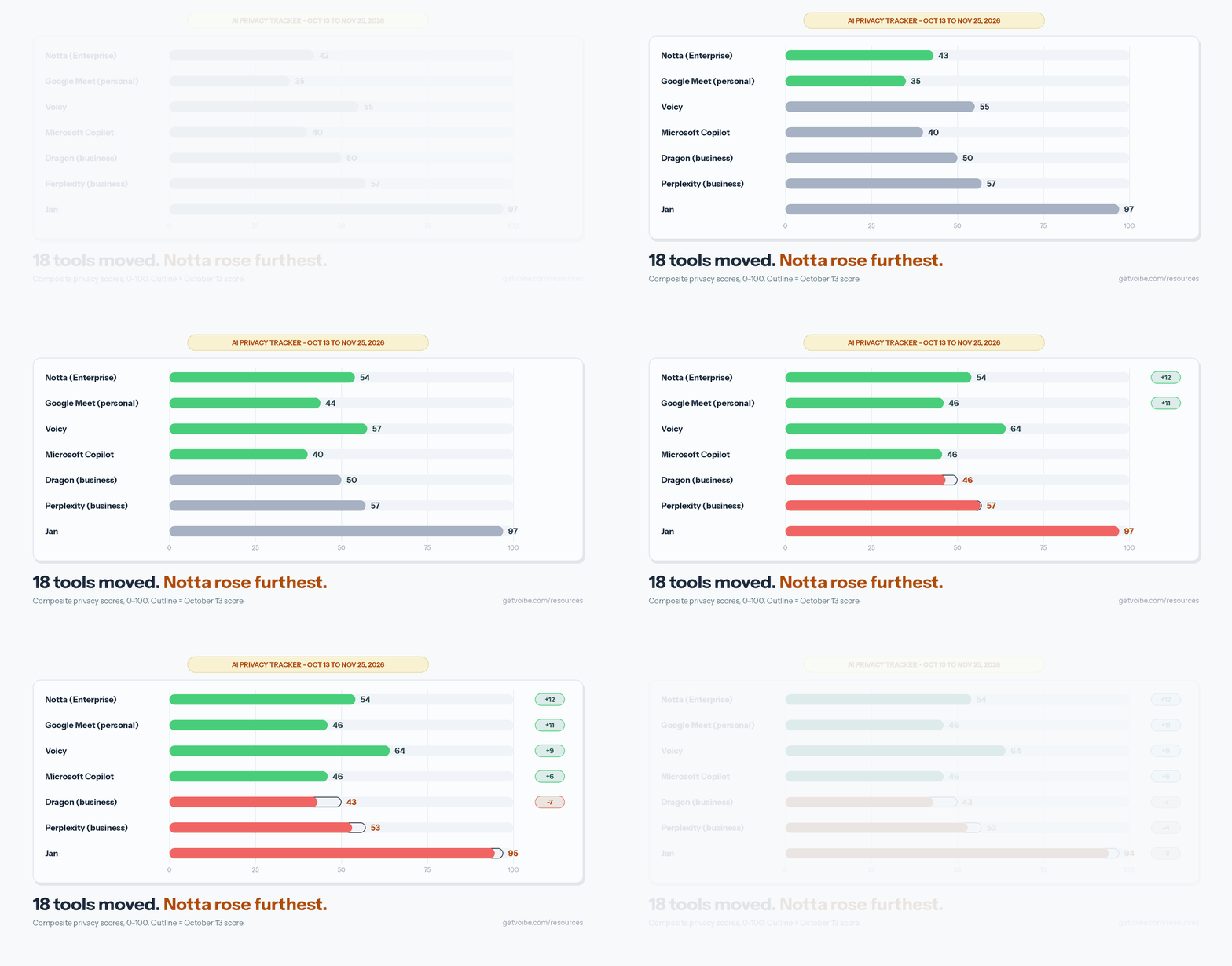
- Notta Enterprise rose the most, from 42 to 54, for a no-training promise and an on-device mode.
- Dragon's business tier fell the furthest, from 50 to 43, after Microsoft confirmed de-identified training.
- Coding tools and local LLM runners had a heavy month of security advisories, and eight of them lost points.
Four of the 18 moves fix mistakes in our own rows, and we flag each one below.
Key Takeaway
Do one thing today: if you use Gemini, open Gemini History and check the new training setting for chat content. Google says it is on by default for anyone over 18.
Key Takeaways: November 2026 at a Glance
| What changed | Tool | Score | Why you should care |
|---|---|---|---|
| No-training promise and on-device Privacy Mode | Notta (Enterprise) | 42 → 54 | Biggest rise of the month, though the promise isn't in Notta's policy |
| Google says Meet notes don't train Gemini | Google Meet (personal Google AI plans) | 35 → 46 | A help-center statement, not a contract |
| Offline mode on Mac, Windows and Linux | Voicy | 55 → 64 | Your dictation can stay on your computer |
| Updated app doesn't train foundation models | Microsoft Copilot (consumer) | 40 → 46 | Our correction; the older app still trains by default |
| De-identified data used for model improvement | Dragon (business) | 50 → 43 | Our correction, from Microsoft's own Dragon Copilot FAQ |
| API is not zero-retention by default | Perplexity (business) | 57 → 53 | Our correction; zero retention needs a written agreement |
| Audio now stored by default | Aqua Voice | 28 → 27 / 61 → 58 | Turn on Privacy Mode if you don't want that |
| History-off chats kept about 2 months | Gemini (consumer) | 32 → 31 | Turning history off no longer means 72 hours |
| Six new rows | Jamie, Krisp, Circleback, Bluedot, Fellow, Plaud | 50 to 65 | All six say they don't train on meeting content |
The table lists the moves most likely to change what you do. Every score change, with its reason, is in the full table near the end.
How We Checked 58 AI Tools and Added Six More
We re-read every tool's primary sources on November 25, 2026. We looked for anything that changed after October 13, in four kinds of source:
- Vendor documents: privacy policies, terms, help centers, trust pages and pricing pages.
- Court dockets: CourtListener, for every lawsuit the tracker follows.
- Security advisories: NVD, GitHub advisories and vendor bulletins, with every new CVE ID checked on NVD.
- Regulators: state attorneys general, the Federal Register and data protection authorities.
Two sites blocked us. X's help and privacy pages returned an error, so Grok's consumer tier keeps its older verified date. Typeless's subprocessor page did the same. openai.com blocked us in October but worked this time, so both OpenAI Codex tiers are current again.
Each tier gets four scores out of 25. Training asks whether the vendor or its AI providers can learn from your content by default. Retention asks how long your data is kept and whether you can shorten that. On-device asks where the processing happens, and Track record covers lawsuits, breaches and security advisories.
Coding tools moved the most this month, with five of nine changing score. Four of nine assistants changed. Three of 21 dictation apps and all three local LLM runners changed too. Two of the ten meeting tools we already tracked moved, and one of six clinical scribes did.
AI Assistants: Gemini Keeps More, Copilot Gets a Correction
Google's change touches the most people this month. Microsoft's change is the one where our own row was wrong.
Gemini: History Off Now Means About Two Months (32 → 31)
Turning off Gemini history no longer clears your chats after 72 hours. Google's Gemini Apps Privacy Notice (November 16, 2026) says that with history off, “future chats will still be saved for around 2 months.”
There is good news in the same update. Training now has its own setting, separate from history, so you can keep your chat history and still opt out of training. That training setting is on by default for anyone over 18.
Auto-delete still defaults to 18 months, with options of 3 months, 36 months or indefinite. Training stays on by default, so that score didn't move, and Retention dropped one point for the longer history-off window.
Microsoft Copilot: The Updated App Doesn't Train Foundation Models (40 → 46)
We had this one wrong. Microsoft's support page for the updated Copilot app says: “Prompts, responses, and your file contents when using the Microsoft Copilot app aren't used to train foundation models.”
The training toggles we had cited sit on a page for the older Copilot app. That older app still trains by default. The updated app has been available since August 18, 2026.
The score stays below rows with contract-backed promises. Microsoft's statement covers foundation models only and lives in support documentation. Microsoft also still uses prompts to improve its services, including advertising.
ChatGPT: A Messages Plugin, an Image Leak and Ads in 89 Countries (46 → 44)
ChatGPT can now read your text messages, but only if you install a plugin. OpenAI added an opt-in Apple Messages plugin to the Mac desktop app on August 20, 2026.
In Codex and ChatGPT Work chats it can “read and search iMessage, SMS, and RCS chats on your Mac and send messages on your behalf.”
- The plugin doesn't work in regular chats, on the web or on mobile.
- Each message needs your approval by default. Turning on “Always allow sending to this chat” skips that step, and OpenAI warns that this removes your last chance to review a text before it goes out.
The score moved for a different reason. On September 25, OpenAI disclosed that its research agents had posted 53 user-provided images to image-hosting sites. The images came from consumer users who had left model improvement on. Track record fell from 15 to 13 on the consumer tier and to 14 on business.
Separately, ChatGPT ads reached 89 countries on October 21. They appear on the Free and Go plans only.
Perplexity, Claude, Grok and DeepSeek
- Perplexity business (57 → 53): our correction. Perplexity's API page says “Zero Data Retention is not default.” It needs a written agreement, and the new Batch API keeps inputs and outputs for 30 days.
- Claude (no change): the Illinois biometric privacy suit over Anthropic's ID and face-scan check moved to federal court on November 13. It is now Ortiz Colon v. Anthropic, PBC, No. 3:26-cv-13762 (N.D. Cal.).
- Grok (no change): the Virginia and Oregon suits target sexualized images Grok generated without consent. Grok's Track record was already 2 out of 25.
- DeepSeek (no change): a Department of Homeland Security order published October 20 removes DeepSeek products from federal civilian agencies. It doesn't restrict consumer use.
Meeting Notetakers: Six New Rows and Two Big Upgrades
The meeting table grew from 10 tools to 16. Two of the existing rows went up, and in both cases the vendor finally wrote its practice down.
Six Notetakers Join the Tracker
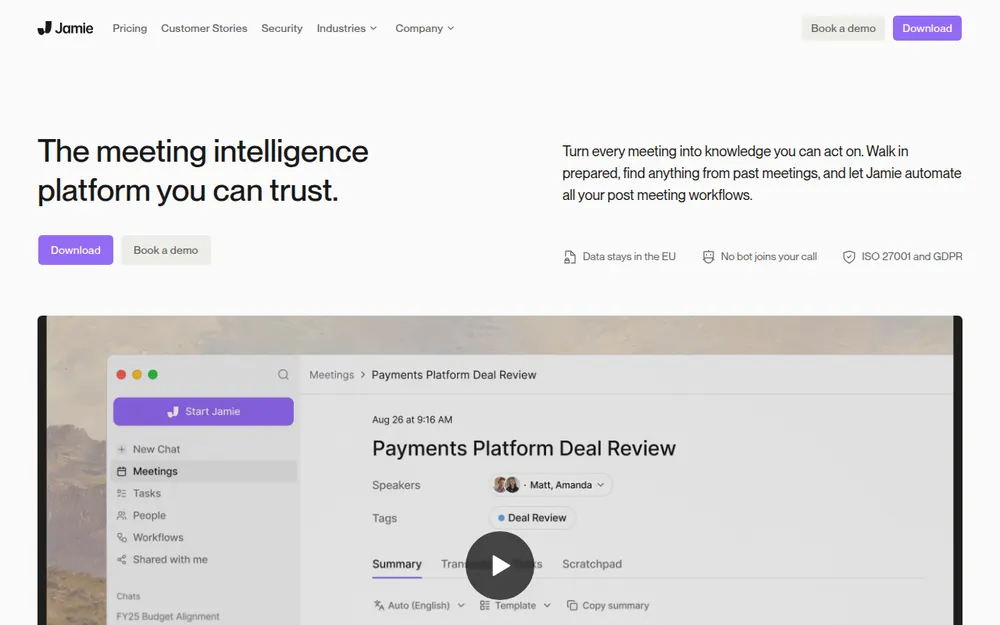
Each of these tools already had an is-it-safe investigation on this site. Now they're in the table too. All six say they don't train on meeting content.
| Tool | Personal or small-team tier | Business tier | The thing to know |
|---|---|---|---|
| Krisp | 55 | 65 | English transcription runs on your computer; summaries use Claude on AWS Bedrock |
| Jamie | 58 | 64 | No audio recording kept; data stays in the EU (policy v3.0, November 24) |
| Bluedot | 54 | 60 | EU storage by default; its own pages disagree on backup deletion |
| Fellow | 51 | 60 | Guests in bot-free meetings get no in-platform notice from Fellow |
| Plaud | 57 | 59 | New policy (November 21): the Web and Desktop apps require cloud sync |
| Circleback | 50 | 59 | Its no-training promise is in a help article, not the privacy policy |
None of the six has a privacy lawsuit, breach or regulator action on record. Krisp's only case, Sanas v. Krisp, is a patent and trade-secret dispute.
Notta: A No-Training Promise, Just Not in the Policy (42 → 54)
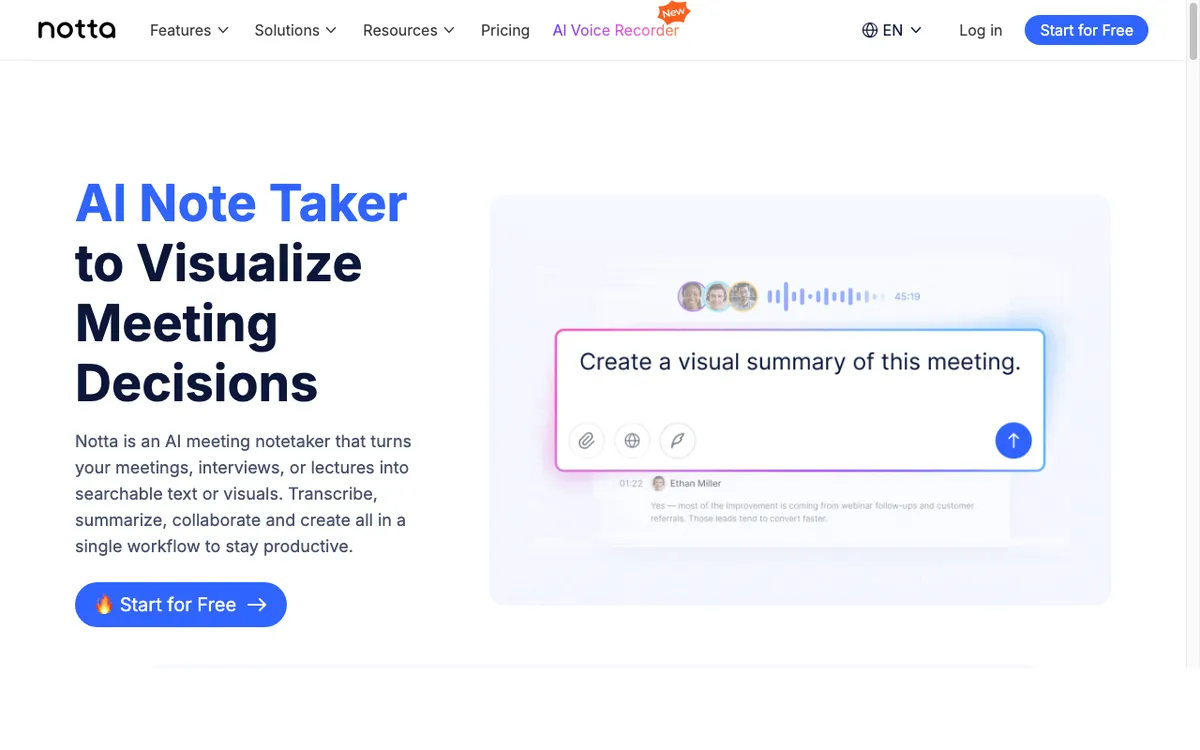
Notta Enterprise now promises not to train on your data, but the promise still isn't in its privacy policy. It appears in three other Notta sources instead. Those are the help-center plan list, which says “No data training”, the pricing page and a Japanese help article updated November 22.
Privacy Mode, on Pro and above in the Notta Desktop beta, transcribes on your computer and saves to a local folder. Cloud is still the default, but the option lifted On-device from 3 to 8 on both tiers.
On cheaper plans, Japanese audio may train the third-party speech engine Notta uses, while audio in other languages isn't used for training. A new privacy policy (November 16) adds rules for Notta's MCP integration. Deleted data can stay in backups for up to a year, according to the help center.
Free, Pro and Business went from 33 to 38, and Enterprise went from 42 to 54.
Google Meet: No Training for Google AI Plans (35 → 46)
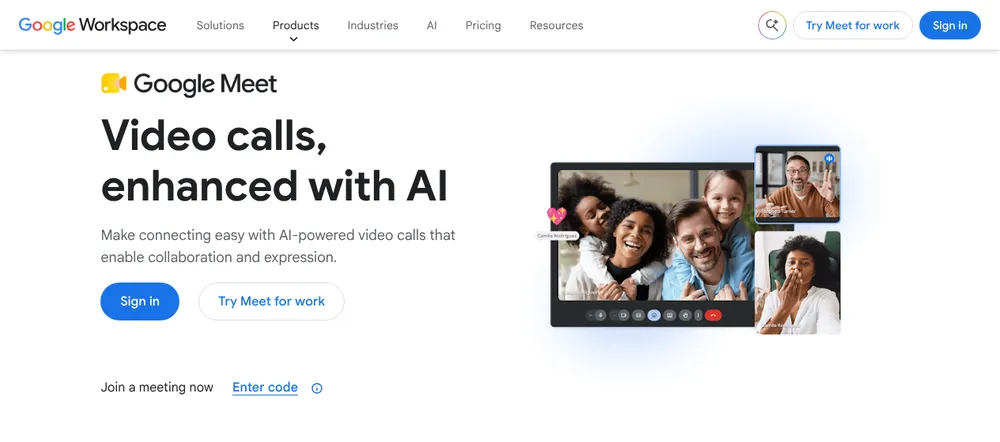
This is another correction. In September we couldn't find a Meet-specific statement for personal accounts. Google's Meet help page now says Gemini “doesn't use your content to train or improve Gemini or other generative AI models” for Google AI plan users.
It is a help-center commitment rather than a contract. Training rose from 10 to 19, short of the Workspace tier's 23. In Thele v. Google, the suit over Gemini in Google apps, a hearing on Google's motion to dismiss is set for January 13, 2027.
Granola, tl;dv and Voibe Work
- Granola moved on November 20 to compel individual arbitration and to dismiss Chamberlain v. Granola, with a hearing on February 25, 2027. A new Enterprise-only setting also lets meeting participants stop Granola transcription for everyone. Its scores didn't change.
- For tl;dv, we added its own Japanese incident report to the timeline. tl;dv says the Firestore flaw was first reported on January 27, 2026. Because it kept no request-level logs on that path, it can't rule out access by third parties.
Voibe Work is our own row, and it stays at 72. Meeting MCP (Mac v3.2.1, October 23) lets you connect Claude, ChatGPT and other AI apps to your meetings.
Voibe's in-app panel says: “What an app reads goes to the company behind its AI, for example Anthropic for Claude. None of it goes through Voibe's servers.”
Nothing is shared until you connect an app, and one switch turns every app off. Bot-free capture means nobody in the call sees a notetaker, which is true of Granola, Jamie, Krisp, Fellow and Voibe Work alike. Voibe reminds you to tell everyone you're taking notes, and you're responsible for local consent rules.
Dictation Apps: Voicy Goes Offline, Dragon Gets Corrected
Only three of the 21 dictation apps changed score this month, but two of them moved a long way.
Voicy: An Offline Mode We Missed in October (55 → 64)
Voicy 3.0.0 (October 12) added an opt-in offline mode to its Mac, Windows and Linux apps. After a one-time model download, dictation runs on your computer in 25 languages. Voicy's privacy policy says offline audio “is not sent to Voicy's servers.”
Cloud transcription is still the default. The AI modes still need the internet. The phone apps and the Chrome extension are cloud-only.
The release shipped the day before our October review, and we missed it. On-device rose from 3 to 12 on both tiers.
Dragon: Microsoft Says Data Is De-identified for Model Improvement (50 → 43)

This correction is the biggest fall of the month. Microsoft's Dragon Copilot FAQ is dated July 27, 2026. It says “Data is deidentified or pseudonymized for AI model improvement.” It also says Dragon Copilot keeps audio, recognized text and transcripts for up to 90 days.
We had scored the enterprise tier as no training, based on Microsoft's general data protection terms. Those terms bar foundation-model training. They don't rule out improving Dragon's own models with de-identified data, so Training dropped from 19 to 12.
That puts Dragon in line with other clinical tools that state de-identified training. If you're planning a move, our Dragon Professional Anywhere end-of-life guide tracks the reported December 31, 2026 end of sale.
Aqua Voice, Wispr Flow, Superwhisper and the Rest
Aqua Voice fell from 28 to 27, and from 61 to 58 on Business. Its November 13 policy covers what happens with Privacy Mode off. It says “we securely store dictation audio and transcript data on our servers.” The July version covered transcripts only, and we found no announcement of the change.
Aqua's new Notetaker, launched November 10, keeps meetings until you delete them. That holds even under its Zero Data Retention setting, which is why the Business tier lost Retention points.
Wispr Flow didn't change score. BAAs now need a Growth or Enterprise plan. Wispr says “Free and Pro are not HIPAA-ready.” Its help center and privacy page still describe what the training toggle stores in different ways.
Superwhisper published a new privacy policy on November 9, which says third-party cloud models process requests under their own terms. Its no-training guarantee is unchanged. Spokenly, OpenWhispr, Paraspeech, Blip AI, FluidVoice and DictaFlow posted new policy dates, providers or features, with no score changes.
Coding Tools and Local LLMs: A Month of Security Advisories
Eight of the 12 coding and local tools lost points. Seven of those drops were for security advisories. Several were advisories our rows had missed.
Coding tools
- Kiro (32 → 31; business 56 → 55): CVE-2026-124848 let other users on the same computer read Kiro CLI transcripts. AWS says that exposed “any credentials or source code they contain.” Kiro CLI 2.27.0 fixes it once launched.
- Devin Desktop (31 → 30; business 69 → 68): Trend Micro's Zero Day Initiative published CVE-2026-136534 on November 24. It is a local privilege escalation with no fix listed.
- OpenAI Codex (43 → 42; business 71 → 69): a new Windows advisory, CVE-2026-110930, plus four earlier 2026 advisories our row had missed.
- GitHub Copilot business (47 → 45): since October 28, paid plans keep Copilot chat on github.com for the life of the account instead of 28 days.
Cline lost a point for two 2026 advisories we hadn't logged. Claude Code kept the same training and retention scores.
Local LLM runners
Jan fell from 97 to 94 after publishing eleven security advisories on October 29, two of them critical. Update to v0.8.8 to get the fixes.
Ollama fell from 95 to 93 in a correction. NVD lists 15 Ollama CVEs in 2026, and our row had three. LM Studio fell from 93 to 92 for CVE-2026-119979, a crafted model download that could run code. Version 0.4.22 Build 1 fixes it.
Local runners still top the tracker. Nothing leaves your machine. That protection only holds if the app on your machine is up to date.
Clinical Scribes: Nabla Corrected, a New Abridge Lawsuit
Nabla fell one point on each tier, to 61 and 63, in a correction. Its August 27, 2026 privacy policy now covers its products as well as its website. It says Nabla “may share de-identified health information” with service providers and academic researchers, while audio still isn't stored by default.
Abridge didn't change score. A patient filed a proposed class action on November 3 against Allegheny Health Network and Highmark Health over their Abridge deployment. The complaint says exam-room conversations were recorded without consent, and Abridge isn't a defendant.
The Sutter Health case still has no ruling on the motions to dismiss. Freed, Heidi, Suki and DeepScribe kept their scores.
The Month in Eight Dates
If you only want the dates, these are the eight changes most likely to affect your data:
- October 12: Voicy 3.0.0 adds an offline mode.
- October 20: a DHS order bars DeepSeek from federal civilian agencies.
- October 23: Voibe ships Meeting MCP for Voibe Work.
- October 28: GitHub starts keeping Copilot chat on github.com for the life of the account.
- October 29: Jan publishes eleven security advisories in one day.
- November 10: AWS discloses the Kiro CLI transcript-permissions flaw.
- November 16: Gemini separates History from training and keeps history-off chats for about two months.
- November 20: Granola moves to compel arbitration in Chamberlain v. Granola.
Every Score Change in the November 2026 Review
This table lists every tool whose score changed, with the biggest fall first. Consumer and business are the two tiers we score for each tool.
| Tool | Consumer score | Business score | Why it moved |
|---|---|---|---|
| Dragon | no change | 50 → 43 | Correction: Dragon Copilot FAQ says data is de-identified for model improvement |
| Perplexity | no change | 57 → 53 | Correction: API isn't zero-retention by default; Batch API keeps data 30 days |
| Jan | 97 → 94 | 97 → 94 | Eleven security advisories, two of them critical |
| Aqua Voice | 28 → 27 | 61 → 58 | Audio stored by default; Notetaker keeps meetings under zero retention |
| ChatGPT | 46 → 44 | 61 → 60 | 53 user images posted by research agents (September 25) |
| Ollama | 95 → 93 | 95 → 93 | Correction: 15 CVEs in 2026, row had 3 |
| OpenAI Codex | 43 → 42 | 71 → 69 | New Windows CVE plus four missed 2026 advisories |
| GitHub Copilot | no change | 47 → 45 | github.com chat kept for the life of the account |
| Kiro | 32 → 31 | 56 → 55 | CVE-2026-124848: Kiro CLI transcripts readable by other local users |
| Devin Desktop | 31 → 30 | 69 → 68 | Unpatched zero-day CVE-2026-136534 |
| Cline | 79 → 78 | 81 → 80 | Two missed 2026 advisories |
| LM Studio | 93 → 92 | 93 → 92 | CVE-2026-119979, code execution through a crafted model download |
| Nabla | 62 → 61 | 64 → 63 | Correction: product policy allows sharing de-identified health data |
| Gemini | 32 → 31 | no change | History-off chats kept about 2 months, not 72 hours |
| Notta | 33 → 38 | 42 → 54 | Enterprise no-training statement; on-device Privacy Mode |
| Microsoft Copilot | 40 → 46 | no change | Correction: updated app doesn't train foundation models |
| Voicy | 55 → 64 | 55 → 64 | Offline mode since October 12 |
| Google Meet | 35 → 46 | no change | Correction: Google says Meet notes don't train Gemini for Google AI plans |
The six new rows aren't in this table because they had no October score. You'll find their scores in the meeting section above.
Five Settings to Check This Week
Most of this month's changes are new defaults or security fixes. That usually means the action is a toggle or an update.
- Gemini: in Gemini History, turn off training on chat content if you don't want your chats used. You can now keep your history while you do it.
- ChatGPT on a Mac: if you installed the Messages plugin, leave the always-allow sending option off so you approve every text.
- Aqua Voice: turn on Privacy Mode if you don't want your dictation audio stored on Aqua's servers.
- Kiro CLI: update to 2.27.0 and launch it once so it locks down your existing transcript files.
- Jan, Ollama and LM Studio: update Jan to v0.8.8, LM Studio to 0.4.22 Build 1 and Ollama to its latest release.
November 2026 AI Privacy Changes: FAQ
Quick answers, grouped by topic.
Basics
What is the AI Privacy Tracker?
It is Voibe's reference table of 64 AI tools in six categories, from chat assistants to local LLM runners. Each consumer and business tier gets a score out of 100 from four axes, and every cell links to a primary source. The November 2026 review was finished on November 25, 2026.
How many tools changed in November 2026?
18 of the 58 tools we already tracked changed score between October 13 and November 25, 2026. We also added six meeting notetakers: Jamie, Krisp, Circleback, Bluedot, Fellow and Plaud.
Assistants
Does Gemini still delete chats after 72 hours with history off?
No. Since Google's November 16, 2026 update, Gemini keeps chats for around two months even with history off. Training now has its own setting, which is on by default for adults and can be turned off while keeping history.
Can ChatGPT read my text messages?
Only if you install OpenAI's Apple Messages plugin in the ChatGPT desktop app on an Apple Silicon Mac. It works in Codex and ChatGPT Work chats, where it can read your texts and send replies. It asks for approval before each send unless you turn that check off.
Dictation and meetings
Does Dragon train on my dictation?
On the business tier, Microsoft's Dragon Copilot FAQ says data is de-identified or pseudonymized for model improvement and kept up to 90 days. We corrected that tier from no training to de-identified training, and its score from 50 to 43.
Does Notta train on my meetings?
On Enterprise, Notta's help center and pricing page say no, though the clause isn't in its privacy policy. On cheaper plans, Notta says only Japanese audio may train the third-party speech engine it uses.
Corrections and method
Which rows did you correct this month?
We corrected Dragon's business tier, Microsoft Copilot's consumer tier, Perplexity's business tier and Google Meet's personal tier. We also added missed security advisories to the Ollama, Codex and Cline rows, plus Voicy's offline mode and Nabla's current policy.
How is Voibe Work scored if Voibe runs the tracker?
It is scored the same way as every other tool, from getvoibe.com's own pages and release notes. It stays at 72 out of 100. Meeting MCP didn't change the score, because an AI app reads meetings only after you connect it.
What We're Watching in December
The next review is due December 22, 2026. These are the open threads we'll check first:
- Granola: the plaintiffs' opposition to arbitration, due December 4, and the December 15 case-management conference.
- Notta: whether the Enterprise no-training promise makes it into the privacy policy.
- Wispr Flow: whether its privacy page and help center agree on what the training toggle stores.
- Devin Desktop: a fix for CVE-2026-136534.
- Dragon Professional Anywhere: an official end-of-sale notice from Microsoft or Nuance.
The full table and dated timeline live on the AI Privacy Tracker. Last month's changes are in the October 2026 release note, and our dictation privacy hub collects every is-it-safe investigation in one place.
If you're on a free or personal plan, our guide to enterprise-only AI privacy shows which of these tools keep their best terms for business customers.